Patek Philippe
Founded 1839 in Geneva, Patek Philippe holds the portable complication record and remains in private family ownership.
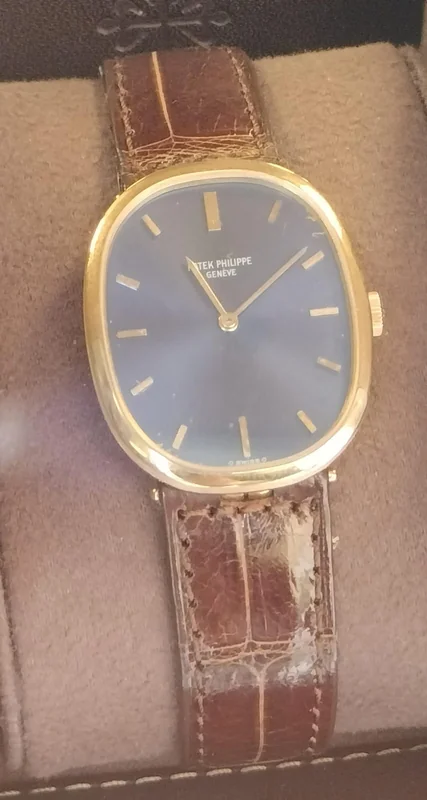
Patek Philippe & Co. is a Swiss watch manufacture founded in Geneva in 1839 by Antoni Patek and François Czapek; Jean-Adrien Philippe joined in 1845 and became a partner in 1851, bringing the perpetual crown-winding mechanism that replaced the external key previously required for pocket watch winding. The company's name reflects the 1851 partnership. Patek Philippe is privately held by the Stern family (owners since 1932), making it the only significant Swiss manufacture not owned by a luxury conglomerate. The manufacture produces approximately 60,000–65,000 watches per year across its classical, complication, and grand complication collections, develops its own movements (all in-house calibres), and holds numerous patents in watchmaking including key developments in perpetual calendar mechanics, split-seconds chronograph levers, and tourbillon escapement design.
Quick facts
- Type
- Brand History
- Era
- 1839-present
- Origin
- Switzerland (Geneva)
Foundation and Early Patents
Antoni Patek (1812–1877) and François Czapek founded Patek, Czapek & Co. in Geneva in 1839. The firm produced pocket watches using movements from Geneva's established ébauche suppliers. In 1844, Patek met Adrien Philippe at the Paris Exhibition, where Philippe demonstrated his stem-winding and stem-setting mechanism — a crown-winding system eliminating the need for an external key to wind the mainspring. Patek purchased the rights and began incorporating the mechanism; Philippe joined the firm in 1845 and became a partner in 1851, at which point Czapek departed and the name became Patek Philippe & Co. The crown-winding mechanism, while not exclusively patented to Philippe (similar designs existed contemporaneously), was instrumental in commercialising the product and establishing the partnership's reputation.
The Calibre 89 and World Records
Patek Philippe's most technically significant production piece is the Calibre 89 pocket watch, completed in 1989 to mark the manufacture's 150th anniversary. At completion, the Calibre 89 contained 1,728 parts and 33 complications, making it the most complicated portable timepiece ever made at that date. Complications include: a perpetual calendar, equation of time display, sky chart for Geneva's latitude, sidereal time display, Westminster chime, tourbillon, minute repeater, and split-seconds chronograph. Four were produced (yellow gold, white gold, rose gold, platinum); the yellow gold reference sold at auction in 2009 for CHF 6.0 million. The Calibre 89 remains among the most technically ambitious single watchmaking projects ever undertaken and is cited in the Guinness World Records. Patek Philippe's more recent Sky Moon Tourbillon (reference 6002G) and Grandmaster Chime (reference 6300) have extended the complication count in wristwatches.
Stern Family Ownership
Patek Philippe was acquired by Charles Stern and Jean Stern in 1932, when the manufacture faced financial difficulties in the Great Depression. The Stern family had supplied watch dials to Patek Philippe since the late 19th century and were already commercial partners. The Stern family has maintained ownership continuously since 1932; current President Thierry Stern (fourth generation) assumed leadership in 2009. The private ownership structure distinguishes Patek Philippe from Rolex (also privately held, but by a foundation rather than a family) and from all other major Swiss manufactures (IWC, Jaeger-LeCoultre, A. Lange & Söhne — Richemont; Omega, Longines, Blancpain — Swatch Group; TAG Heuer, Zenith — LVMH). The private ownership affects production volume decisions, collection strategies, and capital allocation — the manufacture does not face shareholder pressure for quarter-by-quarter revenue growth.
Patek Philippe Seal
The Patek Philippe Seal (introduced 2009, replacing the Geneva Seal for Patek Philippe movements) is a proprietary quality certification applied to all Patek Philippe movements produced after 2009. The Seal certifies: movement finishing to specified standards, case and bracelet finishing, water resistance (where applicable), crown winding system, clasp function, and accuracy (±1 second per day for mechanical movements, tested in multiple positions over 10 days). Unlike the Hallmark of Geneva (which certifies finishing) or COSC (which certifies accuracy only), the Patek Philippe Seal applies a comprehensive standard covering both finishing and rate. The seal is indicated by a hallmark on the movement.
Sources & further reading (3)
- encyclopedia — accessed 2026-05-07
- encyclopedia — accessed 2026-05-07
- watch-reference — accessed 2026-05-07
Frequently asked questions
What is the most popular Patek Philippe watch?
The Nautilus (reference 5711 and 5726, designer Gerald Genta, introduced 1976) became the most commercially discussed Patek Philippe reference in the early 21st century — demand significantly exceeded supply, leading to waitlists and secondary market premiums. The Calatrava (reference 5196, 5127) and Aquanaut (reference 5167) are among the other high-volume references. Patek Philippe does not publish sales volume by reference. The 5711 Nautilus in stainless steel was discontinued by Patek Philippe in 2021, which contributed to significant secondary market interest.
Does Patek Philippe manufacture all its own movements?
Yes. Patek Philippe is a fully vertically integrated manufacture — it designs, produces, finishes, and assembles its own movements without sourcing ébauches from ETA, Sellita, or other third-party movement suppliers. This distinction matters in the Swiss industry because many brands described as 'manufactures' use base movements sourced from third parties and modify or decorate them. Patek Philippe's in-house calibres include the base automatic calibre 324 and 315, the perpetual calendar calibres (240 Q, 315/187), and the grand complication calibres.
What does the Patek Philippe advertising slogan refer to?
Patek Philippe's long-running campaign ('You never actually own a Patek Philippe. You merely look after it for the next generation.') references the durability and serviceability of the watch — the campaign invites customers to consider the watch as an heirloom rather than a personal consumer good. The campaign began in 1996. It is an advertising strategy, not a legal claim or purchase condition. Patek Philippe watches are owned outright by buyers in the ordinary commercial sense.