Omega
Founded 1848, Omega has timed the Olympics since 1932 and qualified the Speedmaster for NASA Moon missions in 1965.
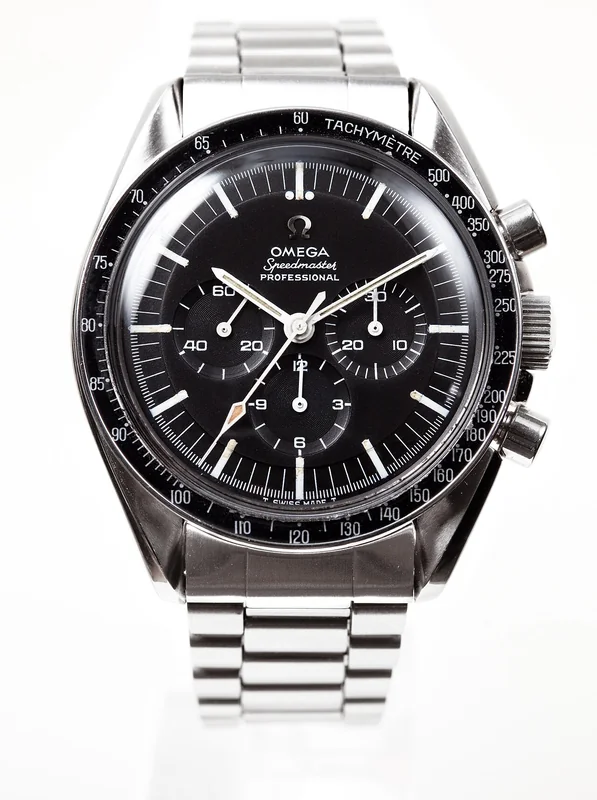
Omega SA is a Swiss watch manufacture founded in La Chaux-de-Fonds in 1848 by Louis Brandt as Louis Brandt & Frère. The Omega name was adopted in 1903, derived from the final letter of the Greek alphabet — signifying a completion of excellence. Omega is part of the Swatch Group (since the 1983 consolidation that created SSIH/ASUAG into SMH, later renamed Swatch Group). The manufacture is headquartered in Biel/Bienne, Switzerland. Key distinctions: official timekeeper of the Olympic Games since 1932; official watch supplier to NASA, with the Speedmaster Professional qualifying for EVA (Extravehicular Activity) use in 1965 and worn on every NASA crewed mission to the Moon; movement innovation including the coaxial escapement (developed by George Daniels, licensed 1999) and Master Chronometer certification (METAS standard, ±0/+5 seconds/day).
Quick facts
- Type
- Brand History
- Era
- 1848-present
- Origin
- Switzerland (La Chaux-de-Fonds / Biel-Bienne)
Louis Brandt and the Omega Calibre
Louis Brandt (1825–1879) established a pocket watch assembly workshop in La Chaux-de-Fonds in 1848, sourcing parts from local suppliers and assembling finished pocket watches for sale to retailers in Europe and internationally. His sons Louis-Paul and César Brandt transformed the business after his death, moving to Biel/Bienne in 1880 (where the manufacture remains headquartered) and investing in movement manufacture rather than just assembly. In 1894, Louis-Paul Brandt developed a calibre of 19 lignes (approximately 42.8 mm movement diameter) capable of very high-volume production with interchangeable parts — the '19 lignes' movement became so successful that the company adopted the name 'Omega' for the calibre and then for the entire company in 1903. The Greek omega (Ω) in the company logo dates from this period.
Olympic Timekeeping and Precision
Omega became the official timekeeper of the Olympic Games at the 1932 Los Angeles Summer Olympics, supplying 30 chronographs for timing events. The relationship has continued at every Olympic Games since — both Summer and Winter — for 90+ years. Olympic timekeeping demanded successive generations of precision: at the 1948 London Olympics, Omega introduced the first photo-finish camera integrated with a stopwatch; at the 1952 Helsinki Games, the Racend Master mechanical chronograph measured to 1/100th of a second; at subsequent Games, electronic timekeeping systems measured to 1/1000th of a second. The Olympic timekeeping contract drove significant investment in precision measurement technology beyond watchmaking — Omega's timing systems are now electronic rather than mechanical, though the brand association remains central to Omega's technical identity.
NASA and the Speedmaster
In 1962, NASA began evaluating wristwatches for potential use by astronauts in crewed spaceflight. The testing programme (conducted 1964–1965) subjected watches to 11 environmental tests including high temperature (93°C for 48 hours), vacuum, shock (40 g), acceleration (6.8 g), high humidity, and low temperature (-18°C). Of the brands tested — Omega, Rolex, Hamilton, and Longines — the Omega Speedmaster Professional (reference ST 105.003) was the only watch to pass all 11 tests. NASA qualified the Speedmaster Professional in March 1965, and it was first worn in space during the Gemini IV mission (June 1965). It was worn on every crewed NASA Moon mission from Apollo 10 onward (1969–1972). The watch worn by Buzz Aldrin on the lunar surface during Apollo 11 (July 1969) was the specific configuration that established the 'Moonwatch' association.
Coaxial Escapement
The coaxial escapement is a modified lever escapement developed by British independent watchmaker George Daniels over approximately 30 years of theoretical and practical development, completed by 1974. The mechanism uses a three-level coaxial design in which the impulse is delivered directly to the balance wheel's periphery rather than via a lever — reducing the friction at the escapement-balance interface and the quantity of oil required, with implications for long-term rate stability as lubricants degrade. Daniels licensed the coaxial escapement to Omega in 1999 after other manufacturers declined interest; Omega introduced it in the calibre 2500 in 1999. The coaxial is now standard across the Omega calibre range. Independent testing has confirmed that coaxial Omega movements maintain rate stability over longer intervals between services compared to conventional lever escapements, partly validating the extended service interval (10 years) that Omega recommends for coaxial movements.
Sources & further reading (3)
- encyclopedia — accessed 2026-05-07
- encyclopedia — accessed 2026-05-07
- watch-reference — accessed 2026-05-07
Frequently asked questions
What is the difference between Omega and Rolex?
Omega and Rolex are both Swiss manufactures in the sport and professional watch segment with overlapping price positioning. Key differences: Rolex is privately held (Hans Wilsdorf Foundation); Omega is part of the Swatch Group (publicly traded parent). Rolex's volume is approximately double Omega's in the prestige tier. Omega produces a broader range of references including entry quartz watches under the Swatch Group umbrella. On technical distinction: Omega uses the coaxial escapement; Rolex uses its own proprietary lever escapement. Olympic timekeeping and NASA association are Omega distinctions; Rolex's explorer/diving professional associations are distinct marketing histories.
Is the Omega Speedmaster still worn by NASA astronauts?
The Omega Speedmaster Professional remains the official NASA astronaut watch as of 2026. NASA has renewed the contract through successive generations. However, NASA no longer conducts crewed lunar missions (as of 2026, Artemis has not yet landed astronauts on the Moon), so the 'worn on the Moon' distinction applies specifically to the Apollo programme (1969–1972). Speedmaster references have been worn on the International Space Station and on Space Shuttle missions. The current issue is the Speedmaster Professional reference 310.30.42.50.01.001.
What is METAS certification on Omega watches?
Master Chronometer certification is a standard developed by Omega and certified by METAS (the Swiss Federal Institute of Metrology), introduced in 2015. It specifies: accuracy between 0 and +5 seconds/day (tighter positive-only tolerance than COSC's ±4 s/day); resistance to magnetic fields up to 15,000 gauss (approximately 1,193 kA/m, far exceeding the Rolex Milgauss's 1,000 gauss rating and the ISO antima0gnetic standard of 4,800 A/m); water resistance; and power reserve measurement. Testing is performed by METAS on the complete cased watch (not the bare movement), similar to Rolex's Superlative Chronometer post-casing testing.