Moon Phase Complication
A disc showing the lunar phase — new, waxing, full, and waning — as seen from Earth, driven from the calendar train.
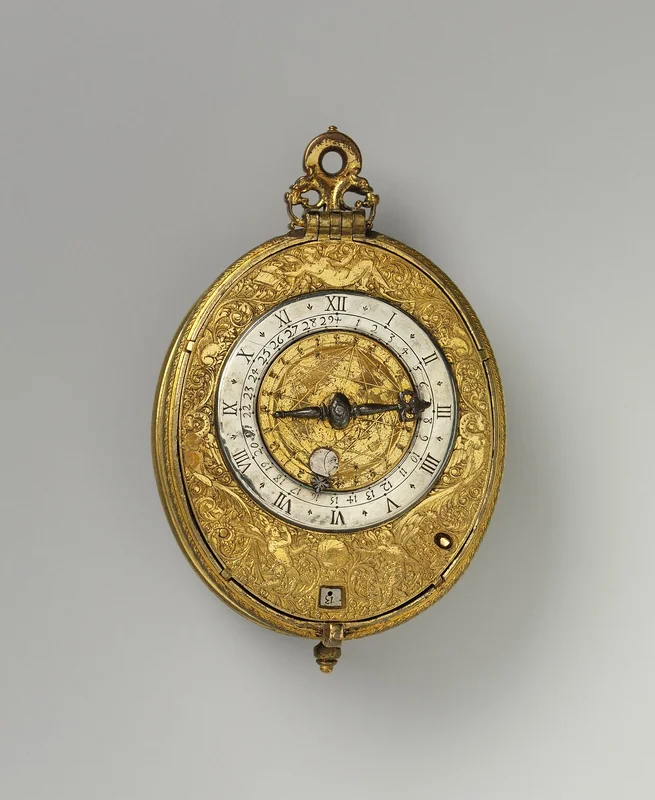
The moon phase complication displays the current phase of the lunar cycle — the illuminated portion of the Moon as seen from Earth — using a rotating disc showing two moon discs visible through an aperture shaped to represent the sky. The disc advances one tooth per day driven by the calendar mechanism's date wheel, completing one full revolution every 59 days (two lunar months). The actual synodic month (new moon to new moon) is 29 days, 12 hours, 44 minutes, and 2.9 seconds. A standard 59-tooth moon-phase wheel accumulates an error of approximately 44 minutes per month — one day's error every 32 months. High-precision moon phase mechanisms use wheels with more teeth (135 or 135-tooth drives) to reduce the monthly error to under 10 seconds.
Quick facts
- Type
- Complication
- Complication
- moonphase
- Era
- Antiquity / 17th century (pocket watches) / 1930s (wristwatches)
- Origin
- Europe (Switzerland / England)
The Moon Phase Disc Mechanism
The moon phase disc is a thin metal plate with two identical moon images painted or applied 180 degrees apart. The disc sits behind a dial aperture that is curved to represent the arc of the sky. As the disc rotates, one moon image is progressively revealed (waxing crescent to full) and then concealed (waning gibbous to new moon) by the fixed aperture edge. The disc advances one position per solar day via a 59-tooth ratchet driven by the date wheel — one click per 24 hours. The 59-tooth ratchet drives half a revolution per complete lunar cycle pair: 59 days covers two synodic months of nominally 29.5 days each. The cumulative error is approximately 44 minutes per month because 59 days is slightly less than two true synodic months.
High-Precision Moon Phase Mechanisms
Patek Philippe calibre 240 LU and IWC calibre 50610 use 135-tooth moon phase wheels driven from a higher-ratio gear, reducing the monthly error to approximately 7 seconds — requiring correction only once every 577 years. Ochs und Junior's moon phase watch uses a unique mechanism that displays both the current lunar phase and the fraction of the synodic month elapsed, designed by Ludwig Oechslin. A. Lange & Sohne's Grand Complication and Lange 1 Moon Phase use a 135-tooth design. The Breguet ref. 7787 uses a hemispherical moon to represent the three-dimensional Moon rather than the conventional flat disc.
Historical Context
Knowledge of the lunar cycle was practically important to pre-industrial societies for agricultural calendaring, tidal prediction (navigation and fishing), and lunar religious calendars (Jewish, Islamic, Hindu). Moon phase complications in portable clocks and pocket watches date to the 17th century. By the 18th century, moon phase displays were standard in English and Swiss repeater and equation-of-time pocket watches. The first wristwatch moon phase displays appeared in the 1930s, typically incorporated into calendar wristwatches. Patek Philippe reference 1526 (1941) established the benchmark aesthetic of aperture-displayed moon phase in a dress wristwatch.
Setting and Accuracy
A moon phase display requires initial setting against the known current lunar phase. Most moon phase complications are set by pressing a pusher or corrector to advance the disc to the correct position for the current date. The display must be checked and corrected approximately every 2.5 years on a standard 59-tooth mechanism (one day's error accumulates every 32 months). An accurate moon phase display is therefore a complication that rewards periodic attention — the aesthetic value is unchanged by minor error, but practical users who depend on the display for tidal or agricultural planning must account for the cumulative drift.
Sources & further reading (3)
- encyclopedia — accessed 2026-05-07
- encyclopedia — accessed 2026-05-07
- watch-reference — accessed 2026-05-07
Frequently asked questions
How accurate is a standard moon phase complication?
A standard 59-tooth moon phase wheel advances slightly faster than the true synodic month (29d 12h 44m 2.9s), accumulating an error of approximately 44 minutes per month — about one full day's error every 32 months. A high-precision 135-tooth mechanism reduces this to roughly 7 seconds per month (one day's error every 577 years). Most wristwatch moon phases have the standard 59-tooth design.
Does the moon phase automatically adjust for daylight saving time?
No. The moon phase complication advances one position per solar day regardless of daylight saving time changes. When you set your watch back or forward for DST, the moon phase disc does not need to be adjusted — DST changes the clock reference but not the passage of days.
Can a moon phase display show the southern hemisphere view?
Standard moon phase complications display the moon as seen from the northern hemisphere — the crescent opens to the left as the moon waxes. From the southern hemisphere, the moon appears mirrored: the crescent opens to the right as the moon waxes. Some manufacturers have produced southern hemisphere-specific moon phase variants, but most standard movements show the northern hemisphere perspective regardless of where the watch is worn.