Minute Repeater Complication
A complication that strikes the hours, quarters, and minutes on demand via a slide on the case band.
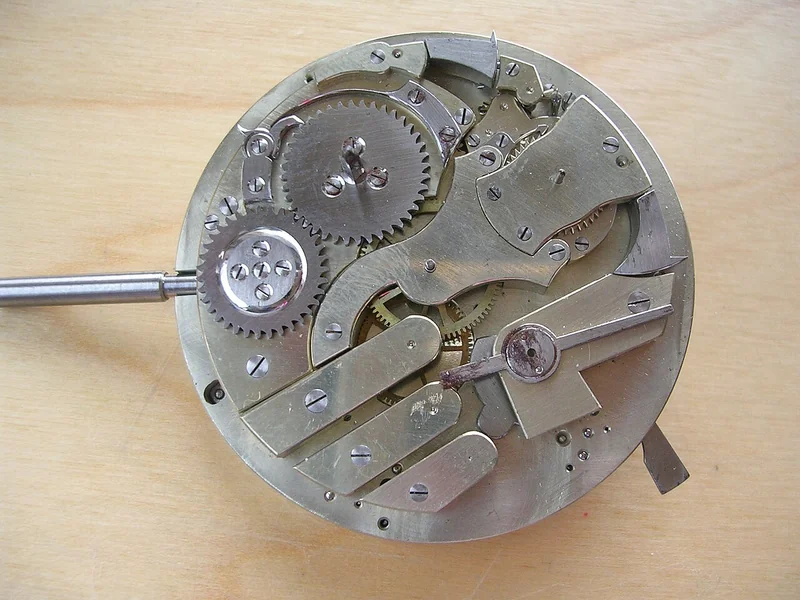
A minute repeater is an acoustic complication that chimes the time on demand when the wearer activates a slide or pusher on the case band. The mechanism strikes: the hours on a low-pitched gong, the quarter hours as a double strike (low-high), and the remaining minutes since the last quarter on a high-pitched gong. For example, 3:47 sounds as three low strikes (hours), three double strikes (quarters = 45 minutes), then two high strikes (2 additional minutes). First applied to pocket watches by Daniel Quare and Edward Barlow in the 1680s and adapted for wristwatches in the early 20th century, the minute repeater is regarded as one of the three 'grand complications' alongside the perpetual calendar and the tourbillon.
Quick facts
- Type
- Complication
- Complication
- minute-repeater
- Era
- 1680s (pocket watches) / 1892 (wristwatch, Audemars Piguet)
- Origin
- England / Switzerland
How a Minute Repeater Strikes the Time
When the activating slide is pushed, it compresses a mainspring dedicated to the striking mechanism. As the spring releases, a rack-and-snail system reads the current time from snails (cam-shaped discs) geared to the hour, quarter, and minute wheels of the timekeeping train. The hour snail has 12 steps corresponding to hours 1–12; the quarter snail has 4 steps (0–3 quarters); the minute snail has 14 steps (0–14 minutes past a quarter). Hammers driven by the striking train strike gongs — thin steel rings attached to the inside of the case — in the correct sequence: hours first, then quarter pairs, then minutes. The entire sequence takes between 15 and 45 seconds depending on the time being struck.
Gongs and Cathedral Gongs
Traditional repeater gongs are circular, finely tuned steel rings pressed to fit against the inner wall of the watch case. Their tone depends on the metallurgy, cross-section profile, diameter, and how firmly they are attached. Cathedral gongs (as in the Patek Philippe calibre R 27 PS and several Jaeger-LeCoultre Reverso Grande Complication references) are extended gongs that follow the circumference of the case more completely, producing a fuller, longer-sustaining tone. Patek Philippe's patent for internal gong attachment, allowing deeper resonance without the case detuning the gong, is considered a significant advancement. The tonal quality of a minute repeater is as much a function of case and dial material as the movement — titanium cases are notoriously difficult to tune.
Audemars Piguet and the Wristwatch Minute Repeater
The first wristwatch with a minute repeater is attributed to Audemars Piguet, produced in 1892. The miniaturisation challenges of fitting a full repeating mechanism — typically 300+ components in a pocket watch — into a wristwatch were enormous: the snail system, rack, gathering pallet, hammers, gongs, and striking spring all had to be redesigned for a case roughly 30 mm in diameter. Contemporary wristwatch minute repeater movements include the Patek Philippe calibre R 27 PS (in ref. 5178), the A. Lange & Sohne calibre L043.5 (in the Lange 1 Minute Repeater), and the Jaeger-LeCoultre calibre 179 (in the Master Minute Repeater).
Acoustic Regulation and Case Design
The loudness and clarity of a wristwatch minute repeater are strongly influenced by case material and construction. A closed solid-gold or platinum case muffle the tone; an open caseback or a sapphire crystal caseback allows sound to project more fully. IWC's 'Acoustic' design (reference 5441) uses case geometry to create a resonating air chamber. Watchmakers test repeater tone by listening at multiple orientations — gongs must sustain their note without buzzing or 'woodpecking' (an irregular rapid-striking defect caused by gong interference). Regulating the tone interval between hour and quarter gongs to produce a pleasing musical interval (a minor third is traditional) requires fine adjustment of gong geometry.
Sources & further reading (3)
- encyclopedia — accessed 2026-05-07
- encyclopedia — accessed 2026-05-07
- watch-reference — accessed 2026-05-07
Frequently asked questions
What is the difference between a quarter repeater, half-quarter repeater, and minute repeater?
A quarter repeater strikes the hours and the number of quarter hours elapsed — accurate to the nearest 15 minutes. A half-quarter repeater adds a strike for the half-quarter (7.5 minutes), giving accuracy to the nearest 7.5 minutes. A minute repeater strikes hours, quarters, and individual minutes, giving the time to the nearest minute. A grand sonnerie strikes the hours and quarters automatically at each quarter without being activated; a petite sonnerie strikes quarters only.
Can the time displayed on the dial be wrong when the minute repeater strikes?
Yes — a discrepancy can occur in poorly regulated or out-of-service movements if the striking snails become misaligned relative to the timekeeping wheel positions. In a correctly functioning repeater, the snails are geared to the going train so they read the position of the hands directly; the struck time should therefore always match the displayed time. Movement service is important for maintaining repeater accuracy.
Are minute repeaters used to tell time in the dark?
That was the original purpose: before artificial lighting, striking mechanisms on watches and clocks were the primary means of knowing the time at night or in low-light conditions. With ubiquitous electric light, the practical need for acoustic time-telling is minimal, and the minute repeater in a contemporary wristwatch is valued as a demonstration of craft and an aesthetic experience rather than a practical dark-reading aid.