Jumping Hour Complication
A digital-style hour display where the numeral changes instantly at the hour rather than sweeping like a hand.
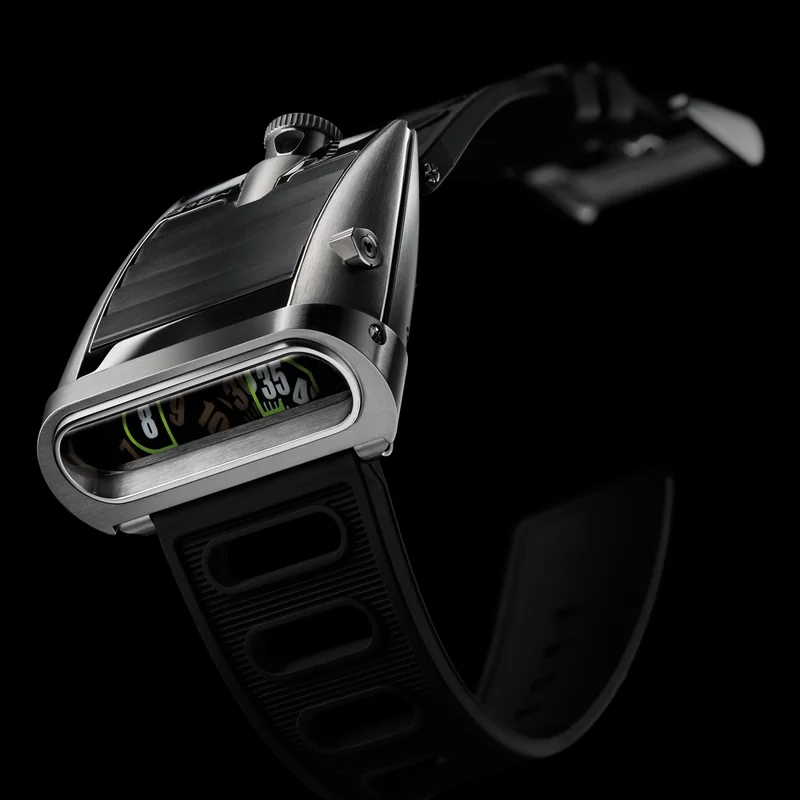
A jumping hour (or saut d'heure) complication displays the current hour as a digit visible through an aperture in the dial, which changes instantaneously at the top of each hour rather than being shown by a sweeping hand. The digital numeral sits on a disc that is held in position by a spring-loaded click mechanism for 59 minutes and released at the exact hour to snap forward to the next digit. The mechanism requires storing sufficient energy from the movement during the course of each hour to power the sudden jump — a challenge that has made jumping hour constructions a test of watchmaking ingenuity. Patek Philippe, A. Lange & Sohne, and independent makers including Harry Winston and F.P. Journe have produced celebrated jumping hour watches.
Quick facts
- Type
- Complication
- Complication
- jumping-hour
- Era
- Late 19th century (pocket watches) / 1920s (wristwatches, Vacheron Constantin)
- Origin
- Switzerland / France
Mechanism: Accumulating Energy for the Jump
A jumping hour mechanism must accumulate energy across 60 minutes and release it instantaneously at the hour change — if released gradually, the digit change would be slow and unsatisfying; a slow change also risks the display stopping mid-way between digits. The energy is stored in a spring compressed by a cam driven from the minute train. As the minute hand approaches 12, the cam has compressed the spring to maximum tension. At the exact moment the minute hand passes 12, a detent (click) releases, allowing the spring to snap the hour disc forward one numeral. The engineering challenge is ensuring the release occurs precisely at the hour (not early or late) and that the return spring force is sufficient for a truly instantaneous jump without harming the mechanism.
Historical Development
Hour-numerals in aperture format (as opposed to hour hands on a chapter ring) appeared in 18th-century 'digital' pocket watches with jumping hour and minute drums. The wristwatch jumping hour was popularised in the 1920s — Vacheron Constantin, LeCoultre, and Patek Philippe produced jumping hour wristwatches in that decade. The Harry Winston Opus series (beginning 2001, with various independent watchmakers) included several jumping hour complications; F.P. Journe's Vagabondage I (2002) is a celebrated jumping hour with retrograde minutes. The A. Lange & Sohne Zeitwerk (2009) combined jumping hour and jumping minutes with a remontoire (force equaliser) to ensure consistent energy delivery to the jumping mechanism — considered a landmark in jumping time display engineering.
Jumping Hour Combined with Retrograde Minutes
A natural pairing with the jumping hour is a retrograde minutes hand: the minutes hand sweeps from 0 to 60 across an arc, and at the hour mark, both the hour numeral jumps and the minutes hand flies back to zero. This combination creates a fully digital time read in an analogue format — no conventional hands are needed for the time display. Examples include F.P. Journe Vagabondage I, Voutilainen Vingt-8, and several Romain Gauthier and De Bethune pieces. The synchronisation of the retrograde minutes flyback with the hour jump is a demanding technical requirement: both events must occur simultaneously and with sufficient force.
A. Lange and Sohne Zeitwerk
The Zeitwerk (2009) introduced a jumping hour and jumping minutes display using a constant-force device (remontoire) to ensure a uniform energy delivery to the jumping discs regardless of the state of the mainspring. The movement uses two separate apertures — one for hours (two digits for 10s and units), one for minutes (two digits) — and the entire display changes simultaneously at each minute. The remontoire releases a fixed increment of stored energy per second, decoupling the display mechanism from the variable torque of the mainspring. The result is a stable, consistent jump regardless of wind state — a design that addresses a common criticism of jumping displays driven directly from the mainspring.
Sources & further reading (3)
- encyclopedia — accessed 2026-05-07
- encyclopedia — accessed 2026-05-07
- watch-reference — accessed 2026-05-07
Frequently asked questions
Does the jump in a jumping hour complication affect the watch's accuracy?
The sudden energy release during the jump creates a brief spike of mechanical stress in the movement. In a well-designed jumping hour, this impulse is absorbed by the spring mechanism and does not perturb the balance wheel's oscillation. In poorly designed or worn mechanisms, the jump impulse can propagate to the balance wheel and cause a momentary rate disturbance. The A. Lange & Sohne Zeitwerk's remontoire specifically addresses this by isolating the balance wheel from the jumping event.
Is a jumping hour more difficult to read than a conventional dial?
Proponents argue that the large numeral in the aperture is easier to read than a hand position on a chapter ring, particularly at a glance or in poor light. Critics note that the minute display (often a small subsidiary dial) requires more attention than a conventional minute hand. The overall readability depends strongly on dial design — the combination of a jumping hour aperture and a clearly legible minutes indication can produce a very quick-read time display.
What happens if the jumping mechanism fails mid-jump?
If the accumulating spring loses tension during the 59-minute build-up (for example, if the watch is allowed to run down), the hour disc may not jump or may jump only partway. This does not damage the mechanism in most modern designs — the spring simply remains compressed until sufficient energy is available again. Rewinding the movement will typically allow the jump to complete. However, the time display will be incorrect until the wearer corrects the hour disc manually.