Jaeger-LeCoultre Reverso
A 1931 Art Deco rectangular watch with a case that rotates 180 degrees exposing a protective back — designed for polo.
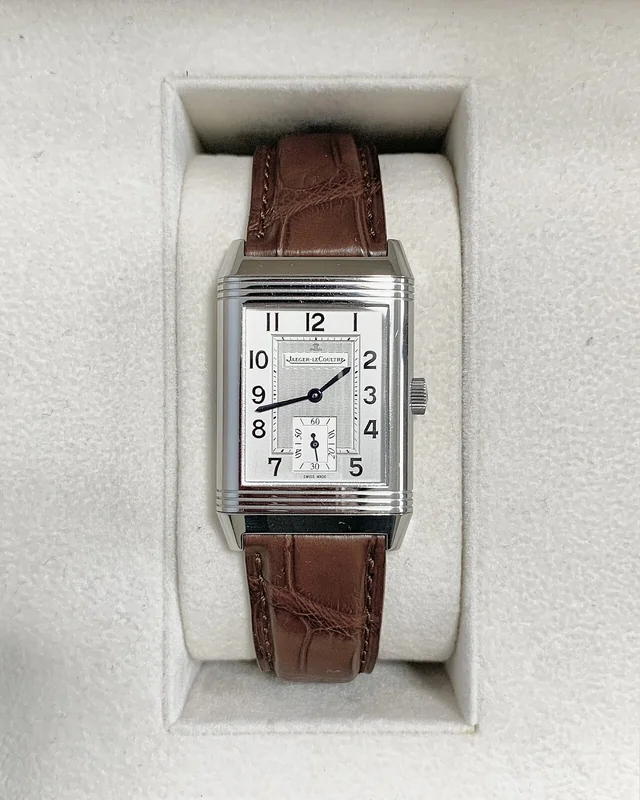
The Jaeger-LeCoultre Reverso is an Art Deco rectangular wristwatch introduced in 1931, designed for British officers stationed in India who played polo. The defining feature is a sliding case mechanism: the rectangular watch case slides out of a fixed chassis and rotates 180 degrees to expose a plain stainless steel back, protecting the crystal from impact during the polo mallet swing. The mechanism uses a spring-loaded detent at each end position (crystal-forward and back-forward) to secure the case. The plain back — initially purely protective — became a surface for personal engraving and eventually for complications, dials, and artistic decoration. The Reverso is the oldest continuously produced watch design in the major Swiss houses' current collections.
Quick facts
- Type
- Iconic Watch
- Era
- 1931-present
- Origin
- Switzerland (Le Sentier, Vallée de Joux)
The 1931 Commission
The Reverso was commissioned in 1930 by Cesar de Trey, a businessman representing British officers in India who approached Jaeger-LeCoultre with a request for a polo-proof watch. The 'polo problem' was well-known: polo mallets swung at ankle height frequently struck players' wrists and shattered watch crystals. Design credit is shared between de Trey's associate Rene-Alfred Chauvot (who filed the design patent in 1931) and LeCoultre engineers. The patent (filed in France in 1931) describes the reversing mechanism: a case sliding in grooves on a fixed chassis, retained at each end by a spring catch. The first references were produced in 1931 and sold primarily in the Indian market.
Mechanism of the Reverso
The Reverso case slides along two parallel rails machined into the fixed chassis (carrure). The sliding action is stopped at each end by a spring-loaded ball catch that engages a dimple in the case body. A light lateral push releases the catch and allows the case to slide to the opposite position; at that position, the user rotates the case 180 degrees about the horizontal axis of the rails and snaps it into the 'back-facing' position. The movement, dial, and hands are all fixed to the sliding case body; the chassis remains on the wrist. When the case is reversed, the protective steel back faces outward and the crystal is protected. The mechanism requires approximately 10 parts beyond the standard case construction.
The Reverso Back as Artistic Surface
The plain metal back of the Reverso rapidly became a surface for personalisation. Cartier jewellers and independent engravers executed coats of arms, portraits, and decorative motifs on customer cases from the 1930s onward. Jaeger-LeCoultre has formalised this tradition through its 'Personalization' service. The Ultimate edition Reverso backs have housed grand feu enamel miniature paintings, cloisonne portraits, hand-engraved scenes, and complications — including a second time zone display, a second complete watch (Reverso a Eclipse), and a tourbillon (Grande Complication). The 'Reverso Duoface' uses both sides: the crystal side shows one time zone, the back shows a second — creating a travel watch that has been cited as one of the most inventive uses of the Reverso architecture.
Art Deco Aesthetic
The Reverso's design is an exemplary Art Deco object: rectangular form, linear decoration confined to parallel stripes on the case bands, geometric dial layout, and visible structural elements treated as decorative features (the ribbed sides, the rectilinear bezel). The 1931 original used applied Roman numerals on a white dial; contemporary references maintain this vocabulary while offering arabic numeral, hour-index, and minimalist dial variants. The Reverso has not undergone major redesign since 1931 — the case proportions, sliding mechanism, and general aesthetic have been preserved across 90 years of production, making it one of the most stable design templates in Swiss watchmaking.
Sources & further reading (3)
- encyclopedia — accessed 2026-05-07
- encyclopedia — accessed 2026-05-07
- watch-reference — accessed 2026-05-07
Frequently asked questions
Was the Reverso actually worn for polo?
The Reverso was commissioned for the specific purpose of protecting a watch crystal during polo and was sold to British officers who played polo in India. Whether it was regularly used in actual polo matches — where wrist injuries are common enough that many players do not wear watches at all — is less documented. The polo origin story is well-attested in the Jaeger-LeCoultre corporate archive and consistent with 1930s market documentation. It may be that the watch was worn for polo practice and social polo events rather than competitive match play.
Is the Reverso mechanism durable?
The sliding and rotating mechanism has been operated by collectors millions of times across nine decades of production without documented systemic failure attributable to mechanism wear. The spring catches and rail design are robust for normal use. Forceful impact to the side of the case (e.g., the case hitting a corner of furniture) can dent or distort the rails; this requires watchmaker realignment but is repairable. The mechanism is designed to be operated deliberately, not by accident — light lateral force is required to release the catch, preventing inadvertent reversal.
What is the Grande Reverso versus standard Reverso?
The 'Grande Reverso' designation refers to larger-case Reverso references, as opposed to the 'Petite Reverso' (smallest) and standard Reverso. Jaeger-LeCoultre has used these size designations to organise the Reverso collection since the 1990s when the range expanded. The Grande Reverso Ultra Thin features the calibre 822 (2.94 mm thick automatic) and a case measuring 47 x 28.4 mm. Size designations (Petite, Reverso Classic, Grande Reverso) correspond to specific case dimensions and are used across both men's and women's references.