Guilloche Dial
A dial engraved with repetitive geometric patterns by a rose engine lathe — an 18th-century craft technique.
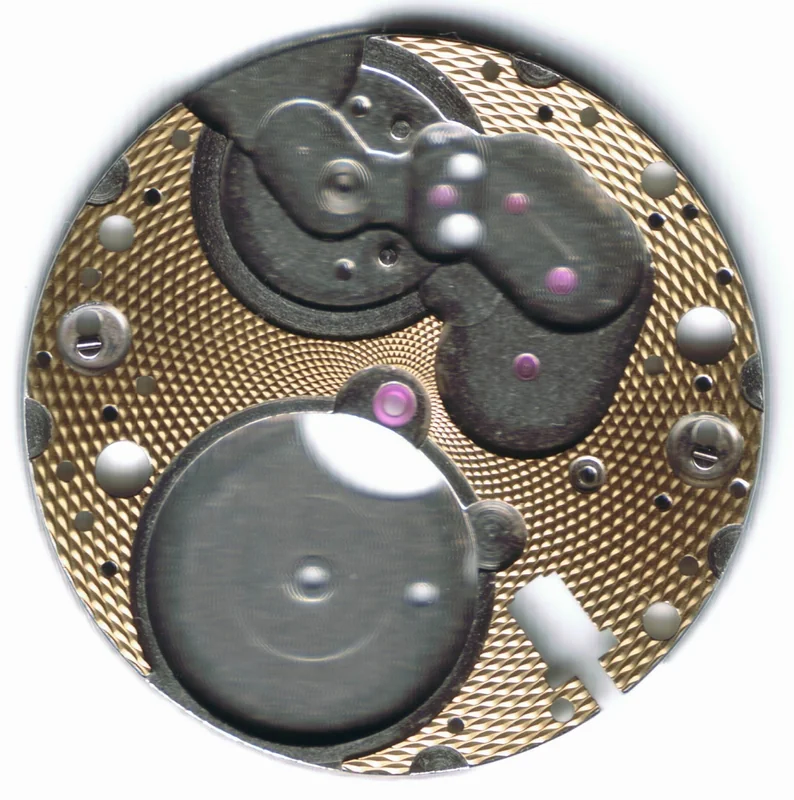
Guilloche (pronounced ghee-oh-SHAY) is a surface engraving technique in which fine, repetitive geometric patterns are cut into a metal surface using a machine called a rose engine or straight-line engine. The machine's spindle or carriage moves in programmed paths controlled by a rosette cam or gears, creating mathematically precise waved, interlocking, or radiating patterns that are beyond the capability of hand engraving. Applied to watch dials — typically on gold or silver blanks before plating and enamel application — guilloche creates a light-reflective, three-dimensional surface of extraordinary intricacy. Breguet perfected the technique for watch dials in the late 18th century and remains its most celebrated practitioner; Patek Philippe, Vacheron Constantin, and Jaeger-LeCoultre also produce guilloche dials.
Quick facts
- Type
- Dial Type
- Era
- 18th century (Breguet) / ongoing
- Origin
- France / Switzerland
The Rose Engine and Its Operation
A rose engine lathe (or rose engine) is a precision machine that rotates a workpiece eccentrically — the spindle's center of rotation is controlled by a shaped cam (the rosette) that wobbles the workpiece as it turns. A graver (cutting tool) held against a fixed rest cuts a line into the spinning surface; the eccentric motion of the rosette creates a wavy rather than circular cut. By indexing the workpiece after each pass and repeating the cut, the operator builds up a complex pattern of interlocking curves — the clou de Paris (hobnail), barleycorn, wavy engine turning, and sun ray patterns are all produced this way. A straight-line engine produces linear patterns (Cotes de Geneve, geometric striping) by moving the cutting tool in programmed straight paths across a non-rotating blank.
Breguet and Guilloche Watch Dials
Abraham-Louis Breguet was among the first watchmakers to systematically apply guilloche engine turning to watch dials, beginning in the 1780s. Breguet's characteristic 'clou de Paris' (hobnail) pattern and waved engine turning on his silver dials became so closely associated with his work that the style is still called a 'Breguet dial.' Contemporary Breguet uses rose engines that date to the 18th and 19th centuries alongside modern programmed machines. Several patterns — including the large hobnail used on reference 7787 — can only be produced on specific old machines whose cams and rosettes encode the pattern in the machine itself. These machines are treated as irreplaceable tooling assets.
Guilloche as Foundation for Grand Feu Enamel
Guilloche is often combined with translucent grand feu enamel: the enamel is fired at high temperature (800°C) over the engraved metal surface, and the transparent enamel layer allows the underlying pattern to show through. The enamel's glass-like depth — 0.3–1 mm of translucent vitreous material — adds a luminous quality to the guilloche pattern beneath. This combination — engine-turned guilloche under translucent enamel — is considered the apex of traditional dial craft. Manufacturers who produce both the guilloche and the enamel firing in-house include Breguet (Vallée de Joux atelier), Patek Philippe, and a handful of independent ateliers in Geneva and the Jura.
Contemporary and Decorative Applications
Guilloche dials are produced at various quality levels. Entry-level 'guilloche-look' dials use photoengraving or printing to simulate the pattern without any actual engine turning — a meaningful distinction because the pattern lacks the three-dimensional topography and light-reflection properties of true guilloche. Mid-range guilloche uses CNC-controlled milling machines to approximate engine-turning patterns. True rose engine work, produced on antique or purpose-built precision machines, is distinguished by the depth and variability of cut, the slight human imperfection of cam-driven patterns, and the physical texture detectable by touch. The market for true hand-guilloche dials from rose engine operators is extremely small — fewer than 30 rose engine operators worldwide produce watch-quality dials.
Sources & further reading (3)
- encyclopedia — accessed 2026-05-07
- encyclopedia — accessed 2026-05-07
- watch-reference — accessed 2026-05-07
Frequently asked questions
What is the difference between guilloche and engine turning?
Guilloche and engine turning are closely related terms often used interchangeably. Engine turning refers broadly to any surface decoration produced on a lathe, engine, or geometric rose engine. Guilloche specifically refers to decorative patterns produced by the eccentric motion of a rose engine — interlocking wavy lines, hobnail patterns, sun ray patterns. In common usage, 'guilloche' has come to mean any watch dial with geometric engraved patterns, while 'engine turning' is sometimes reserved for linear-engine patterns. Both are correctly applied to the same general technique.
Why are guilloche dials more expensive than plain lacquer dials?
A true guilloche dial requires significant machine time and specialist operator skill. A rose engine operation on a single dial blank may take several hours; the operator must set up the rosette, calibrate the graver depth, and index the workpiece precisely for each pattern pass. Any error requires starting again on a new blank. The machine time, operator skill, material cost (typically gold or silver), and subsequent finishing (plating, enamel application, hole drilling for hands and canon) make a hand-guilloche dial far more expensive to produce than a printed or lacquered alternative.
Can you touch a guilloche dial?
The textured surface of a guilloche dial is detectable by touch — the pattern is a physical three-dimensional topography in the metal, not a printed surface. The peaks and valleys of the pattern create a subtle texture. In practice, watch dials should not be touched: fingerprints leave oils that are difficult to remove from the fine texture and can interfere with any applied enamel or plating. Movement finishing convention also discourages handling metal surfaces directly; dials should be held by edges only.