GMT (Dual Time) Complication
A fourth hand displaying a second time zone against a 24-hour scale — developed for transatlantic aviators in 1954.
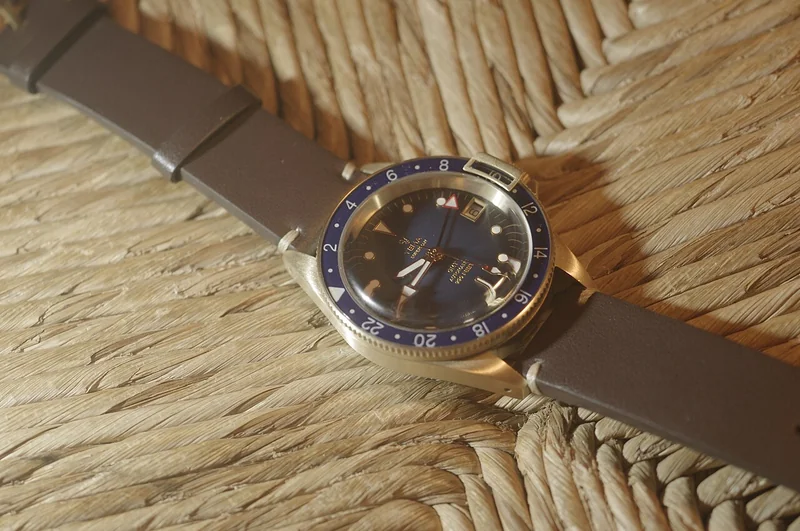
A GMT complication (from Greenwich Mean Time, now UTC) adds a second time zone display to a standard wristwatch. The most common implementation is a fourth hand — a dedicated 24-hour hand — pointing to a bezel or chapter ring graduated in 24 hours, allowing the wearer to read a second time zone at a glance while the standard 12-hour hands show local time. Originally developed by Rolex in collaboration with Pan American Airways for transatlantic pilots in 1954, the GMT complication became associated with aviation, navigation, and travellers. A 'true GMT' or 'true dual-time' complication allows independent setting of the local hour hand without stopping the movement; a simpler 'traveller' design sets local time by adjusting the standard hour hand in one-hour jumps.
Quick facts
- Type
- Complication
- Complication
- GMT
- Era
- 1954 (Rolex Submariner ref. 6542 / GMT-Master)
- Origin
- Switzerland
The 24-Hour Hand System
In the classic GMT architecture, the fourth hand is geared to rotate once every 24 hours — half the rate of the standard minute and hour hands. This hand points to a chapter ring, subdial, or rotating bezel graduated from 0 to 24, with 12 at noon and 24 (or 0) at midnight. The 24-hour scale allows unambiguous AM/PM reading, eliminating the ambiguity of a 12-hour display for night flights. The bezel (in the Rolex GMT-Master design) or chapter ring can be set to display any reference time zone independently of local time. The standard two-tone colour scheme (one colour for day hours, another for night) on the Rolex bezel was designed to help pilots distinguish daytime and nighttime hours at the reference location.
Rolex GMT-Master and Pan American Airways
In the early 1950s, Pan American World Airways sought a watch that would allow its transoceanic flight crews to track two time zones simultaneously — home base and destination. Rolex developed the GMT-Master (reference 6542, launched 1954) in collaboration with the airline. The movement incorporated an additional gear set to drive the fourth hand at half speed, along with a bi-directional rotating bezel. Pan Am equipped its crews with the watch for approximately a decade. The GMT-Master became one of the most recognised professional tool watches of the 20th century, its Bakelite-bezel original (ref. 6542) and the subsequent two-colour bezel variants (reference 1675) now among the most studied reference series in vintage watch collecting.
Quick-Set Complications and True Dual Time
Early GMT watches could only set the home time zone by rotating the bezel — adequate for one-way transatlantic travel but inconvenient for frequent destination changes. From the 1980s, manufacturers developed 'quick-set' local time mechanisms: the hour hand can be advanced or retarded in one-hour increments independently of the running movement (the seconds and minutes continue running). This allows the traveller to set the local hour without stopping the watch or disturbing the home time zone hand. The Patek Philippe ref. 5164 (Aquanaut Travel Time) uses push-button correctors for positive and negative time zone offset; the A. Lange & Sohne Lange 1 Time Zone displays a world time map with a flying-hours indication for the home zone.
World Time Complications
A world time complication displays all 24 time zones simultaneously, typically via a rotating disc showing city names and a 24-hour ring. Louis Cottier, a Geneva watchmaker, developed the world time mechanism in the 1930s for Vacheron Constantin and Patek Philippe. The Patek Philippe reference 1415 HU (1939, with the initials of the original customer Henry Graves) is an early world time example; the contemporary references 5110, 5130, and 5230 continue the tradition. Vacheron Constantin's Harmony World Time (reference 7700V) updates the concept with a modern design. The world time mechanism requires only one hand-set operation when travelling — rotating a disc to position the home city at the 12 o'clock reference — to update all 24 zones simultaneously.
Sources & further reading (3)
- encyclopedia — accessed 2026-05-07
- encyclopedia — accessed 2026-05-07
- watch-reference — accessed 2026-05-07
Frequently asked questions
What is the difference between GMT, dual time, and world time?
A GMT complication adds a single fourth hand that reads a second time zone against a 24-hour scale — it displays two time zones. A dual time watch displays two complete time zone readings (two separate hour/minute hand sets or a subdial), typically also two zones. A world time complication simultaneously displays all 24 standard time zones via a rotating city disc and 24-hour ring. The terms GMT and dual time are often used interchangeably in marketing, though technically a GMT hand shows 24-hour time while a dual-time second display uses a standard 12-hour format.
What does 'true GMT' mean?
A 'true GMT' watch allows the local hour hand to be set independently (forwards or backwards) in one-hour jumps without stopping the movement — the running second hand and home-time reference continue uninterrupted. Some simpler designs require stopping the crown and rotating the standard hour hand, which disturbs the seconds display. 'True' or 'quick-set' local time adjustment is the more useful traveller configuration.
Is the Rolex GMT-Master original bezel really Bakelite?
Yes. The original reference 6542 (1954–1959) featured a bezel insert made from Bakelite, an early thermosetting plastic. Bakelite was chosen for its ability to be moulded with a two-colour (red/blue) design in a single piece. However, Bakelite proved fragile and prone to cracking with age; Rolex replaced it with an aluminium bezel insert beginning with the reference 1675 (c. 1959). Intact original Bakelite bezels are rare and highly sought in vintage watch collecting.