Equation of Time Complication
A display showing the difference between clock time and true solar time, caused by Earth's elliptical orbit.
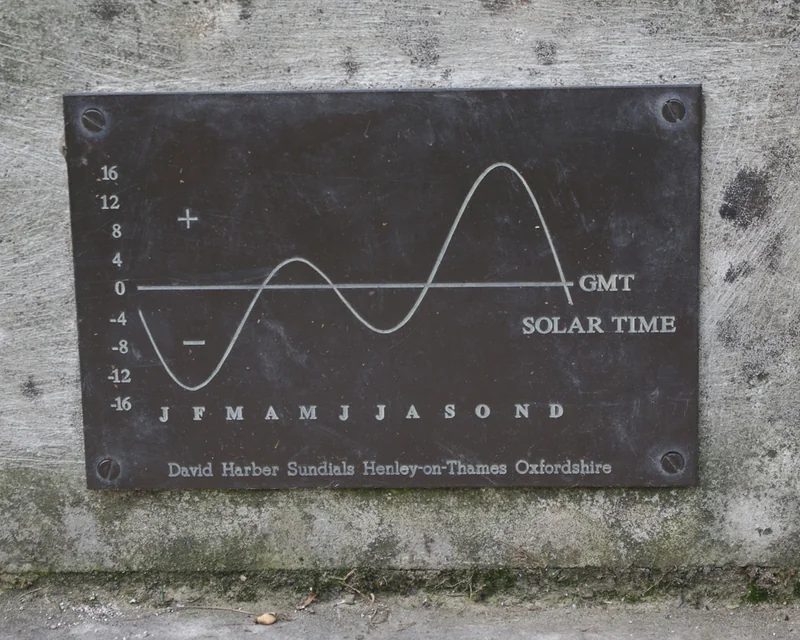
The equation of time is the difference, varying day by day throughout the year, between civil mean solar time (the uniform time shown by clocks) and apparent solar time (the time told by a sundial, based on the actual position of the Sun). This difference arises from two effects: the elliptical shape of Earth's orbit around the Sun (causing orbital speed to vary across the year) and the obliquity of the ecliptic (the tilt of Earth's axis). The combined equation of time swings between approximately +16.4 minutes (early November) and -14.2 minutes (mid-February). An equation-of-time watch displays this difference — typically as a subsidiary sector or hand — allowing the wearer to know when a sundial and a clock should agree. First displayed mechanically in 17th-century clocks, it was applied to pocket watches in the 18th century and to wristwatches in the 20th.
Quick facts
- Type
- Complication
- Complication
- equation-of-time
- Era
- 17th century (clocks) / 18th century (pocket watches) / 20th century (wristwatches)
- Origin
- Europe (Netherlands / France / England / Switzerland)
What the Equation of Time Represents
Civil time (mean solar time) assumes the Sun moves at a constant speed around the Earth — a useful fiction for uniform clock ticking. The real Sun does not: Earth's elliptical orbit means it moves faster (and the Sun rises and sets earlier) when near perihelion (early January) and slower when near aphelion (early July). The tilt of Earth's axis creates a second sinusoidal variation as the Sun moves above and below the celestial equator. The combined effect is the equation of time — a figure that oscillates between approximately -14 to +16 minutes across the year, with four crossings of zero (near 15 April, 13 June, 1 September, and 25 December). These four dates are the only days when a sundial and a mean-time clock agree precisely.
Mechanical Implementation
The equation of time is encoded in a specially shaped cam — an 'equation cam' — that makes one full rotation per year. The cam profile precisely encodes the annual variation of the equation of time: as the cam rotates, a feeler lever traces the cam edge and drives a subdial pointer or retrograde hand showing the current day's difference in minutes. The cam profile is mathematically derived from the combined astronomical equations and machined with high precision — errors in the cam directly translate into errors in the displayed value. A 365-day wheel (or 365-and-a-quarter-day mechanism with leap year correction) drives the cam at the correct annual rate.
Notable Equation-of-Time Timepieces
Breguet produced several celebrated equation-of-time pocket watches in the late 18th and early 19th centuries, including instruments for Napoleon Bonaparte and other notable clients. The Patek Philippe calibre RTO 27 QR SID LU CL (in the Sky Moon Tourbillon reference 5002) includes an equation-of-time display alongside a perpetual calendar, tourbillon, and minute repeater. Patek Philippe reference 5235 (annual calendar with equation of time) and reference 5327 (perpetual calendar with equation of time) offer more accessible versions. F.P. Journe's Octa Calendrier and several A. Lange & Sohne pieces (including the Lange 1 Tourbillon Perpetual Calendar) include equation-of-time indications.
Practical and Historical Significance
Before the adoption of standardised railway time zones in the late 19th century, sundials were the primary public time standard, and clocks were set against the sundial reading with equation-of-time corrections applied. Navigators needed the equation to determine longitude using the Sun as a reference. With the global adoption of mean solar time and eventually UTC as the civil standard, the practical need for equation-of-time displays disappeared — but the complication survives as a demonstration of astronomical knowledge encoded in mechanical form, valued for its educational and artistic content rather than any timekeeping utility.
Sources & further reading (3)
- encyclopedia — accessed 2026-05-07
- encyclopedia — accessed 2026-05-07
- watch-reference — accessed 2026-05-07
Frequently asked questions
Why does the equation of time vary through the year?
Two independent effects combine. First, Earth's orbit is elliptical: near perihelion (early January), Earth moves faster, and the Sun appears to move faster across the sky, so a day (measured Sun to Sun) is slightly longer than the clock's 24-hour mean day. Near aphelion (early July), the opposite occurs. Second, the obliquity of the ecliptic means the Sun moves partly along the ecliptic rather than purely along the equator; its equatorial-component speed varies with the cosine of the ecliptic latitude, adding a second sinusoidal term. The sum of these two effects gives the observed equation of time curve.
Are there days when a sundial and a clock agree exactly?
Yes — four times per year the equation of time is zero: approximately 15 April, 13 June, 1 September, and 25 December. On these dates, a sundial calibrated to the observer's longitude (corrected for local mean solar time within a time zone) should read the same as a correctly set clock. At all other times, the sundial reads ahead of or behind clock time by the equation-of-time correction.
Does an equation-of-time watch need adjustment each year?
No — the equation cam rotates once per year and encodes the full annual cycle permanently. The display automatically shows the correct value each day without any setting. In a perpetual calendar with equation of time, the leap year correction for the calendar also advances the equation cam by the correct amount. The equation of time curve repeats identically each year (ignoring very long-term astronomical precession effects), so no annual user intervention is required.