Dive Watch Case Style
A water-resistant case for underwater use — screw-down crown, rotating bezel, ratings from 100 m to 4,000 m.
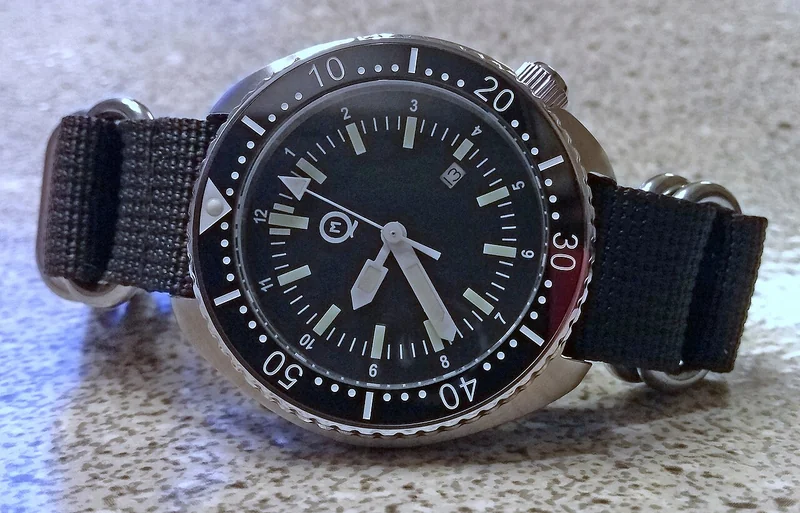
A dive watch case is designed to resist water ingress under pressure, enabling reliable timekeeping during scuba diving, professional underwater work, and saturation diving. Key features are a screwed-down crown (eliminating the primary water-entry point of the winding stem), a case back sealed with gaskets and often screwed or pressed into the case, a crystal (sapphire or mineral glass) mounted with a gasket under tension, and a unidirectional rotating bezel calibrated in minutes that allows a diver to mark elapsed bottom time. ISO 6425 defines the international standard for dive watches: minimum 100 m water resistance, a bezel with markings readable at 25 cm in total darkness, and resistance to magnetic fields of 4,800 A/m.
Quick facts
- Type
- Case Style
- Case style
- dive
- Era
- 1953 onward
- Origin
- Switzerland / Japan
Sealing Technologies
Water resistance in a watch case depends on three sealing points: the crown (most vulnerable), the crystal, and the case back. The screw-down crown, introduced on the Rolex Oyster in 1926 and adapted for dive watch use in the early 1950s, compresses a rubber O-ring around the winding stem when screwed into the case tube. The crystal is mounted with a gasket in compression; sapphire's hardness and surface quality make it easier to seal than softer minerals. The case back — either screw-in (threaded against an O-ring) or snap-on — creates a second sealed chamber. The Rolex Submariner's 1953 introduction rated to 100 m (3.28 atmospheres) defined the baseline; modern dive watches from IWC (Sea Wolf, 2,000 m), Omega (Planet Ocean, 600 m), and Seiko (Prospex 'Tuna,' 1,000 m) extend this to professional saturation-diving specifications.
The Unidirectional Rotating Bezel
Dive watch bezels rotate in only one direction (counter-clockwise in convention), so that any accidental bezel movement extends — rather than shortens — the elapsed-time indication, protecting a diver from unknowingly indicating a shorter dive time and overstaying bottom time. The bezel's zero marker (typically marked with a luminescent pip or arrow) is aligned with the minute hand at dive entry; elapsed time is read directly from the bezel's minute graduation. ISO 6425 requires that the bezel display be readable at 25 cm in darkness, that each 5-minute increment be distinguishable, and that the bezel have defined click-stop detents. Helium escape valves (as on the Rolex Sea-Dweller and Tudor Pelagos) release accumulated helium gas during saturation diving decompression, preventing case damage.
ISO 6425 Standard
ISO 6425 (1996, updated 2018) specifies the minimum requirements for a watch marketed as a 'dive watch': a minimum water resistance of 100 m tested to 125% (125 m), a bezel or other elapsed-time indicator operable in diving gloves, a luminous display readable at 25 cm in darkness after 30 minutes of dark adaptation, resistance to shock, magnetic fields of at least 4,800 A/m, and a strap or bracelet rated for the same water pressure as the case. A watch marked 'Water Resistant 100m' without ISO 6425 certification is not necessarily a dive watch — the ISO standard is a separate and more demanding specification than simple water-resistance ratings.
Iconic Dive Watch References
The Rolex Submariner reference 6204 (1953) is the reference point for the modern dive watch aesthetic: round 38 mm case, Mercedes hands, rotary bezel, lollipop seconds hand. The Blancpain Fifty Fathoms (1953) is an independent development of similar features by French naval divers collaborating with Blancpain. Omega's Seamaster 300 (1957) and Seiko's 62MAS (1965) extended the format to other manufacturers. Japanese professional standards produced the 'Tuna can' Seiko SBBN (ISO 6425 certified, 300 m saturation tested). The Panerai Luminor Submersible, derived from Panerai's Italian Navy instrument designs, represents a distinct aesthetic branch of the dive watch family.
Sources & further reading (3)
- encyclopedia — accessed 2026-05-07
- encyclopedia — accessed 2026-05-07
- watch-reference — accessed 2026-05-07
Frequently asked questions
What does a water resistance rating mean in practice?
Water resistance ratings (e.g., 100m, 200m) are static pressure tests conducted on the case alone — they do not account for the additional hydrodynamic pressure generated by swimming movements. Industry guidelines suggest dividing the stated static rating by a safety factor of approximately 3–4 to estimate the safe depth for dynamic swimming activities. A watch rated 100m is generally considered safe for surface swimming and snorkeling but not for scuba diving; 200m is the practical minimum for recreational scuba. ISO 6425-certified dive watches rated at 100m are specifically tested for dynamic diving conditions.
Can a dive watch be worn in a swimming pool?
Any watch with a water resistance rating of 50m or more (and a screw-down crown if available) can safely be worn in a swimming pool or during recreational swimming. Chlorinated pool water and salt water can accelerate corrosion of gaskets over time; regular gasket inspection and replacement every 2–3 years is recommended for frequently water-exposed watches.
Why does a dive watch bezel only rotate in one direction?
The unidirectional bezel rotates only counter-clockwise so that any accidental movement extends the displayed elapsed time. If a diver is at the bottom and bumps the bezel, a bidirectional bezel could rotate clockwise, reducing the displayed elapsed time and leading the diver to believe less time has passed than actually has — potentially dangerous if the diver stays down too long. A unidirectional bezel can only rotate to show more time elapsed, which is always the safer error.