Chronograph Complication
An independent seconds counter started, stopped, and reset without affecting the main timekeeping train.
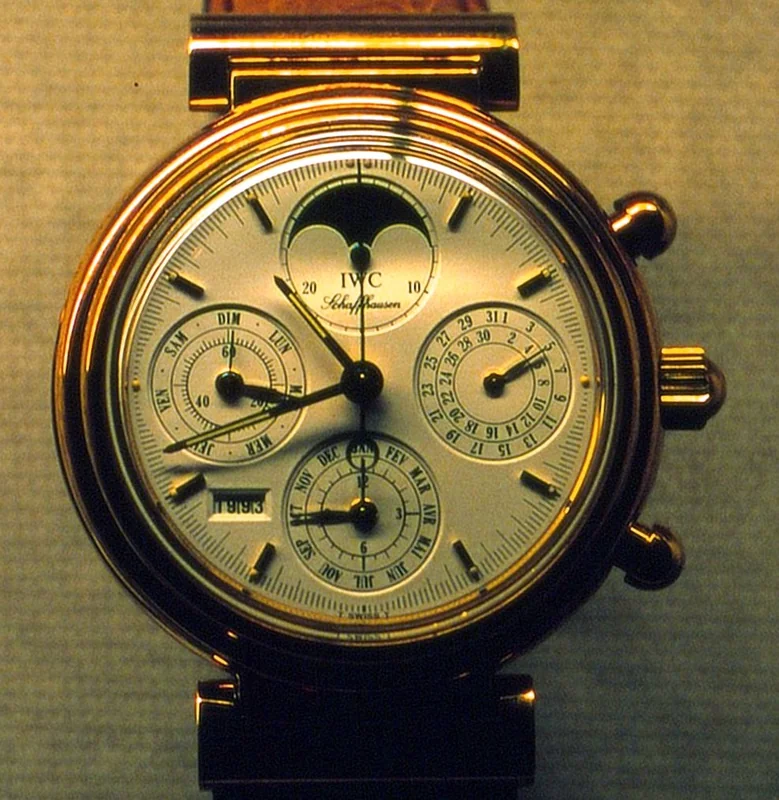
A chronograph is a complication that adds a stopwatch function to a watch: a seconds counter that the wearer can start, stop, and reset independently of the main timekeeping hands. The chronograph seconds hand typically sweeps from the 12 o'clock position and runs on a separate wheel train driven from the movement's main train via a coupling. Sub-dials record elapsed minutes and, in some designs, elapsed hours. First patented by Louis Moinet in 1816 and refined through the 19th century for use in scientific and sporting timing, the chronograph is today the single most commonly produced watch complication across all price ranges.
Quick facts
- Type
- Complication
- Complication
- chronograph
- Era
- 1816 (Moinet patent) / 1820s onward
- Origin
- France / Switzerland
Mechanism Fundamentals
The chronograph complication in a mechanical watch adds a second gear train — the 'chronograph train' — alongside the timekeeping train. A horizontal or vertical coupling clutch connects the chronograph seconds wheel to the movement's third wheel or fourth wheel (which beats once per second). When the pusher at 2 o'clock is pressed, the clutch engages and the chronograph seconds hand begins sweeping. Pressing again disengages the clutch and stops the hand. A third action (reset, typically the pusher at 4 o'clock) returns the hand to 12 via a heart-cam and hammer mechanism. Column-wheel chronographs (considered higher-quality) use a rotating wheel with alternating pillars to orchestrate the start/stop/reset sequence; cam-actuated designs use simpler stamped-lever systems.
Flyback Chronograph
A flyback chronograph allows the wearer to instantly reset and restart the elapsed-time measurement with a single button press, rather than the three-action sequence (stop, reset, restart) of a standard chronograph. This function was developed for aviation use: pilots timing legs of a flight can begin a new measurement immediately at a waypoint without the multi-step sequence. Cartier patented a flyback mechanism in the 1930s; contemporary flyback movements are found in pilot's watches including the IWC Pilot's Watch, Breitling Navitimer references, and the Patek Philippe ref. 5004.
Rattrapante (Split-Seconds)
The rattrapante (French for 'catch-up') or double chronograph adds a second chronograph hand — the split-seconds hand — that can be stopped independently of the primary chronograph hand to record an intermediate time, then springs forward to catch up with the still-running main hand. Used historically in horse racing and athletics to record competing athletes finishing a race at near-identical times, the rattrapante is one of the most mechanically complex wristwatch complications: it requires a second coupling clutch, a second column wheel or cam set, and a 'fly-back' spring mechanism for the split hand. Notable modern rattrapante calibres include the Patek Philippe CH 29-535 PS R and the A. Lange & Sohne L001.1.
Columns and Cams: Quality Indicators
Collectors and watchmakers regard the column wheel as a sign of higher-quality chronograph construction. A column wheel is a cylindrical cam with alternating raised columns (pillars) and recessed valleys that positively index the lever set governing start/stop/reset into defined positions, giving a lighter, crisper pusher feel and reducing friction wear. Cam-actuated chronographs use stamped-lever systems that function equivalently but with a heavier pusher action and more wear-prone sliding contacts. Swiss grade lines such as COSC-certified chronographs and manufacture-calibre movements typically employ column wheels; many volume-production calibres (ETA Valjoux 7750) use cam actuation.
Sources & further reading (3)
- encyclopedia — accessed 2026-05-07
- encyclopedia — accessed 2026-05-07
- watch-reference — accessed 2026-05-07
Frequently asked questions
What is the difference between a chronograph and a chronometer?
A chronograph is a complication (a stopwatch function built into a watch). A chronometer is a certification of timekeeping accuracy — specifically, a movement tested and certified by COSC (Controle Officiel Suisse des Chronometres) to meet the standard of −4/+6 seconds per day. A watch can be both a chronograph and a chronometer (tested for accuracy); most chronographs are not COSC-certified; most chronometers are not chronographs.
Why do some chronographs have two pushers and some have one?
Two-pusher chronographs have separate buttons for start/stop (typically 2 o'clock position) and reset (4 o'clock). Single-pusher mono-pusher chronographs cycle through start, stop, and reset with successive presses of one pusher — a design preferred for simplicity and historically more common in early 20th-century designs. Two-pusher designs allow stopping and restarting without resetting, which is more useful for split-time and lap-timing applications.
How accurate is a mechanical chronograph?
A mechanical chronograph seconds hand advances in increments determined by the balance wheel frequency. At 28,800 vph (vibrations per hour, 4 Hz), the smallest measurable interval is 1/8 second — the chronograph column advances 8 times per revolution of the seconds wheel. At 36,000 vph (5 Hz), resolution improves to 1/10 second. Electronic quartz chronographs can resolve 1/100 or 1/1000 second. Mechanical chronographs are not instruments of precision timing in a scientific sense but provide useful elapsed-time measurement within the context of everyday use.