Casio G-Shock
Ibe's 1983 quartz watch with a floating module in urethane — built to survive a 10-metre drop onto concrete.
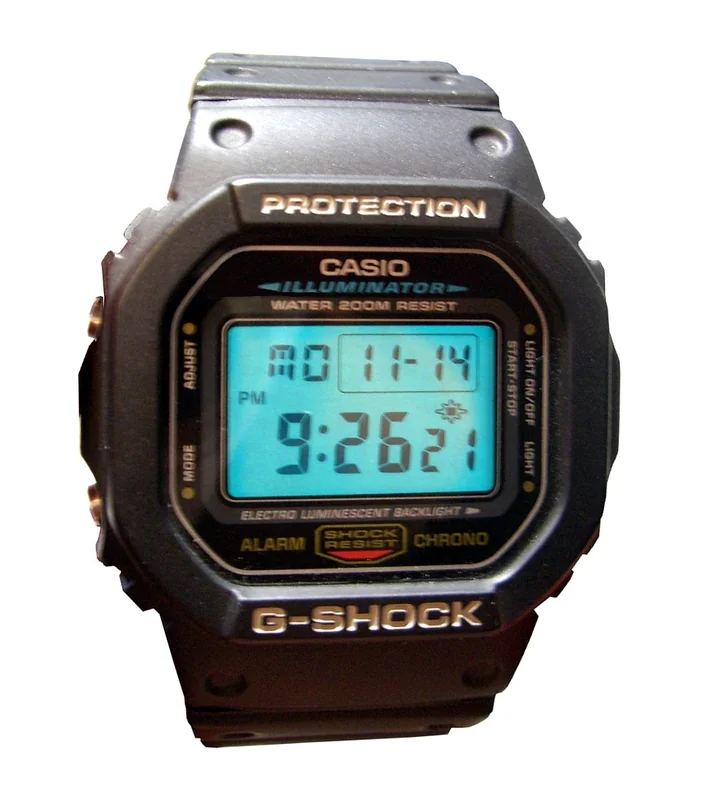
The Casio G-Shock is a line of quartz watches introduced in 1983, designed by Casio engineer Kikuo Ibe following a personal incident in which his father's watch broke when dropped. The G-Shock's design objective — surviving a 10-metre drop onto concrete — was achieved through a triple protection structure: a urethane resin outer case absorbing impact, a hollow inner structure with the module suspended on urethane cushions away from the case walls, and reinforced glass protecting the crystal. The original reference DW-5000C established these principles in 1983. The G-Shock became a globally distributed product across the Japanese market through the mid-1980s, found mainstream adoption in the US through military and hip-hop culture in the 1990s, and remains in continuous production with over 100 million units sold by 2019.
Quick facts
- Type
- Iconic Watch
- Era
- 1983-present
- Origin
- Japan
Kikuo Ibe's Design Challenge
Kikuo Ibe joined Casio in 1979 and was assigned to the research and development division. The G-Shock origin story — Ibe's father's watch breaking when dropped; Ibe observing a rubber ball's bounce properties — is documented in Casio's corporate history and Ibe's own accounts. The development project aimed to create a watch meeting three specifications: 10-year battery life, 10 bar water resistance, and a 10-metre drop survival. The '10-10-10' target guided the design. Ibe and his team tested approximately 200 prototypes over three years, dropping them from windows in the Casio building and studying failure modes — most prototypes failed at the crystal junction, the crown, or from direct transmission of impact to the module.
Triple Protection Structure
The G-Shock's shock resistance derives from three structural innovations: (1) The module (the electronic and display assembly) is mounted on a urethane cushion that holds it away from the inner case walls — the module 'floats' rather than being rigidly fixed, so impact energy is absorbed and transmitted unevenly to the module rather than as a single impulse. (2) The outer case is formed from urethane resin, which deforms elastically under impact and dissipates energy. (3) The mineral glass crystal is recessed below the bezel plane — the bezel takes direct impact before the crystal surface. The DW-5000C bezel design, with its characteristic bumpers at 3, 6, 9, and 12 o'clock, distributes impact forces to the case body. This structure has been maintained as the G-Shock architecture since 1983 across thousands of reference variants.
Military and Cultural Adoption
The G-Shock was initially a slow seller in Japan (1983–1986) but gained rapid adoption in the United States following military procurement — US Army Rangers, Navy SEALs, and other special operations units adopted the DW-5200 and subsequent references through the late 1980s and early 1990s. The watch's appearance in hip-hop culture — particularly through its adoption by LL Cool J and subsequent music video appearances — drove urban US sales through the early 1990s. By the mid-1990s, G-Shocks had become fashion objects independent of their functional utility, with rare colourways and limited series commanding premiums. The G-Shock's transition from tool watch to cultural object paralleled the broader shift in watch collecting toward instrument-aesthetic pieces.
Master of G and Technology Lines
Casio has extended the G-Shock architecture into specialist product lines. The 'Master of G' series addresses specific field environments: Frogman (200m ISO dive rating), Mudmaster (mud/dust resistance), Rangeman (triple sensor: altimeter/barometer, compass, thermometer), Gravitymaster (aviation). The GW (radio-controlled) series, introduced in the 1990s, added time synchronisation via radio signals from national time services (JJY in Japan, WWVB in the US, MSF in the UK, DCF77 in Germany). Solar charging — via a thin photovoltaic layer beneath the dial — was introduced in the G-Shock line in the late 1990s. Contemporary flagship references combine solar charging, multi-band radio reception, GPS time sync, Bluetooth synchronisation with smartphone time data, and step tracking.
Sources & further reading (3)
- encyclopedia — accessed 2026-05-07
- encyclopedia — accessed 2026-05-07
- watch-reference — accessed 2026-05-07
Frequently asked questions
What does G-Shock stand for?
G-Shock stands for 'Gravitational Shock' — referencing the watch's primary design specification of surviving impact from gravitational acceleration (dropping). The 'G' designates the unit of gravitational acceleration (g-force) and the design's response to high-g impact events. The name was assigned to the product line at launch in 1983.
Is the G-Shock movement mechanical or quartz?
All G-Shock watches use quartz movements. The G-Shock design prioritises shock resistance, battery life, and feature integration — objectives that are substantially easier to achieve with quartz than with mechanical movements, which require precision-machined components (balance spring, escape wheel) that are sensitive to both impact and position. Casio does not manufacture mechanical G-Shocks. The quartz module's compact IC-based architecture also enables the digital display, radio timekeeping, and sensor integration that define the G-Shock product line.
How many G-Shock references have been produced?
Casio does not publish a comprehensive reference list, but independent tracking suggests over 3,000 distinct G-Shock references have been produced since 1983. Production milestones: 100 million units by 2019 (announced by Casio). The reference range spans standard DW (digital) and GA/GAS (analogue-digital) formats, specialist Master of G line, artist collaborations, and limited-edition series.