Yunnan Golden Buds
An all-golden-tip Yunnan black tea — made entirely from young buds covered in golden trichomes, producing a uniquely
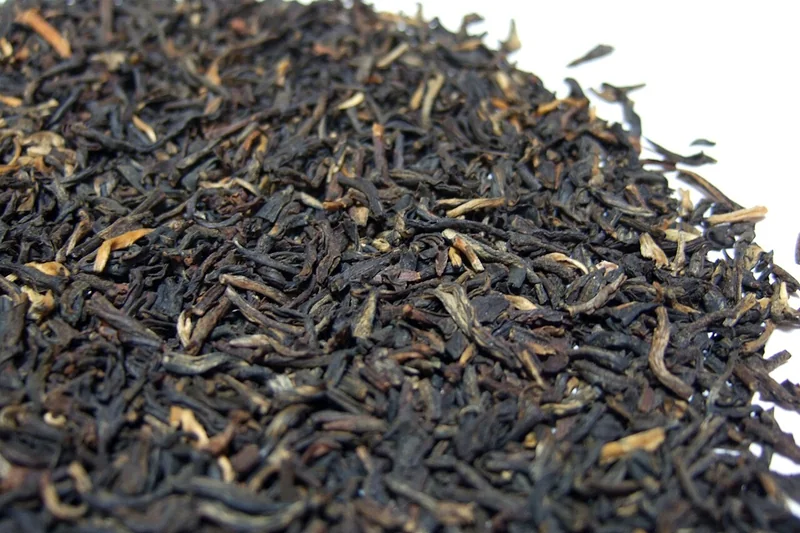
Yunnan Golden Buds (滇金芽, Diān Jīn Yá, or 金芽 jīn yá) is the premium apex of Yunnan black tea production, consisting entirely of single buds covered in golden-yellow trichomes (hairs) plucked from large-leaf Yunnan tea plants (Camellia sinensis var. assamica). Unlike Yunnan Dianhong (which uses buds and leaves), golden bud teas use only the terminal bud — the youngest, most tender growth point, which has the highest trichome density. After full oxidation, these trichomes turn golden, giving the dry tea a striking all-gold appearance. The resulting infusion is copper-amber, very low in astringency, with a distinctive malt-honey sweetness and a smooth, buttery body — quite different from the robust, tannic character of standard CTC Assam or even standard Dianhong.
Quick facts
- Type
- Tea
- Origin
- Yunnan Province, China (particularly Fengqing, Lincang, Mengku areas)
- Oxidation
- Black (full)
- Caffeine
- High
- Astringency
- Very low — bud-only tips have lower catechin than leaf tissue
- Sweetness
- High, honey-malt, almost caramel
- Body
- Medium, smooth and round
- Tasting notes
- honey, malt, cocoa, dried apricot, warm spice, buttery finish
What Makes a Golden Bud
The trichomes (fine hairs) on tea buds serve as a protective coating for the youngest, most tender growth tip. In most tea, these hairs are white or silver on the fresh leaf and remain white or silver in minimally processed teas like Bai Hao Yinzhen. When subjected to full oxidation (black tea processing), the trichomes undergo polyphenol oxidation and turn golden-yellow. The larger the leaf variety and the more trichome-dense the bud, the more dramatic this golden effect. Yunnan large-leaf assamica cultivars (particularly those from Fengqing County and Lincang Prefecture) produce buds with extremely dense trichome coverage — when these buds are fully oxidised, the resulting dry tea is striking: a mass of golden filaments that looks more like spun gold than conventional dry tea. This visual impact is deliberately cultivated as a luxury marker.
Production Economics and Grade Classification
Yunnan Golden Bud teas are extremely labour-intensive: only the terminal bud is picked (no first leaf, no second leaf), requiring approximately 10,000–15,000 individual bud picks per 100 grams of finished tea. This labour intensity, combined with the limited spring bud supply window, drives prices significantly above standard Yunnan Dianhong. The highest grades (sometimes called '100 percent golden tips' or '全金芽') use only buds with complete trichome coverage and consistent gold colour throughout the lot. Lower grades labelled as 'golden tips' or 'golden needle' may include some leaf material or have less consistent trichome coverage. Within the golden bud category, origin also matters: Fengqing and Mengku areas are particularly noted for large bud size and trichome density.
Brewing Character and Comparison
Yunnan Golden Buds brews at 90–95°C (cooler than standard black tea to preserve delicate sweetness) for 2–3 minutes. The liquor is clear copper-amber, often lighter in colour than expected given the dark, roasted-looking dry tea. The character is strikingly different from standard Assam or Kenyan CTC: very low astringency (bud tips contain less catechin than mature leaves), high sweetness with malt-honey notes, and a long, smooth finish. The tea can support 3–4 infusions. Compared to standard Yunnan Dianhong, golden buds are softer, sweeter, and less malty — lacking the bold body that makes Dianhong so popular as a morning tea. Golden buds are better suited to afternoon drinking without milk.
Sources & further reading (2)
- encyclopedia — accessed 2026-05-07
- encyclopedia — accessed 2026-05-07
Frequently asked questions
Why do the tips turn gold when oxidised?
The white or silver trichomes on fresh tea buds contain polyphenol compounds. When the leaf undergoes full oxidation during black tea processing, the polyphenol oxidase enzymes active in the trichome cells (and driven by wounding during withering and rolling) catalyse the oxidation of these compounds into theaflavins and thearubigins — the same compounds that turn the infusion amber. In the trichomes, this oxidation turns the white hairs golden-yellow. The same trichomes remain white in white tea because white tea minimises the oxidation step.
Are Yunnan Golden Buds the same as Yunnan Dianhong?
Yunnan Golden Buds and Yunnan Dianhong both originate from Yunnan Province using large-leaf assamica cultivars and black tea processing. The distinction is in harvest standard and grade: standard Dianhong uses bud-with-one-or-two-leaves harvest and produces a robust malty tea; golden bud teas use bud-only harvest and produce a much softer, sweeter, less astringent tea. Golden buds are a premium subset of the broader Dianhong category.
How do I identify genuine Yunnan Golden Buds?
Authentic Yunnan Golden Buds should show a dry leaf that is uniformly golden — individual needle-shaped buds covered in golden trichomes with no significant brown or black leaf material mixed in. The infusion should be clear amber (not cloudy). A key test is astringency: genuine all-bud golden tips are notably soft and non-astringent, unlike leaf-inclusive teas. Lots sold cheaply with only partial golden appearance likely include leaf material or have lower-quality trichome coverage.