Taiwanese Bubble Tea
Taiwan's global drink invention — tea shaken with ice and milk, topped with chewy tapioca pearls, consumed through a
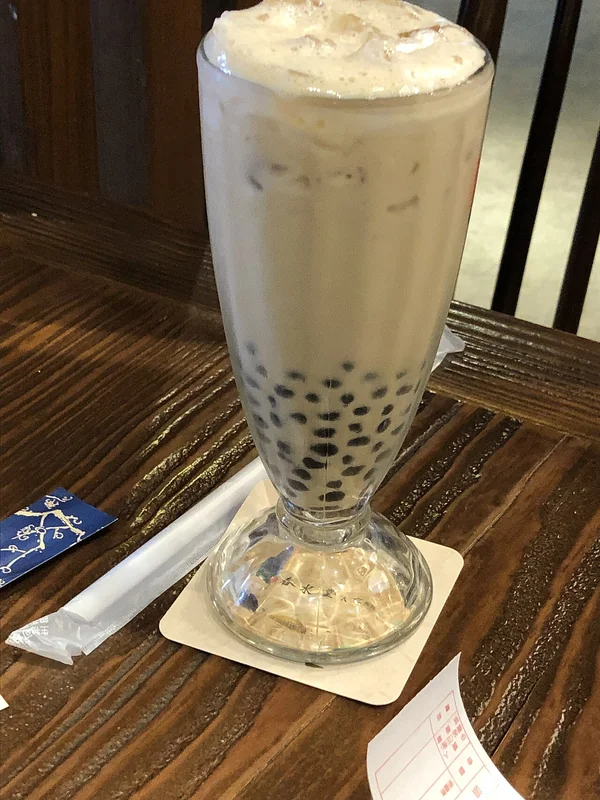
Bubble tea (珍珠奶茶, zhēn zhū nǎi chá, 'pearl milk tea') is a Taiwanese cold beverage consisting of tea (black, green, or oolong), milk or non-dairy creamer, sweetener, and ice, shaken together in a cocktail shaker to produce a frothy drink, then topped with cooked tapioca pearls (boba). The drink is served with an oversized straw wide enough for the pearls to be sucked through. Invented in Taichung, Taiwan, in the 1980s — with competing claims from Chun Shui Tang (春水堂) and Hanlin Tea Room — bubble tea became a global phenomenon by the 2010s, with tens of thousands of shops worldwide. The tapioca pearls (made from cassava starch) have a distinctive chewy texture (QQ texture in Taiwanese parlance) that is as central to the experience as the tea itself.
Quick facts
- Type
- Tea Culture
- Culture
- Taiwanese bubble tea
Origin: Chun Shui Tang and the 1980s Invention
The origin of bubble tea is claimed by two Taichung establishments. Chun Shui Tang (春水堂), founded by Liu Han-Chieh in 1983, claims their product manager Ms. Lin Hsiu Hui added tapioca balls to a cold milk tea at a company meeting in 1988, creating the first pearl milk tea. Hanlin Tea Room in Tainan claims their founder Tu Tsong-he independently created a similar drink around the same time using white tapioca pearls (later dyed black with brown sugar). Both established legal disputes in Taiwan over origin rights. Most tea historians acknowledge both as early pioneers, with Chun Shui Tang credited in most Western accounts for earliest commercial development. The 'bubble' in 'bubble tea' originally referred to the frothy bubbles produced by shaking the drink in a cocktail shaker — not to the tapioca pearls, which came later as a naming addition ('pearl' or 'boba').
Components and the QQ Texture
A standard bubble tea consists of four main components: the tea base (commonly black tea, green tea, or oolong), the milk component (whole milk, condensed milk, or non-dairy creamer), sweetener (simple syrup or fructose syrup), and toppings. Tapioca pearls (波霸, bōbà, or 珍珠, zhēnzhū) are made from cassava (tapioca) starch rolled into spheres 5–8 mm in diameter, cooked until translucent, then soaked in sugar syrup. The cooked pearl has a characteristic chewy, slightly elastic texture — called 'QQ' in Taiwanese food language — that is considered central to the experience. Variations on toppings include popping boba (liquid-filled spheres that burst in the mouth), grass jelly, aloe vera, pudding, and coconut jelly. Tea bases range from classic black tea with milk to fruit teas, taro, matcha, and other flavours. The global market has produced hundreds of flavour combinations.
Global Expansion and Industry
Bubble tea expanded from Taiwan across Asia in the 1990s, driven by Taiwanese diaspora communities and the spread of Taiwanese beverage culture to Hong Kong, Singapore, Malaysia, and mainland China. By the mid-2000s, the drink had significant presence in major Western cities. The global boom accelerated in the 2010s, with dedicated bubble tea chains (Gong Cha, Tiger Sugar, Yi Fang Taiwan Fruit Tea, The Alley, Coco Fresh) expanding internationally. By 2020, the global bubble tea market was valued at several billion US dollars, with projections for continued growth. Taiwan's original Chun Shui Tang opened international locations. The drink's visual impact — layers of milk, tea, and dark pearls visible through transparent cups, with a brightly coloured straw — made it highly photographable and well-suited to social media promotion, which significantly accelerated its international spread after 2012.
Sources & further reading (2)
- encyclopedia — accessed 2026-05-07
- encyclopedia — accessed 2026-05-07
Frequently asked questions
What does 'boba' mean and where does the term come from?
Boba (波霸) is a Taiwanese slang term that translates loosely as 'big breasts' — it was applied to the oversized tapioca pearls as a vulgar-humorous nickname. The term was used regionally in Taiwan and became widespread in Taiwanese-American communities in California (particularly Los Angeles) where the drink established an early foothold in the 1990s. 'Boba' is the most common term in the United States; 'bubble tea' is more common in Europe and much of Asia; 'pearl milk tea' (珍珠奶茶) is the formal Taiwanese name.
Are tapioca pearls made from tea plants?
No. Tapioca pearls are made from cassava (tapioca) starch — a tropical root crop (Manihot esculenta) native to South America, cultivated throughout tropical regions worldwide. The cassava starch is processed into a dough, rolled into spheres, cooked until they become translucent and chewy, and then sweetened. They have no connection to the tea plant (Camellia sinensis).
What is 'tiger sugar' (brown sugar) bubble tea?
Tiger Sugar refers to a style of bubble tea popularised by the Taiwanese chain Tiger Sugar (老虎堂) featuring black tapioca pearls soaked and caramelised in brown sugar syrup, served in a clear cup with the brown sugar syrup drizzled down the inside of the cup creating a 'tiger stripe' pattern, then topped with creamy milk or milk foam. It became a major social media trend in the late 2010s for its visual impact. The name 'tiger' refers to the stripe pattern. It is typically not shaken but layered, allowing customers to photograph the stripe pattern before mixing.