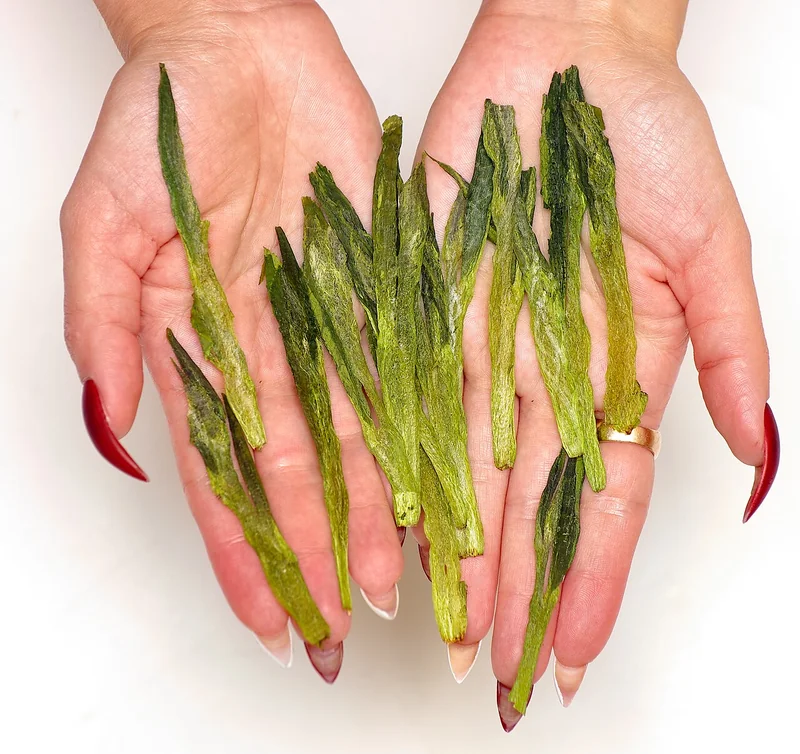
Taiping Houkui (太平猴魁, 'Taiping Monkey Chief') is a renowned Chinese green tea from Taiping County (now Huangshan City), Anhui Province, characterised by its unusually large flat leaves — typically 6–7 cm in length — that are pressed into a distinctive grid or crosshatch pattern during processing. The tea uses the Shijia cultivar (柿大茶), which produces unusually large leaves naturally. Unlike most Chinese green teas, Taiping Houkui is not rolled into pellets or spirals — the leaves are straightened, pressed flat between two layers of silk mesh, and dried. The resulting appearance is striking: long, dark green flat leaves with visible veins and a characteristic pressed texture.
Quick facts
- Type
- Tea
- Origin
- Taiping County (Huangshan City), Anhui Province, China
- Cultivar
- Shijia (柿大茶)
- Oxidation
- Green (unoxidised)
- Caffeine
- Medium
- Astringency
- Very low — large mature leaves and careful processing minimise astringency
- Sweetness
- Moderate, orchid-like
- Body
- Light to medium
- Tasting notes
- orchid floral, fresh grass, honey sweetness, mild vegetal, clean finish
The Shijia Cultivar and Leaf Size
Taiping Houkui owes its distinctive appearance entirely to the Shijia (柿大茶, 'persimmon big tea') cultivar — a large-leaf variety adapted to the mountain environment of Taiping County. Standard tea cultivars produce leaves of 3–5 cm; the Shijia cultivar grows leaves reaching 7–10 cm in the field. After harvest, the one-bud-with-two-leaves standard unit is significantly larger than other Chinese green teas. The picking standard is strict: only the appropriate bud with precisely the first and second leaf is selected, rejecting anything too mature or poorly formed. The large leaf size is not merely aesthetic — it influences the chemistry. Larger, slightly more mature leaves have different cell wall structures than very young buds, contributing to the smooth, low-astringency character that distinguishes Taiping Houkui from more bud-heavy teas.
Processing: Flattening and the Grid Pattern
After harvest, Taiping Houkui undergoes an unusual processing sequence. The fresh leaves are first wilted briefly, then placed between two layers of fine wire mesh or silk screen and pressed flat in a specific arrangement — the leaves aligned lengthwise, the pressing creating the visible cross-pattern on the leaf surface. This pressed configuration is then dried in a low-temperature oven. The resulting flat leaf retains the grid or crosshatch imprint from the pressing screen, which is both a quality indicator and a distinctive visual marker of authentic production. Cheaper imitations may use larger leaves from other cultivars pressed into similar shapes, but the flavour profile and the Shijia cultivar's specific veining are not replicable without the original plant material. Authentic Taiping Houkui is produced only within a defined geographical area of Huangshan City.
Brewing and Aesthetics
Taiping Houkui is frequently brewed in a tall, transparent glass rather than a teapot — allowing the dramatic vertical unfurling of the long flat leaves to be observed as an aesthetic experience. The leaves are placed upright in the glass, hot water (75–80°C) is poured down the side, and the leaves slowly expand and sink as they rehydrate. The infusion is very pale green, almost transparent, with a delicate orchid-floral aroma and a smooth, sweet character. The low catechin concentration in the large leaves means the tea can withstand longer steeping without becoming bitter. Two to three infusions are typically possible before flavour fades. Taiping Houkui is awarded annually at China's famous tea competitions and holds status as one of China's Ten Famous Teas in multiple official lists.
Sources & further reading (2)
- encyclopedia — accessed 2026-05-07
- encyclopedia — accessed 2026-05-07
Frequently asked questions
Why are Taiping Houkui leaves so large?
The large size results from the Shijia (柿大茶) cultivar, which naturally produces leaves significantly larger than standard Chinese tea cultivars. This cultivar is adapted to the mountain environment of Taiping County and produces leaves up to 7–10 cm long in the field. After the pressed-flat processing, the brewed leaf can appear exceptionally large in a glass — this visual drama is part of the tea's appeal and is intentionally showcased by brewing in transparent tall glasses.
What does 'Monkey Chief' mean in the name?
The name Taiping Houkui translates roughly as 'peaceful/taiping area monkey chief.' The 'monkey' (hou, 猴) component has two explanations: one connects it to Monkey Pit (猴坑, Hóu Kēng), the specific village associated with the highest-quality production within Taiping County; the other references local legend about monkeys picking the highest-quality tea from steep mountain terrain. The 'chief' (kui, 魁) implies superiority within the category — 'chief among monkey teas' or more loosely, 'the finest of its type.'
How do I identify authentic Taiping Houkui?
Authentic Taiping Houkui shows long, flat leaves (5–7 cm) with a subtle grid or crosshatch pressing pattern from the wire mesh drying screens. The colour is dark olive-green with visible white veins. The infusion is very pale, almost water-clear green. The aroma should be a subtle orchid floral with fresh grass. Very cheap versions using non-Shijia cultivar leaves pressed into similar shapes will typically lack the characteristic flavour and may show different vein patterns. Geographic origin marking (Taiping County, Huangshan City, Anhui) is a starting marker for authenticity.