Shou Mei
China's third-grade white tea — coarser leaves and buds with more colour and body than Silver Needle or White Peony.
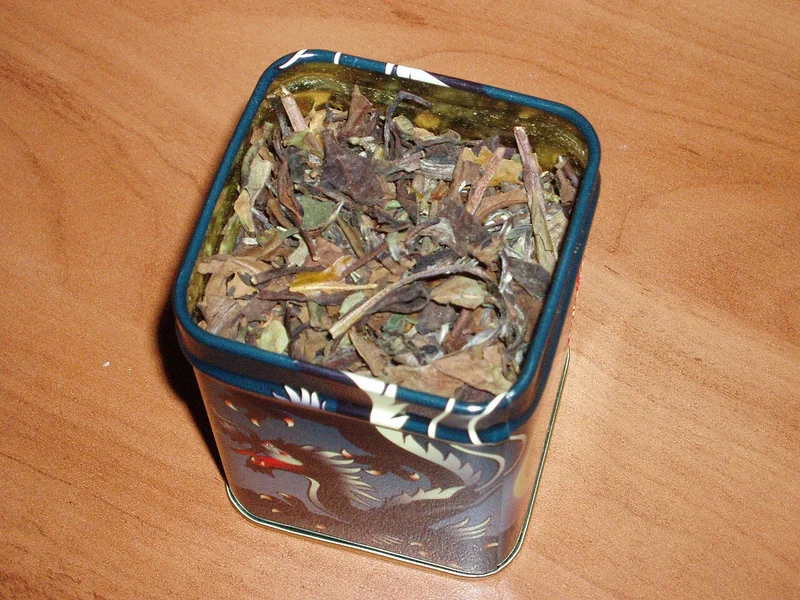
Shou Mei (寿眉, 'Longevity Eyebrow') is the third-grade white tea in the Chinese white tea hierarchy, produced from the coarser, more mature leaves of Camellia sinensis that fall below the picking standards for Bai Hao Yinzhen (Silver Needle) and Bai Mudan (White Peony). The name refers to the curled leaf shape, which was thought to resemble an old man's eyebrow. Shou Mei contains higher proportions of stems and mature leaf tissue, which produce a darker, more amber infusion and a more full-bodied, earthy character than the premium grades. Processing follows white tea method — extended outdoor withering followed by gentle drying — without rolling or kill-green.
Quick facts
- Type
- Tea
- Origin
- Fuding and Zhenghe Counties, Fujian Province, China
- Oxidation
- White (minimal)
- Caffeine
- Low
- Astringency
- Moderate — more than Silver Needle or White Peony due to mature leaf
- Sweetness
- Moderate, with honey and dried fruit notes in aged versions
- Body
- Medium — fuller than premium white teas
- Tasting notes
- dried hay, honey, subtle earthiness, dried fruit, warm wood in aged versions
Leaf Composition and Processing
Shou Mei is made from the third or fourth leaf and associated stem material that results from the same plants and picking cycles that produce Bai Hao Yinzhen and Bai Mudan at the same time of year. When tea pickers harvest the top bud (Silver Needle standard) or bud-with-first-leaf (White Peony standard), the remaining leaf material below — the second, third, and sometimes fourth leaves, which are more mature and less delicate — accumulates as the Shou Mei grade. The leaf colour is more olive-green and yellow-green than the white-tipped buds of Silver Needle. Processing is identical to other white teas: extended withering (72–96 hours) outdoors or in controlled withering rooms at 20–25°C with good airflow, followed by low-temperature drying. No rolling, no kill-green firing. The resulting dry leaf is a mixture of olive, brown, and white leaf and stem material with significant variation in colour within a single lot.
Aged Shou Mei as a Collector's Tea
The aged white tea market (老白茶, lǎo bái chá) has expanded rapidly since approximately 2010 as Chinese and international collectors recognised parallels between aged white tea and aged pu-erh: both undergo slow post-production transformation through long-term storage, developing new flavour compounds, reducing astringency, and gaining complexity. Shou Mei is particularly suited to aging because its thicker, more mature leaf structure withstands the slow transformation better than the delicate Silver Needle buds, which can degrade with improper storage. Aged Shou Mei (5–15+ years) develops dried jujube, honey, and wood notes, transforms from greenish-amber to deep amber or dark brown liquor, and increases in market value. Compressed Shou Mei cakes (shou mei bing, pressed into rounds like pu-erh) are a major segment of the aged white tea market.
Market Position and Value
As the third-grade white tea, Shou Mei commands significantly lower prices than Silver Needle or White Peony in new-production form. This price difference makes it the most accessible white tea for everyday drinking and high-volume brewing. It is also frequently used in blends where white tea character is desired without premium pricing. However, the aged Shou Mei market inverts this value relationship: well-stored, authentically aged Shou Mei (10+ years) from reputable producers can command prices exceeding fresh Silver Needle. The challenge in the aged Shou Mei market is authenticity — artificial aging (storing in humidified environments to accelerate development) is widespread and difficult to detect without laboratory analysis or deep knowledge of authentic aged white tea character.
Sources & further reading (2)
- encyclopedia — accessed 2026-05-07
- encyclopedia — accessed 2026-05-07
Frequently asked questions
Is Shou Mei lower quality than Bai Mudan and Silver Needle?
As fresh tea, Shou Mei is the third grade of white tea, using more mature leaf material with more body and less delicacy than the premium grades. However, quality is relative to purpose: for everyday high-volume brewing, Shou Mei is often preferred for its fuller body and lower price. For aging, Shou Mei is arguably the superior choice due to its robust leaf structure. The grading hierarchy reflects the picking standard and delicacy, not an absolute judgement of worth.
Can Shou Mei be aged like pu-erh?
Yes, and this is the main direction of premium Shou Mei storage. Like pu-erh, Shou Mei undergoes slow post-production transformation when stored in cool, dry conditions with good airflow. Over 3–15+ years, the character shifts from grassy-honey to dried fruit, jujube, and warm wood. Compressed Shou Mei cakes (pressed into round bing discs) are the format most associated with aging, as compression slows the transformation relative to loose-leaf storage. Storage conditions (humidity, temperature, air circulation) significantly affect the outcome.
What does Shou Mei taste like compared to Bai Mudan?
Shou Mei is fuller-bodied and less delicate than Bai Mudan. Bai Mudan (White Peony) has a bud-with-one-leaf standard, producing a tea with noticeable bud sweetness and clean floral notes. Shou Mei, from more mature leaf material, has more body, more earthiness, and more astringency — a warmer, more full cup that lacks the delicate floral top notes of White Peony. In aged form, the differences become more pronounced: aged Shou Mei develops robust jujube and caramel complexity, while aged Bai Mudan retains more floral character.