Korean Hwangcha
Korea's semi-oxidized yellow-green tea — a mellow, distinctive style between green and oolong, often called Korean
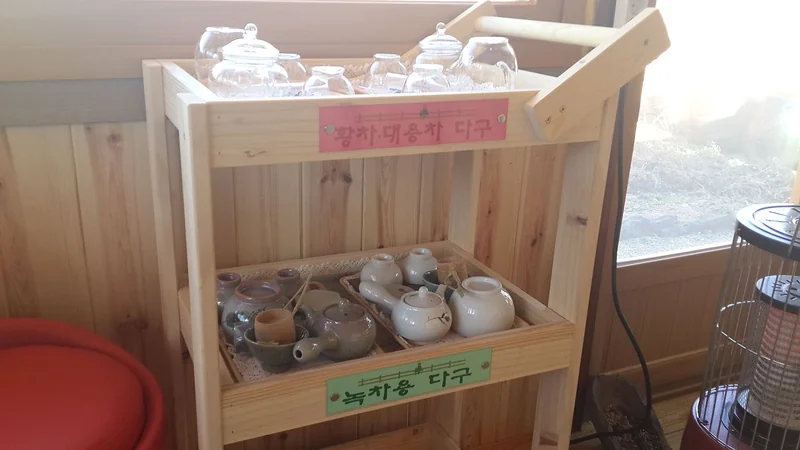
Hwangcha (황차, 黃茶, 'yellow tea') is a Korean semi-oxidized tea that occupies a position between green tea and oolong. Unlike Chinese yellow teas (which undergo a specific smothering step called menhuang), Korean hwangcha achieves its yellow-amber character through intentional partial withering and mild oxidation of the leaf before firing. The result is a tea that lacks the astringency of green tea and the pronounced oxidised character of oolong — instead producing a mellow, soft, honey-like sweetness with subtle earthy and woody notes. Hwangcha is produced primarily in Hadong, South Gyeongsang Province, and Boseong, South Jeolla Province.
Quick facts
- Type
- Tea
- Origin
- Hadong, South Gyeongsang Province; Boseong, South Jeolla Province, Korea
- Oxidation
- Oolong (partial)
- Caffeine
- Medium
- Astringency
- Very low — partial oxidation reduces catechin sharpness
- Sweetness
- Moderate, honey-like
- Body
- Light to medium
- Tasting notes
- honey, dried fruit, mild earthiness, subtle woody, light floral
Processing and Oxidation
Hwangcha processing begins with the fresh-picked Korean tea leaf (from Camellia sinensis var. sinensis adapted to Korean growing conditions) and intentionally allows partial wilting and mild oxidation before the kill-green step. The leaf is typically spread and left to partially oxidise at controlled temperature and humidity for several hours — longer than green tea but far less than a full oolong. During this window, cellular enzymes begin oxidising catechins, developing the honey-amber colour and mellowing the grassy sharpness of fresh leaf. The tea is then pan-fired or steamed to halt oxidation, then rolled and dried. Some producers use a traditional charcoal-fired Korean iron wok (musoha) for the roasting stage, adding a subtle smoky warmth. The final leaf colour ranges from olive-green to amber-brown, and the infusion is typically amber-gold.
Distinction from Chinese Yellow Tea
Chinese yellow tea (huangcha, 黄茶) — including Junshan Yinzhen and Mengding Huangya — uses a specific 'smothering' step called menhuang (闷黄) in which newly kill-greened leaves are wrapped in cloth or paper and allowed to yellow through a mild non-oxidative process driven by residual heat and moisture. Korean hwangcha's yellowing comes primarily from partial oxidation before the kill-green step — a mechanistically different process that produces somewhat different flavour compounds. The resulting taste is also different: Chinese yellow teas tend toward a mellow, slightly fermented quality, while Korean hwangcha has a brighter, more honey-forward character. The shared yellow-amber colour is the primary resemblance. Neither should be confused with the Chinese category simply because of shared colour.
Cultural and Commercial Context
Hwangcha emerged as a documented Korean tea category in the 20th century revival of Korean tea culture. Before the Joseon dynasty's suppression of Buddhist tea practice and the Japanese colonial period, Korean tea traditions did not formally categorise teas in the same way as Chinese or Japanese systems. The modern Korean tea revival — beginning in the 1970s — led to systematic exploration of what Korean tea could be beyond Japanese-influenced green tea production. Hwangcha was developed as a distinctively Korean style suited to the Korean leaf and production environment. It is now marketed as a premium Korean alternative for drinkers who find Korean green tea too astringent but want to remain within the Korean tea tradition. Specialty shops in Seoul and Busan stock multiple hwangcha producers, and Hadong's hwangcha has achieved some recognition in international specialty tea markets.
Sources & further reading (2)
- encyclopedia — accessed 2026-05-07
- regional-authority — accessed 2026-05-07
Frequently asked questions
Is hwangcha the same as Chinese yellow tea?
No. Both are called 'yellow tea' and share amber-gold colours, but the processing is fundamentally different. Chinese yellow tea uses a smothering (menhuang) process after kill-green to create mild non-oxidative yellowing. Korean hwangcha achieves its yellow-amber character through intentional partial oxidation before kill-green — closer to a very light oolong process. The flavour profiles also differ: Chinese yellow tea tends toward mellowness and subtle sweetness, while Korean hwangcha has a honey-forward, slightly fruity character.
Where is hwangcha primarily produced in Korea?
Hadong County in South Gyeongsang Province and Boseong County in South Jeolla Province are the two main producing areas. Both regions have long histories of Korean green tea production (sejak, ujeon) and Camellia sinensis cultivation. Hadong in particular — associated with historical wild tea plants in the Jirisan mountain area — has several specialty producers making small-batch hwangcha. The climate of these coastal and mountain areas provides suitable conditions for the semi-oxidation step.
How should hwangcha be brewed?
Hwangcha is brewed at slightly higher temperatures than Korean green tea — approximately 75–85°C with a 60–90 second steep. The partial oxidation makes it more tolerant of higher temperatures than green tea without becoming bitter. Multiple infusions (3–4) are possible, with the later infusions becoming progressively softer and sweeter. Traditional Korean darye-style brewing in a small ceramic teapot with minimal leaf quantity and careful attention to water temperature is the preferred approach among enthusiasts.