Eastern Beauty Oolong (Bai Hao)
Taiwan's bug-bitten oolong — 60–70% oxidized through leafhopper feeding that triggers unique honey-muscatel sweetness.
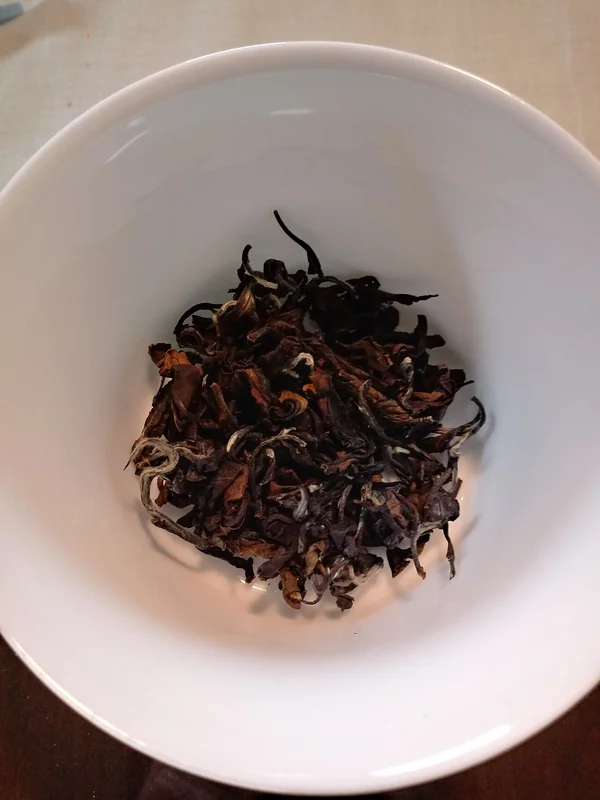
Eastern Beauty (東方美人, Dōngfāng Měirén, also known as Bai Hao oolong, Oriental Beauty, or Peng Feng Cha 膨風茶 'boastful tea') is a Taiwanese heavily-oxidized oolong distinguished by a unique production requirement: the young tea shoots must be bitten by the green leafhopper (Jacobiasca formosana) before harvest. The insect's feeding triggers a defensive biochemical response in the tea plant — the production of volatile compounds called monoterpene diols and hotrienol — which are responsible for Eastern Beauty's signature honey, muscatel, and fruity aromatic complexity.
Quick facts
- Type
- Tea
- Origin
- Taiwan (Hsinchu County, Miaoli County; also produced in Taoyuan, Yilan)
- Oxidation
- Oolong (partial)
- Caffeine
- Medium
- Astringency
- Low — high oxidation reduces catechins significantly
- Sweetness
- High — pronounced honey and muscatel sweetness from leafhopper biochemistry
- Body
- Medium to full
- Tasting notes
- honey, muscatel grape, ripe peach, rose, warm spice, light malt
The Leafhopper Mechanism: Bug-Bitten Tea Science
The defining characteristic of Eastern Beauty — and what makes its production unique among Taiwanese oolongs — is deliberate dependence on Jacobiasca formosana (小綠葉蟬, 'small green leafhopper') feeding. This tiny insect, approximately 2–3 mm long, pierces young tea shoots and extracts sap from the phloem. In response, the tea plant activates a defence pathway producing volatile monoterpenes — specifically (Z)-3-hexenol, (E)-2-hexenal, and crucially the compounds hotrienol and linalool oxide — that deter further insect feeding. These defensive volatiles are the precursors to Eastern Beauty's characteristic honey and muscatel aroma: during the subsequent withering and oxidation process, enzymatic reactions convert these plant-defence compounds into the aromatic molecules that define the tea's sensory signature. The result is that unbitten leaf from the same plant, processed identically, produces a fundamentally different and less complex tea. Eastern Beauty production therefore requires maintaining leafhopper populations in the tea garden — which means rejecting pesticide use. Producers who seek Eastern Beauty quality work in certified organic or naturally managed gardens to allow leafhopper populations to establish.
Harvest Timing, Multi-Colour Appearance, and Processing
Eastern Beauty is harvested in summer (typically late June through August in Hsinchu County) — the warmest season, when leafhopper populations peak and feeding activity is highest. Only young one-bud-two-leaf shoots with visible leafhopper bite marks are selected; hand-picking is necessary because machine harvesting cannot discriminate between bitten and unbitten shoots. The multi-coloured appearance of finished Eastern Beauty — white bud tips, green leaf sections, yellow withered areas, brown and red oxidised sections — directly reflects the different oxidation states of bitten versus unbitten areas of the same leaf. Bitten areas wither and oxidise more rapidly; unbitten areas remain greener; the bud tip whitens during processing. Processing involves indoor withering (萎凋), gentle hand-tossing (浪青), partial oxidation to 60–70%, a brief pan-firing kill-green (殺青) step to halt oxidation, and drying — without the rolling step used in ball-rolled oolongs like Dong Ding or Alishan. The open-leaf style preserves the multi-colour visual effect.
Historical Names and Market Context
Eastern Beauty has accumulated several names reflecting its complex history. Peng Feng Cha (膨風茶, 'boastful tea' or 'braggart's tea') is the oldest local Hsinchu name — legend holds that a farmer who sold his bug-eaten tea at high price was accused of boasting (peng feng) by neighbours who thought damaged crops worthless. The name became ironic when the true cause of the premium quality was understood. Bai Hao (白毫, 'white hair') oolong refers to the prominent white bud tips visible in the finished tea. Oriental Beauty was the earlier English export name; Eastern Beauty is now more standard in specialty circles. The tea achieved international recognition in the early 20th century through British export markets, where it was reportedly served to Queen Elizabeth (the story of Queen Elizabeth is sometimes attributed to Elizabeth II, who reportedly named it 'Oriental Beauty' — though this attribution is disputed). Today Eastern Beauty commands among the highest prices of any Taiwanese oolong, with certified heavy-bitten harvests from Hsinchu's Emei and Beipu townships achieving premium market positions.
Sources & further reading (2)
- encyclopedia — accessed 2026-05-07
- encyclopedia — accessed 2026-05-07
Frequently asked questions
Does Eastern Beauty require pesticide-free cultivation?
Yes, as a practical requirement. Jacobiasca formosana leafhoppers (which must bite the shoots to trigger the aromatic response) are suppressed by pesticides. Producers who use conventional pesticide programmes destroy the leafhopper populations necessary for authentic Eastern Beauty production. This means genuine high-quality Eastern Beauty is grown in pesticide-free or certified organic gardens — making it one of the few teas where natural pest management is a direct quality requirement rather than an ethical marketing choice. The leafhopper-free tea from the same bushes in the same season would produce a competent but qualitatively ordinary oolong without the distinctive honey-muscatel character.
What is the right way to brew Eastern Beauty?
Eastern Beauty is typically brewed at 85–95°C — slightly higher than lightly oxidized oolongs because its 60–70% oxidation can withstand more heat without becoming harsh. A gaiwan or small teapot is traditional. Leaf-to-water ratios of 4–5 grams per 100 ml for gongfu cha, or 3–4 grams per 150 ml for Western-style brewing, work well. First infusion of 45–60 seconds, with subsequent infusions extended by 15–20 seconds each. 5–8 infusions are typical. The honey-muscatel character is most prominent in the first 2–3 infusions; later infusions reveal underlying fruit and spice notes.
How do I identify genuine Eastern Beauty from lower-quality imitations?
Genuine high-quality Eastern Beauty has several visual markers: abundant white bud tips throughout the dry leaf; a clear multi-colour appearance (white, green, yellow, brown, red tones visible simultaneously); an open, unrolled leaf structure. The liquor should be amber-golden to orange with exceptional clarity. The aroma should be distinctly honey and muscatel — if it smells primarily vegetal or grassy, leafhopper activity was minimal. Price is a reasonable quality signal: authentic heavily-bitten Eastern Beauty from Hsinchu's best townships is expensive. Suspiciously cheap 'Oriental Beauty' may be lightly oxidized oolong with a misleading label, or may use leaf with minimal leafhopper activity.