Chapan (Tea Tray)
The bamboo or wooden tea tray that collects rinse water and overflow — the draining platform central to gongfu cha.
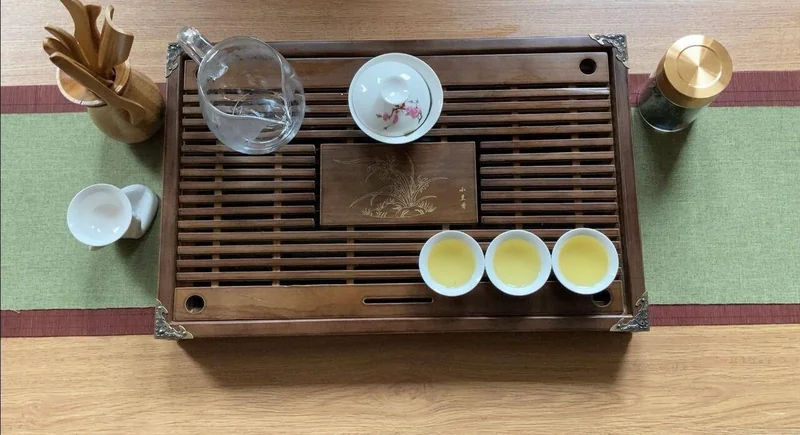
Chapan (茶盘, chá pán, 'tea tray' or 茶台, chá tái, 'tea platform') is the horizontal surface on which gongfu cha implements are arranged and where tea-rinsing water, overflow, and discarded initial infusions drain away. In Chinese gongfu cha practice, significant quantities of water are used beyond what ends up in the cup — the teapot, gaiwan, and cups are pre-warmed with boiling water, the first infusion is often discarded as a rinse, and water is frequently poured over the exterior of yixing teapots. All of this liquid collects on the chapan and drains into a reservoir below or through a connected tube.
Quick facts
- Type
- Tea Ware
Function in Gongfu Cha: Managing Waste Water
The volume of water used in gongfu cha preparation significantly exceeds the volume consumed. A typical session involving a 120 ml yixing teapot serving 3–4 cups involves: pre-heating the pot with boiling water (approximately 120 ml, discarded), pre-heating the cups (30–50 ml each, discarded), a first-infusion rinse of the tea (120 ml, typically discarded), and then multiple serving infusions. On a single-session basis, 400–600 ml of water may be discarded for every 200–400 ml consumed. Without a chapan with drainage capacity, this water management would be impractical at a table setting. The chapan's slatted bamboo or perforated wooden surface allows water to pass through immediately; the tray beneath either connects to a drainage tube leading to a bucket below the table, or incorporates an integrated reservoir container (typically 1–2 litres) that is emptied periodically. In home settings, the tube-to-bucket configuration is most practical; in tea shop settings, some chapan are plumbed into sink drainage.
Materials and Design Variants
Chapan are produced in several materials, each with different aesthetic and practical characteristics. Bamboo: the traditional and most common material — lightweight, naturally water-resistant, warm in appearance, and easy to clean. High-quality bamboo chapan are carved or assembled from solid bamboo strips rather than pressed bamboo board. Rosewood and other hardwoods: premium wooden chapan from carved hardwood (zitan, 紫檀; huali, 花梨; or similar) are significant decorative objects in their own right, often featuring carved relief designs (dragons, cloud patterns, bamboo motifs) and sealed with natural oils for water resistance. Stone and slate: dark stone chapan (black slate, purple-clay stone) give a minimalist, contemporary aesthetic that pairs well with modern ceramic tea ware. Ceramic chapan with integrated drainage exist in workshop styles. The connection between the chapan's drainage hole and the waste container below can be via a silicone tube, a bamboo cylinder, or (in built-in designs) a concealed pipe. The most functional chapan for active use prioritise rapid, complete drainage; the most ornamental prioritise visual integration with high-end tea ware collections.
Size, Layout, and the Organised Tea Table
The chapan determines the available working surface for a gongfu cha session and thus governs what equipment can be simultaneously accessible. A compact personal chapan (30×20 cm) accommodates a small gaiwan or 60–100 ml yixing pot plus two cups — suitable for solo sessions. A standard household chapan (40×25 cm) handles a 120–150 ml teapot and four cups. Large communal or tea shop chapan (60×40 cm or larger) can accommodate a teapot, fairness cup (gong dao bei), six to eight cups, and presentation vessels simultaneously. On the chapan surface, the traditional arrangement places the teapot at the rear-centre, cups in front and to the sides, and the cha dao (tool set including cha ze, cha zhen, cha clip) to one side. The fairness cup or gong dao bei sits adjacent to the teapot for pouring infusions before distributing to cups. The chapan's edges provide natural boundaries for this layout and prevent implements from sliding.
Sources & further reading (2)
- encyclopedia — accessed 2026-05-07
- encyclopedia — accessed 2026-05-07
Frequently asked questions
Do I need a chapan for gongfu cha?
A chapan is not strictly required — some practitioners use a large ceramic plate or a cloth tea mat (cha bu, 茶布) — but a proper chapan with drainage makes gongfu cha significantly more practical for home use. Without drainage, the table surface accumulates rinse water and requires constant wiping. For occasional or simple brewing, a cloth mat absorbs minor overflow; for regular gongfu cha with significant rinsing and discarding, a chapan with integrated drainage is the most practical solution. Most serious gongfu cha practitioners consider a chapan essential infrastructure.
How do I clean a bamboo chapan?
Rinse the chapan with hot water after each session and allow it to dry completely in a well-ventilated area. Tea tannins will gradually stain the bamboo to a deeper, richer colour — this is considered normal and desirable patina. Do not use soap or detergent on an unsealed bamboo chapan, as it can penetrate and impart off-flavours. Periodically clean the drainage tube with hot water to prevent mould growth. Some bamboo chapan benefit from an occasional light oiling with food-safe oil to maintain the wood's integrity. Stone and ceramic chapan tolerate more direct cleaning and are easier to sterilise.
What is the difference between a chapan and a cha xi?
A chapan (茶盘) is the functional drainage tray — the working surface of the tea table where brewing happens. A cha xi (茶席, 'tea seat' or 'tea arrangement') is a broader aesthetic concept referring to the complete visual composition of the tea brewing space — including the chapan, the tea ware, a cloth runner, natural objects (stones, bamboo, seasonal flowers), and the overall spatial arrangement. Cha xi is as much art installation as functional setup; chapan is specifically the tray component. A cha xi always includes a chapan or a substitute surface; a chapan can exist independently of any broader cha xi aesthetic intent.