Anji Bai Cha
A Zhejiang green tea from a white-leaf cultivar — almost white leaves turn vivid green at harvest, producing
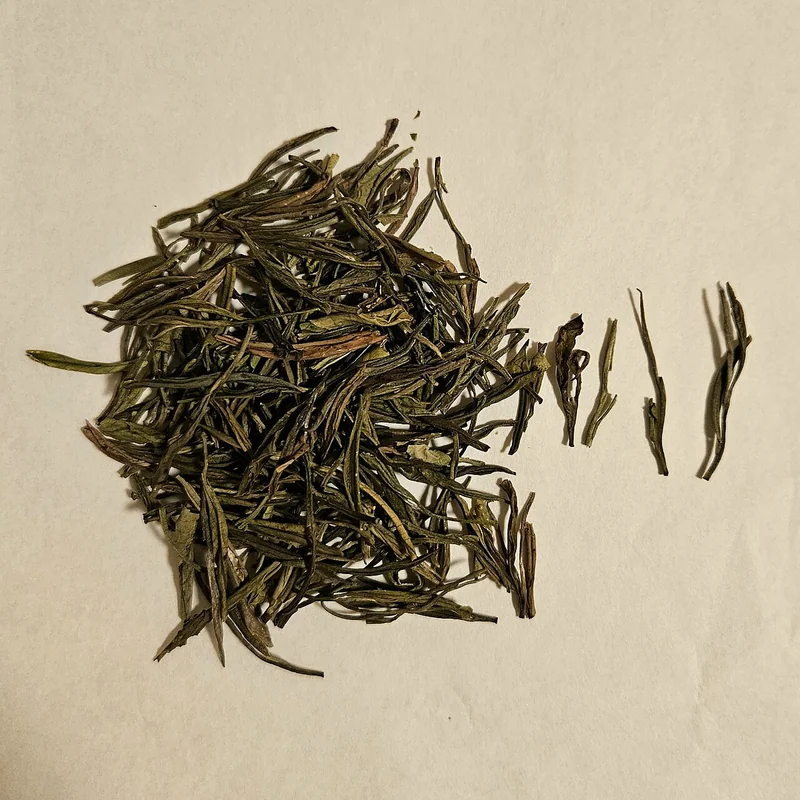
Anji Bai Cha (安吉白茶, 'Anji White Tea') is a Chinese green tea from Anji County, Zhejiang Province — named for its striking white-leaf cultivar (Bai Ye 1 Hao, 白叶一号) whose leaves emerge almost completely white during the narrow spring harvest window. Despite its name containing 'white,' Anji Bai Cha is processed as a green tea, not a white tea. The white-leaf phenotype is caused by a temperature-sensitive gene (CsUGT1) that inhibits chlorophyll production at temperatures below 23°C — so the early spring leaves are pale, almost white-yellow, before temperatures rise and the leaves green up. This albino-like spring flush is when the tea is harvested.
Quick facts
- Type
- Tea
- Origin
- Anji County, Zhejiang Province, China
- Cultivar
- Bai Ye 1 Hao (白叶一号)
- Oxidation
- Green (unoxidised)
- Caffeine
- Medium
- Umami
- Very high — abnormally high theanine from albino phenotype
- Astringency
- Exceptionally low — reduced catechin due to suppressed chlorophyll synthesis
- Sweetness
- Very high, clean
- Body
- Light
- Tasting notes
- orchid floral, fresh bamboo, sweet grass, clean umami, honey
The White-Leaf Phenomenon
The Bai Ye 1 Hao (白叶一号, 'white leaf number one') cultivar was discovered growing as a wild plant in Tianhuang Village, Anji County, in 1982. The plant's leaves were almost white in spring and were initially thought to be a disease. Research revealed it was a natural genetic variant producing a temperature-sensitive albino phenotype — at temperatures below approximately 23°C, chlorophyll synthesis is suppressed, leaving the leaves pale yellow-white. When spring temperatures rise above this threshold (typically by late April), the same leaves turn green and lose their exceptional qualities. The harvesting window is therefore extremely narrow: typically only 20–30 days in early spring (before Grain Rain, guyu) when temperatures remain cool enough to maintain the white-leaf character. This timing, combined with hand-picking requirements, makes authentic Anji Bai Cha expensive despite being a relatively modern tea (commercial production began only in the 1990s).
Processing as Green Tea
Despite its common name 'Anji White Tea,' the processing is standard Chinese green tea: the fresh leaves are withered briefly, then pan-fired (kill-green) in a wok or machine to halt oxidation, then shaped by rolling into a flat form similar to Longjing (two-leaf-and-bud format flattened), and finally dried. No withering beyond the standard green tea wither, no white tea processing (which would involve extended outdoor withering). The finished dry leaf ranges from pale green-white to light green depending on how white the harvested leaves were. The name 'bai cha' in the product name refers to the white leaf colour of the plant, not the processing category. Consumers unfamiliar with this distinction sometimes confuse it with Fujian white tea (bai mudan, bai hao yinzhen), which is an entirely different product.
Flavour Profile and Commercial Position
Anji Bai Cha's extraordinary theanine concentration produces a sweetness and umami depth comparable to gyokuro without any of the marine-seaweed character associated with Japanese shaded teas. The flavour is clean, floral, and almost syrupy in sweetness at optimal brewing temperatures (70–75°C). Astringency is essentially absent. This combination — extreme sweetness, high umami, low bitterness — makes Anji Bai Cha particularly accessible to drinkers who find other high-quality green teas too bitter. The tea has experienced rapid commercial growth since the 1990s, with Anji County now producing significant volumes and its Bai Ye 1 Hao cultivar being transplanted to other growing regions (Guizhou, Sichuan) where similar phenotypes can be produced.
Sources & further reading (2)
- encyclopedia — accessed 2026-05-07
- encyclopedia — accessed 2026-05-07
Frequently asked questions
Is Anji Bai Cha a white tea or a green tea?
It is a green tea, despite its name. The 'white' (bai) in the name refers to the white-leaf colour of the cultivar in spring, not to the white tea processing method. White tea (like Bai Hao Yinzhen or Bai Mudan) involves extended outdoor withering and minimal processing. Anji Bai Cha is pan-fired and rolled like green tea. The confusion is common and important to clarify when purchasing, as the two categories are completely different in flavour, caffeine, and processing.
Why is the harvest window for Anji Bai Cha so short?
The white-leaf phenotype only occurs when temperatures remain below approximately 23°C — a condition that exists for just 20–30 days in early spring in Anji County before warming temperatures trigger chlorophyll production and the leaves turn green. Once the leaves green up, the theanine-to-catechin ratio normalises and the exceptional flavour characteristics disappear. Only the early spring, pre-guyu (Grain Rain) harvest is authentic white-leaf Anji Bai Cha. Later harvests from the same plant produce standard green tea.
What does Anji Bai Cha taste like compared to Longjing?
Both are flat Chinese green teas from Zhejiang Province, but the flavour profiles differ significantly. Longjing has a characteristic chestnut-roasted sweetness from its pan-firing method and produces a slightly more complex, slightly more astringent cup. Anji Bai Cha is sweeter, cleaner, and more umami-forward with essentially no astringency — the white-leaf cultivar's high theanine makes it softer and more delicate. Anji Bai Cha is sometimes described as having a 'pure' sweetness that Longjing does not match.