Alishan Oolong
Taiwan's beloved high-mountain oolong from the Alishan range — creamy, floral, and bright green, produced above 1000
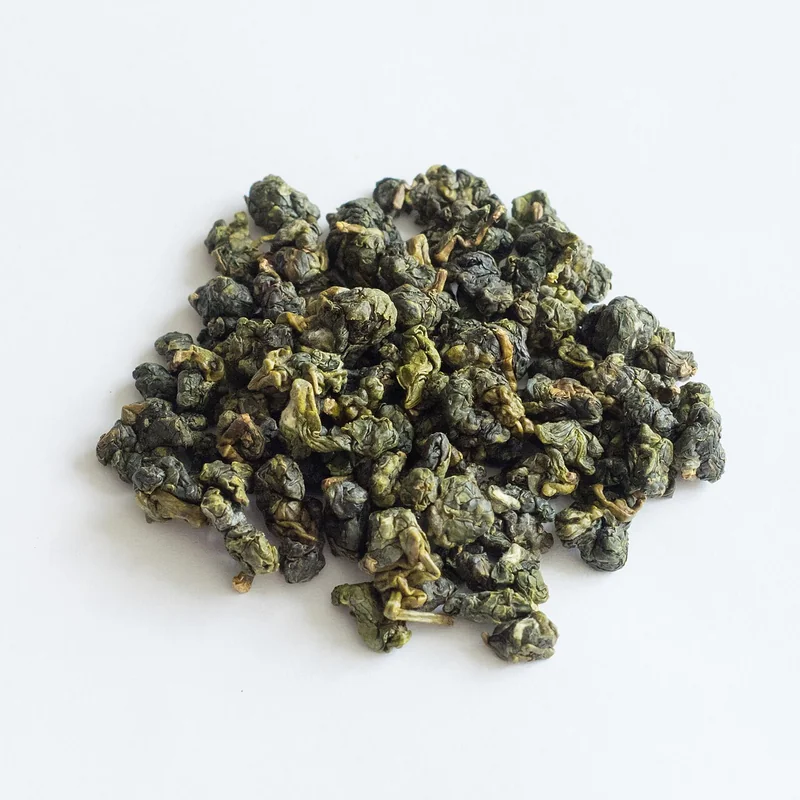
Alishan oolong is produced in the Alishan mountain range of Chiayi County, Taiwan, at elevations between 1000 and 1600 metres above sea level. It is one of Taiwan's most produced and internationally recognised high-mountain oolongs (高山茶, gāoshān chá), a category defined by cultivation above 1000 metres. The high altitude, mist, cooler temperatures, and volcanic soil of the Alishan area slow leaf growth, concentrating aromatic compounds and reducing bitterness. Alishan oolong is lightly oxidised (15–25%) and lightly roasted, producing tightly rolled green pellets that brew a bright, clear green-gold liquor with a creamy, buttery character, prominent floral notes (gardenia, osmanthus), and significant sweetness. Spring (April–May) and winter (November) harvests are the most prized.
Quick facts
- Type
- Tea
- Origin
- Alishan mountain range, Chiayi County, Taiwan
- Cultivar
- Qingxin Oolong (青心烏龍), Jin Xuan (金萱)
- Oxidation
- Oolong (partial)
- Caffeine
- Medium
- Astringency
- Very low — high altitude and light oxidation minimise astringency
- Sweetness
- High, creamy-sweet
- Body
- Light to medium
- Tasting notes
- gardenia, osmanthus, creamy butter, fresh green, honey
High-Mountain Tea and the Altitude Effect
Taiwan's high-mountain tea (gaoshaan cha) designation applies to teas grown above 1000 metres, and Alishan is one of the most established areas within this category. The critical altitude effect involves multiple variables: cooler temperatures throughout the growing season slow leaf metabolism, increasing the accumulation of aromatic precursors; more cloud cover and mist reduces solar radiation, shifting the plant's photosynthetic investment toward theanine (contributing sweetness and umami) rather than catechins (contributing astringency and bitterness); and the day-night temperature variation (diurnal range) in mountain environments concentrates fragrance compounds that would otherwise volatilise in warmer lowland conditions. Alishan gardens in the Tefuye and Shanmei areas (the highest-altitude subzones) are particularly noted for the concentration of these effects.
Processing and the Tightly Rolled Green Pellet
Alishan oolong processing follows the standard Taiwanese ball-rolled oolong sequence: fresh-picked leaf is withered in the sun briefly, then indoors; gentle hand or machine tossing bruises the leaf edges to initiate selective oxidation (to 15–25%); a kill-green step halts oxidation; the leaf is then repeatedly kneaded and rolled into tight spherical pellets, interspersed with resting periods that compact the shape further; finally, baking at low temperature to remove residual moisture. The tightly rolled ball shape is significant: it preserves the leaf's aromatic compounds during storage far more effectively than strip-form oolongs, and the unfurling of the ball during brewing is a key part of the gongfu cha aesthetic. The finished dry leaf is dark olive-green to jade-green, with individual pellets 3–6 mm in diameter.
Spring vs. Winter Harvest
Alishan oolong is produced in multiple harvests: spring (Li Chun, April–May), summer, fall, and winter (around November). Spring and winter harvests command the highest quality and prices. Spring tea benefits from the plant's accumulated stored energy after winter dormancy — the first flush produces highly aromatic, complex leaves. Winter tea, harvested after cooler autumn temperatures have further slowed growth and concentrated aromatic compounds, is prized for its particularly intense floral character and sweetness — often described as having a more 'cold fragrance' (冷香, lěng xiāng) quality. Summer teas are produced for volume but are considered lower quality. Many premium Alishan producers label their spring and winter harvests separately.
Sources & further reading (2)
- encyclopedia — accessed 2026-05-07
- encyclopedia — accessed 2026-05-07
Frequently asked questions
What is the difference between Alishan and Li Shan oolongs?
Both are Taiwanese high-mountain oolongs, but Li Shan (梨山, 'Pear Mountain') is produced at higher average elevation (1800–2600 m) in Taichung County — significantly higher than most Alishan gardens (1000–1600 m). The greater altitude of Li Shan produces an even more concentrated floral-sweet character and a more 'cold' fragrance quality. Li Shan is generally more expensive and considered the apex of Taiwan high-mountain oolong. Alishan is more widely available and produced in larger quantities.
Which cultivar is used for Alishan oolong?
Two main cultivars: Qingxin Oolong (青心烏龍, 'Green Heart Oolong') is the traditional cultivar associated with the finest Alishan oolong, with a delicate, complex floral character. Jin Xuan (金萱, TRES #12) is a modern cultivar known for producing a characteristic creamy, sometimes milk-like sweetness — Jin Xuan Alishan is popular for this buttery quality. Both are tightly rolled into pellets by the same processing sequence.
How many times can Alishan oolong be re-steeped?
Good quality Alishan oolong can be re-steeped 5–8 times in gongfu cha style. The tightly compressed ball pellets release flavour gradually as the leaf unfurls — typically not fully open until the second or third infusion. Successive infusions evolve from more aromatic and floral (early) to more sweet and body-forward (middle) to more light and clean (later). The full multiple-infusion character is a key reason why high-mountain oolongs are valued in gongfu cha contexts.