Place
Yggdrasil
The World Tree of Norse mythology, an immense ash tree at the centre of the cosmos.
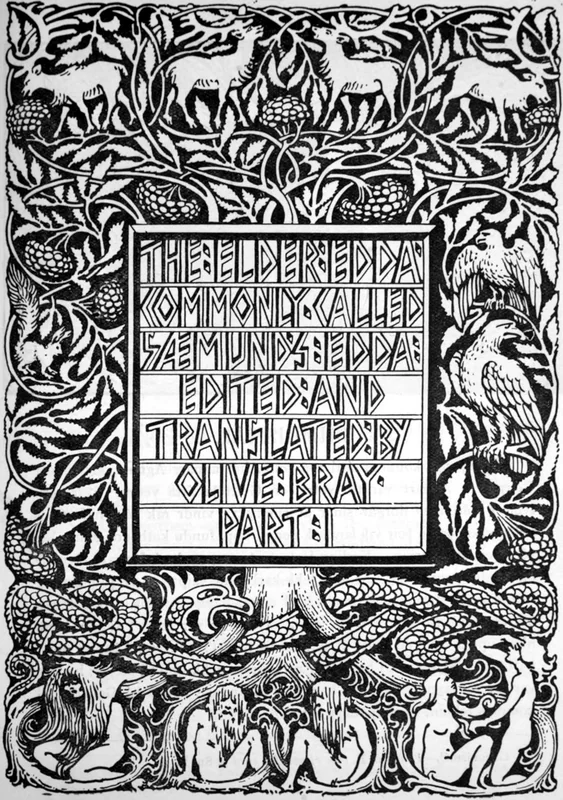
Yggdrasil (Old Norse: Yggdrasill) is the immense ash tree (or possibly yew tree) at the centre of the Norse cosmos, connecting the nine worlds. Its three roots reach to the well of Urðr (the Norns' well, in Ásgarðr), the well of Mímir (in Jötunheimr), and Hvergelmir (the spring in Niflheim). The eagle, the serpent Níðhöggr, and the squirrel Ratatoskr are among its inhabitants. Odin hung from it for nine days to discover the runes. It will tremble and groan at Ragnarök but survive. Yggdrasil is described in detail in the Poetic Edda (Völuspá, Grímnismál) and Snorri's Prose Edda.
Quick facts
- Pantheon
- Norse
- Figure type
- Place
- Period
- Attested in Norse literary sources from the 13th century CE
- Primary sources
- Snorri Sturluson Prose Edda: Gylfaginning 15–16; Poetic Edda: Völuspá 19–20; Poetic Edda: Grímnismál 29–35; Poetic Edda: Hávamál 138–144
- Related figures
- odin, nidhogg, fenrir, hel, norns
Structure and inhabitants
Snorri's Prose Edda (Gylfaginning 15–16) describes Yggdrasil as the greatest and best of all trees. Its branches spread over all the worlds and above the heavens. Its three roots reach to three wells: in Ásgarðr lies the well of Urðr, where the Norns (Fates — Urðr, Verðandi, Skuld) water the tree with sacred water and white clay to keep it fresh. In Jötunheimr lies Mímir's well of wisdom. In Niflheim lies Hvergelmir, gnawed at by the serpent Níðhöggr. The eagle perched at the top and the serpent Níðhöggr at the roots are in constant conflict; the squirrel Ratatoskr runs between them carrying insulting messages to keep their enmity alive.
Odin's sacrifice
The Poetic Edda's Hávamál (138–144) contains Odin's description of his self-sacrifice on Yggdrasil: 'I know that I hung on the windswept tree for nine full nights, pierced by a spear and given to Odin, myself given to myself, on that tree of which no one knows from what roots it rises. I was not given bread or drink from a horn; I peered downward, I took up the runes, screaming I took them; I fell back from there.' The self-sacrifice was voluntary — 'given to myself' — and served as a shamanic initiation to discover the runes, symbols of wisdom and power that Odin then passed to humanity.
Sources & further reading (2)
- primary-source — accessed 2026-05-06
- encyclopedia — accessed 2026-05-06
Frequently asked questions
What are the nine worlds connected by Yggdrasil?
The nine worlds connected by Yggdrasil are listed in various Poetic Edda sources (Völuspá 2, Vafþrúðnismál 43): Ásgarðr (realm of the Aesir gods), Miðgarðr (realm of humans), Jötunheimr (realm of giants), Niflheim (primordial realm of ice and cold), Múspelheim (realm of fire), Álfheimr (realm of light elves), Svartálfaheimr (realm of dark elves/dwarves), Hel (realm of the dead), and Vanaheimr (realm of the Vanir gods). Snorri Sturluson's Prose Edda (Gylfaginning 7) confirms there are nine worlds but does not always provide a complete consistent list.
What is Níðhöggr?
Níðhöggr (Old Norse: Níðhöggr, 'Malice Striker') is the great serpent (or dragon) that gnaws at the roots of Yggdrasil beneath Hvergelmir in Niflheim (Snorri Prose Edda: Gylfaginning 16). The Poetic Edda (Grímnismál 32, 35) describes Níðhöggr gnawing at the roots of Yggdrasil, slowly weakening the cosmic order. At Ragnarök, Níðhöggr will survive and emerge to fly over the battlefield bearing corpses in its wings (Völuspá 66). It represents the principle of entropy and decay that constantly threatens the cosmic structure.