God
Baldr
The beloved god of light in Norse mythology, whose death foretells Ragnarök.
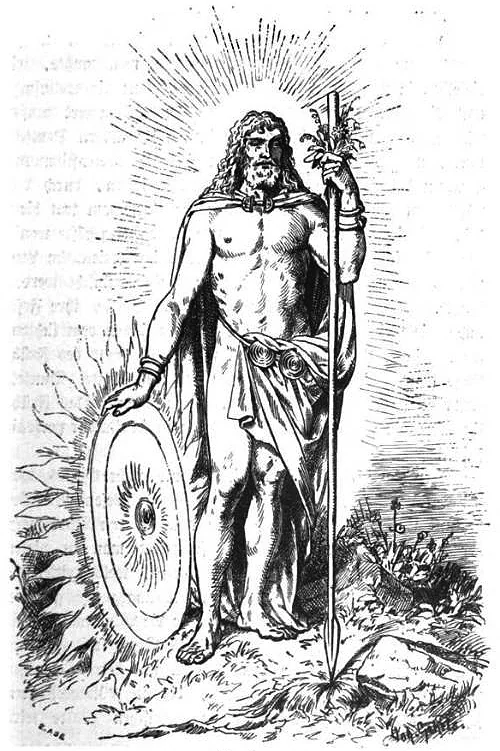
Baldr (Old Norse: Baldr, also Baldur) is the son of Odin and Frigg and the most beloved of the Norse gods, described by Snorri Sturluson as the fairest of the gods, the wisest, and the most eloquent. He is associated with light, beauty, and radiance. His death at the hands of the blind god Höðr — engineered by Loki with a dart of mistletoe — is the pivotal event marking the approach of Ragnarök. All creation wept at his death. He now dwells in the realm of Hel, from which he will return after Ragnarök when the world is renewed.
Quick facts
- Pantheon
- Norse
- Figure type
- God
- Period
- Attested in Norse literary sources from the 13th century CE
- Primary sources
- Snorri Sturluson Prose Edda: Gylfaginning 22; Snorri Sturluson Prose Edda: Gylfaginning 49–50; Poetic Edda: Baldrs Draumar
- Related figures
- odin, frigg, loki, hel, hodr, thor
Death of Baldr
Baldr's death is narrated by Snorri in Gylfaginning 49. After Baldr's prophetic dreams, Frigg secured oaths from all things not to harm him. The gods made a game of throwing weapons at him, all of which bounced off harmlessly. Loki, disguised as an old woman, tricked Frigg into revealing that only the mistletoe had been overlooked. He fashioned a dart of mistletoe and gave it to the blind god Höðr, guiding his hand to throw it at Baldr in the game. Baldr fell dead. All the gods and all living things wept. Hermod volunteered to ride to Hel to plead for Baldr's return; Hel agreed to release him if all things in the world wept. Every creature wept except Loki in disguise — Baldr remained in Hel.
Return after Ragnarök
Snorri's Prose Edda (Gylfaginning 53) records the prophecy of Baldr's return after the destruction of Ragnarök: 'After Ragnarök, when the world is renewed, Baldr and Höðr will come from Hel and reconcile.' The two brothers will live again in the renewed world. Baldr's death and eventual return frame him as a figure of cyclical renewal — the sacrifice of the beloved god who must die before the world can be remade. His myth has been compared by scholars to other Indo-European dying-and-rising god motifs, though in Norse tradition the rebirth is explicitly post-apocalyptic.
Sources & further reading (2)
- primary-source — accessed 2026-05-06
- encyclopedia — accessed 2026-05-06
Frequently asked questions
What killed Baldr in Norse mythology?
Baldr was killed by a dart made from mistletoe, guided by Loki and thrown by the blind god Höðr (Snorri Prose Edda: Gylfaginning 49). His mother Frigg had extracted oaths from all things in the world not to harm Baldr — fire, water, iron, stone, trees, animals, and more — but overlooked the mistletoe, thinking it too young and harmless. Loki discovered this sole exception, fashioned a dart from it, and guided the blind Höðr's hand at the gods' game of throwing things at the invulnerable Baldr.
What happens to Baldr after Ragnarök?
According to Snorri Sturluson's Prose Edda (Gylfaginning 53), Baldr will return to the living world after Ragnarök, when the old world has been destroyed and a new one rises from the sea. He and his brother Höðr (who killed him) will both emerge from Hel's realm and be reconciled. The surviving gods and the reborn world will start anew. Baldr's post-Ragnarök return makes him one of the few Norse deities whose story ends in renewal rather than destruction.