Place
Valhalla
Odin's hall of slain warriors, where the einherjar feast and train for Ragnarök.
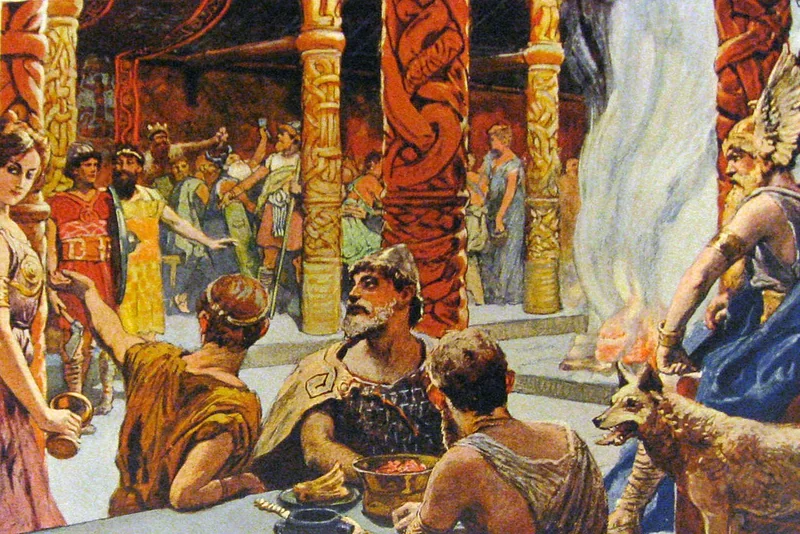
Valhalla (Old Norse: Valhöll, 'Hall of the Slain') is Odin's great hall in Ásgarðr, where warriors slain in battle are received by the Valkyries and brought to feast and fight until Ragnarök. Its roof is made of shields; its rafters of spears. Every day the einherjar (chosen warriors) fight each other in the courtyard; every night their wounds heal and they feast on the flesh of the boar Sæhrímnir, which is reborn each day, and drink mead from the goat Heiðrún. Valhalla has 540 doors, each wide enough for 800 warriors to march through abreast. Described in detail in Snorri Sturluson's Prose Edda (Gylfaginning 38–40) and the Poetic Edda (Grímnismál 8–10, 23–25).
Quick facts
- Pantheon
- Norse
- Figure type
- Place
- Period
- Attested in Norse literary sources from the 13th century CE
- Primary sources
- Snorri Sturluson Prose Edda: Gylfaginning 38–40; Poetic Edda: Grímnismál 8–10, 23–25; Poetic Edda: Eiríksmál (anon., c. 954 CE)
- Related figures
- odin, valkyries, ragnarok, yggdrasil
Structure and inhabitants
Snorri's Prose Edda (Gylfaginning 38–40) gives the most detailed description of Valhalla. Its walls are made of spears; its roof of shields; its benches are strewn with coats of mail. The Poetic Edda (Grímnismál 23–25) adds that it has 540 doors, each wide enough for 800 warriors abreast — a number that emphasises the scale of Odin's army for Ragnarök. The einherjar feast on the flesh of the boar Sæhrímnir, which is slaughtered and cooked each day by the cook Andhrímnir in the cauldron Eldhrímnir, then made whole again each night. The goat Heiðrún grazes on the leaves of Yggdrasil and produces enough mead to fill a great vat daily.
The Valkyries and selection
Warriors do not go to Valhalla automatically. The Valkyries (Old Norse: valkyrjur, 'choosers of the slain') ride across battlefields selecting those worthy of death in Odin's service (Poetic Edda: Grímnismál 36; Völuspá 30). Half the battle-slain go to Valhalla; the other half go to Freyja's hall Fólkvangr. The purpose of gathering the einherjar in Valhalla is explicitly martial: they train and fight each day, their wounds healing each night, so that they will form Odin's army when the gods march out to battle at Ragnarök (Gylfaginning 51). The daily feast and combat cycle is not reward — it is preparation.
Sources & further reading (2)
- primary-source — accessed 2026-05-06
- encyclopedia — accessed 2026-05-06
Frequently asked questions
How do warriors reach Valhalla?
In Norse mythology, warriors reach Valhalla by dying in battle and being selected by the Valkyries, Odin's supernatural warrior-maidens (Poetic Edda: Grímnismál 36, Völuspá 30). Only those who die in combat qualify — those who die of illness, old age, or accident go to Hel's realm (Snorri Prose Edda: Gylfaginning 34). The Valkyries 'choose the slain' on the battlefield and conduct the worthy to Valhalla. Half the battle-dead go to Valhalla; the other half to Freyja's Fólkvangr. The selection criteria are not always explicit in the sources — heroic death in battle seems to be the primary requirement.
What do the einherjar do in Valhalla?
The einherjar ('those who fight alone' or 'one-army men') spend their time in Valhalla in a cycle of combat and feasting. Each day they arm themselves and fight each other in the courtyard (Völund's field in the sources); each evening their wounds heal, they return to Valhalla, and feast on the boar Sæhrímnir and drink mead from the goat Heiðrún (Snorri Prose Edda: Gylfaginning 38–40). This cycle is explicitly purposeful: Odin is assembling them so that they will fight alongside the gods when Ragnarök arrives and Fenrir breaks free (Gylfaginning 51).