God
Tyr
One-handed Norse god of justice, law, and single combat.
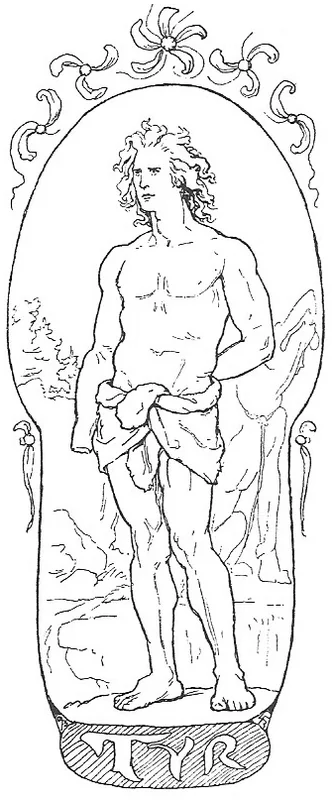
Tyr (Old Norse: Týr) is an Aesir god in Norse mythology, son of Odin (or of the giant Hymir in some sources). He is the god of justice, law, and single combat — in earlier Germanic tradition he may have been the chief sky-god before Odin assumed that role. He is best known for sacrificing his right hand to bind the wolf Fenrir: Tyr placed his hand in Fenrir's jaws as a pledge of good faith while the gods fastened the magical binding Gleipnir on the wolf. When Fenrir discovered the deception, he bit off Tyr's hand. Tuesday is named after him. His deeds are narrated in Snorri's Prose Edda and the Poetic Edda.
Quick facts
- Pantheon
- Norse
- Figure type
- God
- Period
- Attested in Norse literary sources from the 13th century CE; Tuesday (Old English Tīwesdæg) attests the cult from the early medieval period
- Primary sources
- Snorri Sturluson Prose Edda: Gylfaginning 25; Snorri Sturluson Prose Edda: Gylfaginning 34; Poetic Edda: Sigrdrífumál 6 (Tyr runes)
- Related figures
- odin, fenrir, loki, thor
The binding of Fenrir
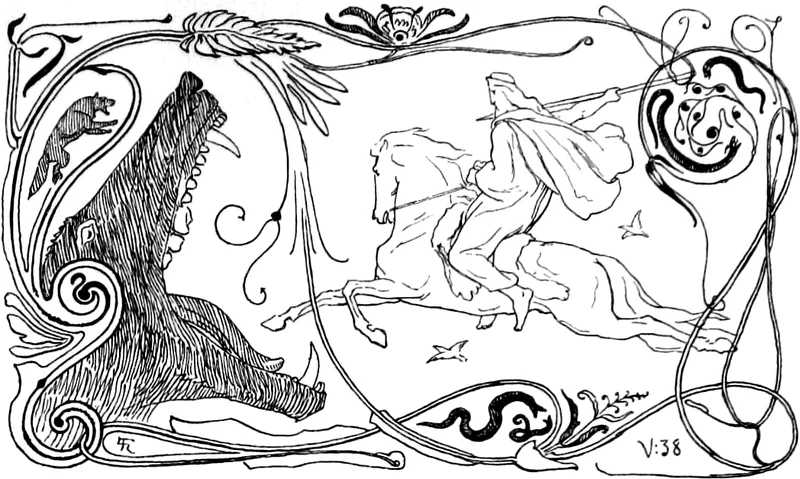
Snorri's Prose Edda (Gylfaginning 34) narrates the binding of the wolf Fenrir. The gods were alarmed by Fenrir's growing size and strength. They twice had Fenrir test his strength against conventional chains, which he broke easily. They then commissioned the dwarves of Svartalfheim to craft the magical ribbon Gleipnir — made from the sound of a cat's footstep, the beard of a woman, the roots of a mountain, the sinews of a bear, the breath of a fish, and the spittle of a bird. Fenrir refused to be bound unless a god placed a hand in his jaws as a pledge of good faith. Only Tyr offered his hand. When Fenrir found himself unable to break free, he bit off Tyr's hand at the wrist.
Tuesday and the Tiwaz rune
Tuesday (Old English: Tīwesdæg, 'Tiw's day') is named after Tyr, the English form of his name. The Roman dies Martis (Mars's day) was translated into the Germanic equivalent as Tyr's day, based on the identification of Tyr with Mars as the god of war and justice. The runic character Tiwaz (ᛏ), shaped like an upward-pointing arrow, is named after Tyr and appears in runic inscriptions associated with victory in battle. The Poetic Edda (Sigrdrífumál 6) advises carving Tyr's rune on swords for victory in battle.
Sources & further reading (2)
- primary-source — accessed 2026-05-06
- encyclopedia — accessed 2026-05-06
Frequently asked questions
Why does Tyr have one hand?
Tyr sacrificed his right hand to deceive the wolf Fenrir. When the gods bound Fenrir with the magical ribbon Gleipnir (Snorri Prose Edda: Gylfaginning 34), Fenrir agreed to be bound only if a god placed a hand in his jaws as a pledge of honour. Tyr volunteered. When Fenrir discovered he could not break free of the binding, as the gods had secretly planned, he bit off Tyr's hand at the wrist. Tyr's loss of his hand in an act of honour and deception is characteristic of his role as a god of justice: he accepted the cost of maintaining the cosmic order.
Why is Tuesday named after Tyr?
Tuesday (Old English: Tīwesdæg) derives from Tiw or Tyr, the Norse/Germanic god of justice and war. The English weekday names were adapted from the Roman system: the Roman dies Martis (Mars's day, Monday in French: mardi) was replaced by Tyr's day in Old English, as Tyr was identified with Mars as the god governing war and single combat. The same pattern occurs in other Germanic languages: Old Norse þýsdagr, Old High German Ziestag. The name Tyr also gives the runic letter Tiwaz (ᛏ).