God
Thor
Norse god of thunder, storms, and the protection of humanity.
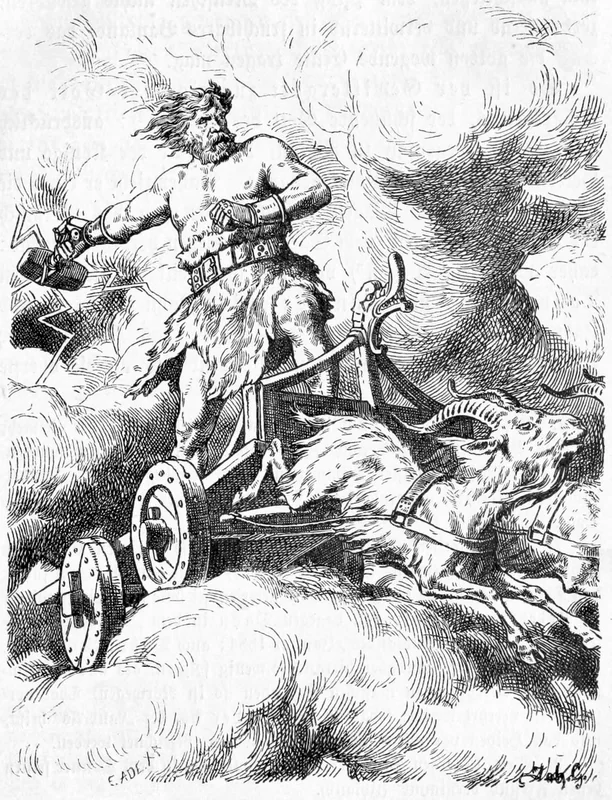
Thor (Old Norse: Þórr) is the son of Odin and one of the most prominent Norse gods, protector of humanity and the strongest of the Aesir. He is the god of thunder, lightning, storms, strength, and the sanctification of marriage and the dead. Thor wields Mjölnir, his magical hammer forged by the dwarf brothers Sindri and Brokkr, which returns to his hand when thrown. He drives a chariot drawn by two goats, Tanngrisnir and Tanngnjóstr, and wears the belt Megingjörð that doubles his strength. Thursday is named after him. His deeds are narrated extensively in Snorri Sturluson's Prose Edda and the Poetic Edda.
Quick facts
- Pantheon
- Norse
- Figure type
- God
- Period
- Attested in Norse literary sources from the 13th century CE; the weekday Thursday (Old English Þūnresdæg) attests the cult from the early medieval period
- Primary sources
- Snorri Sturluson Prose Edda: Gylfaginning 21–22; Poetic Edda: Þrymskviða; Poetic Edda: Hymiskviða
- Related figures
- odin, loki, jormungandr, frigg, fenrir
Mjölnir and attributes
Thor's most important attribute is his hammer Mjölnir (Old Norse: Mjǫllnir), described in Snorri's Prose Edda (Skáldskaparmál 35) as the best of all weapons — it never misses its target and always returns to Thor's hand. It was forged by the dwarf brothers Sindri and Brokkr, with a slightly short handle as the result of Loki's interference in the process. Thor's other equipment includes the belt Megingjörð that doubles his strength, and iron gauntlets (Járngreipr) without which he cannot grip Mjölnir. Thor uses the hammer both as a weapon against the giants (Jötnar) and as a ritual instrument for blessing marriages and the dead.
Battle with Jörmungandr
The destined mutual death of Thor and the World Serpent Jörmungandr at Ragnarök is one of the most prominent prophecies in Norse mythology, recorded in the Prose Edda (Gylfaginning 51). Thor will slay the Midgard Serpent with Mjölnir but then stagger nine steps before dying from its venom. This fate frames their prior encounters: the myth of Thor's fishing expedition with the giant Hymir (Poetic Edda: Hymiskviða 22–24), in which Thor hooks Jörmungandr and nearly hauls it from the sea before Hymir cuts the line in terror, serves as a prelude to their final, fatal meeting.
Sources & further reading (2)
- primary-source — accessed 2026-05-06
- encyclopedia — accessed 2026-05-06
Frequently asked questions
What is Mjölnir?
Mjölnir (Old Norse: Mjǫllnir) is the magical hammer of Thor, described in Snorri Sturluson's Prose Edda as the finest weapon in existence. It was forged by the dwarf brothers Sindri and Brokkr in Svartalfheim; Loki, in the form of a fly, bit Brokkr's hand during the forging, causing a slight shortening of the handle. Despite this, Mjölnir is invincible: it never misses, never breaks, and always returns to Thor's hand. In Norse tradition, Mjölnir amulets were widely worn as protective symbols; thousands of small Mjölnir pendants have been found in Norse-period archaeological contexts across Scandinavia.
Why is Thursday named after Thor?
Thursday (Old English: Þūnresdæg, 'Thor's day') is directly named after the Norse god Thor. The English weekday names were adapted from Roman planetary names to Germanic equivalents in the early medieval period: the Roman dies Jovis (Jupiter's day) became Thor's day, because both Jupiter and Thor were thunder gods who wielded thunderbolts or hammers. This naming pattern is preserved in English, Norwegian (torsdag), Swedish (torsdag), and other Germanic languages, reflecting the widespread worship of Thor across the Germanic world.