Hero
Sigurd
Greatest Norse hero, slayer of the dragon Fáfnir and wielder of the sword Gram.
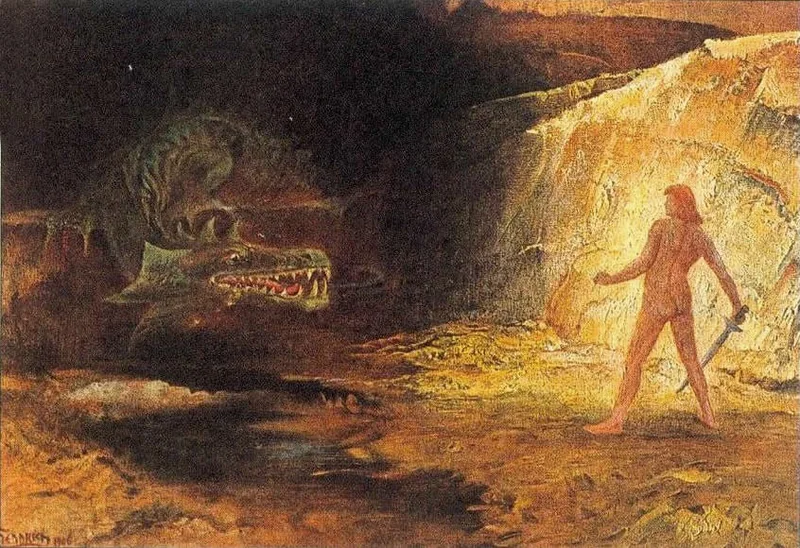
Sigurd (Old Norse: Sigurðr; German: Siegfried) is the greatest hero of Norse mythology and the central figure of the Völsunga Saga. Son of Sigmundr and Hjördís, he was raised by the smith Reginn, who crafted him the magical sword Gram. Sigurd slew the dragon Fáfnir, whose blood gave him the ability to understand the speech of birds and, when he bathed in it, near-invulnerability (except for a spot on his back). He woke the Valkyrie Brynhildr from an enchanted sleep. His eventual death — stabbed in the back through treachery by the warrior Guttorm — reflects the Norse theme of fate and the doom of great men. His story is narrated in the Poetic Edda and the Völsunga Saga (c. 1270 CE).
Quick facts
- Pantheon
- Norse
- Figure type
- Hero
- Period
- Legendary hero; the underlying traditions may preserve memory of historical Migration Period figures (5th–6th century CE)
- Primary sources
- Poetic Edda: Fáfnismál; Poetic Edda: Sigrdrifumál; Völsunga Saga chapters 15–31 (c. 1270 CE)
- Related figures
- odin, brynhildr, fafnir, regin, gudrun
Slaying of Fáfnir
The Poetic Edda's Fáfnismál narrates Sigurd's slaying of the dragon Fáfnir. On Reginn's advice, Sigurd dug a trench in the path the dragon used to reach a watering hole. As Fáfnir crawled overhead, Sigurd stabbed upward through his belly with the sword Gram. Dying, Fáfnir warned Sigurd that the gold he guarded was cursed. After Fáfnir's death, Sigurd tasted the dragon's blood and discovered he could understand the language of birds. The birds advised him that Reginn planned to betray him. Sigurd killed Reginn and took Fáfnir's treasure — the cursed gold of Andvari, which would bring ruin to all who possessed it.
Brynhildr and doom
After slaying Fáfnir, Sigurd rode to the mountain Hindarfjall and found a sleeping figure encircled by flames — the Valkyrie Brynhildr, placed in an enchanted sleep by Odin for disobedience and destined to be woken only by a hero who knew no fear (Poetic Edda: Sigrdrífumál introduction). Sigurd woke her; they pledged themselves to each other. Their story then becomes tangled in treachery: Sigurd was given a potion of forgetfulness, married Guðrún instead, and helped the hero Gunnarr court Brynhildr. The resulting betrayal and broken oaths led to Sigurd's murder and Brynhildr's death on his funeral pyre.
Sources & further reading (2)
- primary-source — accessed 2026-05-06
- encyclopedia — accessed 2026-05-06
Frequently asked questions
What is the sword Gram?
Gram (Old Norse: Gramr, 'Fierce') is the legendary sword of Sigurd, forged by the smith Reginn from the shards of Sigmundr's broken sword (which Odin himself had originally placed in a tree). Reginn reforged it so perfectly sharp that a lock of wool placed against the current in water was cleaved in two, and it cut through Reginn's own anvil when Sigurd tested it (Völsunga Saga 15). Gram is the weapon with which Sigurd kills Fáfnir. In the German tradition (the Nibelungenlied, c. 1200 CE), the equivalent sword is called Balmung.
How is Sigurd related to Siegfried of the Nibelungenlied?
Sigurd (Norse) and Siegfried (German) are cognate heroes from a shared Germanic legendary tradition. Both slay a dragon, gain a treasure, and are killed by treachery involving a faithless pledge and a magic potion. The Norse version survives in the Völsunga Saga and the Poetic Edda (c. 1270 and c. 1270 CE respectively); the German version in the Nibelungenlied (c. 1200 CE). Richard Wagner based his four-opera cycle Der Ring des Nibelungen (1876) primarily on the Eddic and Saga tradition. The shared stories suggest an early medieval origin, possibly connected to historical Burgundian and Frankish events of the 5th century CE.