God
Odin
Allfather and chief of the Norse gods, god of wisdom, war, and death.
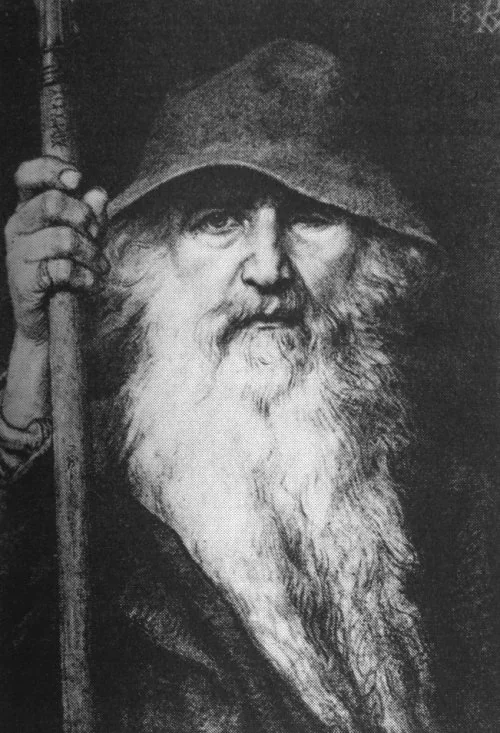
Odin (Old Norse: Óðinn) is the chief deity of the Norse pantheon, ruler of Asgard and father of many gods including Thor, Baldr, and Vidar. Known as the Allfather, he is the god of wisdom, war, death, poetry, and magic. He sacrificed his eye at Mimir's well to drink from the waters of wisdom, and hanged himself on the World Tree Yggdrasil for nine days to discover the runes. He leads the einherjar (slain warriors) in Valhalla, preparing for the final battle of Ragnarök. His chief sources are Snorri Sturluson's Prose Edda (c. 1220 CE) and the Poetic Edda.
Quick facts
- Pantheon
- Norse
- Figure type
- God
- Period
- Attested in Norse literary sources from the 13th century CE; underlying tradition centuries older
- Primary sources
- Snorri Sturluson Prose Edda: Gylfaginning 20–21; Poetic Edda: Hávamál 138–144 (self-sacrifice on Yggdrasil); Snorri Sturluson Prose Edda: Gylfaginning 37–38 (Valhalla)
- Related figures
- thor, frigg, baldr, loki, tyr, yggdrasil, fenrir
Sacrifice for wisdom
Snorri Sturluson's Prose Edda (Gylfaginning 15) records two great self-sacrifices by Odin. He gave up one eye to the well of the wise giant Mimir, which lies at the root of the World Tree Yggdrasil, in exchange for a drink of wisdom from its waters. He also voluntarily hung himself from Yggdrasil for nine nights, pierced by a spear, in order to discover the runes — the magical symbols that encode all wisdom and power (Poetic Edda: Hávamál 138–144). These sacrifices characterise Odin as the god of wisdom obtained through suffering and self-sacrifice.
Valhalla and the Valkyries
Odin rules Valhalla (Old Norse: Valhǫll, 'Hall of the Slain'), the great hall in Asgard where warriors slain in battle are received (Snorri Prose Edda: Gylfaginning 37–38). Odin's Valkyries ('Choosers of the Slain') ride over battlefields, selecting the bravest fallen warriors for Valhalla. The einherjar ('lone fighters') train there daily, fighting and feasting in preparation for Ragnarök. Odin rides the eight-legged horse Sleipnir and is accompanied by his two ravens Huginn ('Thought') and Muninn ('Memory'), who fly across the world each day and return to report what they have seen.
Sources & further reading (2)
- primary-source — accessed 2026-05-06
- encyclopedia — accessed 2026-05-06
Frequently asked questions
Why does Odin have one eye?
According to Snorri Sturluson's Prose Edda (Gylfaginning 15), Odin sacrificed his left eye to the giant Mimir in exchange for a drink from the well of wisdom (Mímisbrunnr) beneath the root of Yggdrasil. Mimir's well was said to contain all wisdom and hidden knowledge. Odin's willingness to give up his eye for wisdom is characteristic of his mythological personality: he consistently makes extreme personal sacrifices in pursuit of knowledge and power. His one-eyed appearance is a consistent iconographic feature in ancient Norse imagery.
What is Valhalla?
Valhalla (Old Norse: Valhǫll) is the great hall of Odin in Asgard where warriors killed in battle are received, as described in Snorri Sturluson's Prose Edda (Gylfaginning 37–38) and the Poetic Edda (Grímnismál 8–10). The hall has 540 doors, each wide enough for 800 warriors to march through abreast. The warriors (einherjar) feast on the boar Sæhrímnir (which regenerates each day) and drink mead from the she-goat Heiðrún's udders. They battle each day and their wounds heal each evening. They are preparing for Ragnarök, the final battle at the end of the world.