Place
Mjölnir
Thor's hammer, the most feared weapon of the Norse gods, forged by the dwarves.
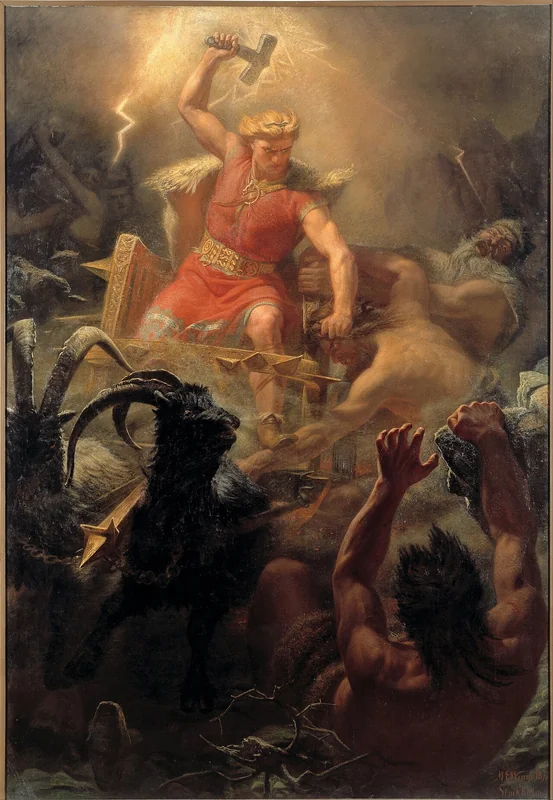
Mjölnir (Old Norse: Mjǫllnir, possibly meaning 'lightning' or 'crusher') is the hammer of Thor, the most powerful weapon among the Norse gods. It was forged by the dwarves Brokkr and Sindri (or Eitri) on a wager with Loki, who sabotaged the bellows so that the handle came out too short. Despite this flaw, Mjölnir became the most prized treasure of the Aesir: it could level mountains, smash giant skulls, and always returned to Thor's hand. Thor used it to defend Ásgarðr and Miðgarðr against giants and monsters. Its short handle required Thor to use a belt of strength (Megingjörð) and iron gloves (Járngreipr) when wielding it. Described in Snorri's Prose Edda (Skáldskaparmál 35) and the Poetic Edda (Þrymskviða).
Quick facts
- Pantheon
- Norse
- Figure type
- Place
- Period
- Attested in Norse literary sources from the 13th century CE
- Primary sources
- Snorri Sturluson Prose Edda: Skáldskaparmál 35; Poetic Edda: Þrymskviða; Snorri Sturluson Prose Edda: Gylfaginning 21
- Related figures
- thor, loki, odin, ragnarok
Forging of Mjölnir
Snorri's Prose Edda (Skáldskaparmál 35) tells the story of how Mjölnir was forged. Loki had cut off the hair of Sif (Thor's wife) as a prank. When Thor threatened him, Loki went to the dwarves of Svartalfheim and had them make a replacement of spun gold. He then wagered his own head with a dwarf named Brokkr that Brokkr and his brother Sindri could not make three items equal to those already made by the dwarves Sons of Ívaldi. Loki (transformed into a fly) repeatedly bit the bellows-operator Sindri to sabotage the work, succeeding only in shortening the hammer's handle. Despite the flaw, the Aesir judged Mjölnir the greatest gift of all — too valuable a weapon against giants for the short handle to matter. Loki kept his head on a technicality: only his head was forfeit, not his neck.
Theft and recovery
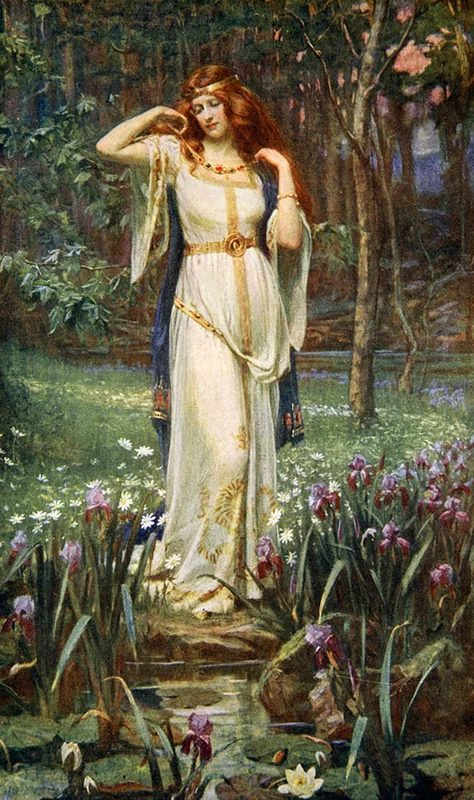
The Poetic Edda's Þrymskviða narrates the most elaborate story involving Mjölnir. The giant Þrymr stole the hammer and buried it eight miles underground, demanding the goddess Freyja as his bride in exchange for its return. On Loki's advice, Thor disguised himself as Freyja (in bridal dress, with a veil) and Loki disguised himself as the bride's handmaid. At the wedding feast, Þrymr's suspicions were aroused by the 'bride's' enormous appetite, but Loki deflected them with excuses. When Mjölnir was brought out to consecrate the marriage — a genuine Norse wedding ritual — Thor seized it and killed Þrymr and all his guests. The myth explains both the hammer's importance and its role as a sacred object in ritual blessing.
Sources & further reading (2)
- primary-source — accessed 2026-05-06
- encyclopedia — accessed 2026-05-06
Frequently asked questions
What were Mjölnir's magical properties?
According to Snorri Sturluson's Prose Edda (Gylfaginning 21), Mjölnir has three notable properties: it always hits its mark, it always returns to Thor's hand after being thrown, and it can be made small enough to hide inside Thor's shirt. Snorri also mentions that Thor requires two accessories to wield it properly — the belt Megingjörð ('Power Belt'), which doubles his strength, and the iron gloves Járngreipr, which allow him to grip the short handle. In Gylfaginning 21, Snorri states that of all Thor's possessions, Mjölnir is the one the giants most dread, and for good reason: Thor uses it to defend the gods and humanity from the jötnar.
Was Mjölnir used in Norse religious rituals?
Archaeological and literary evidence suggests Mjölnir was indeed used in real Norse religious practice, not only in myth. The Poetic Edda's Þrymskviða includes a scene where Mjölnir is used to consecrate a marriage by being laid in the bride's lap — a ritual act. Numerous small hammer amulets (miniature Mjölnirs) have been found across Scandinavia and the Viking diaspora, dating from roughly 800–1100 CE, worn as protective pendants. Some scholars argue these were a deliberate marker of Norse religious identity in response to the spread of the Christian cross amulet. Inscribed stones from this period sometimes invoke Thor with the hammer sign.