Place
Miðgarðr
The realm of humans in Norse cosmology, encircled by the World Serpent Jörmungandr.
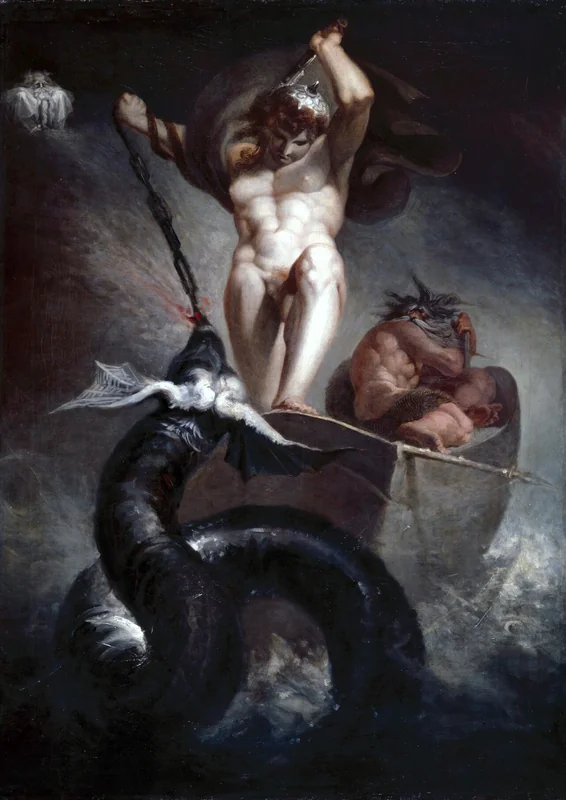
Miðgarðr (Old Norse: Miðgarðr, 'Middle Enclosure') is the realm of humanity in Norse cosmology, one of the nine worlds connected by Yggdrasil. It was created from the body of the primordial giant Ymir: his flesh became the earth, his blood the sea, his bones the mountains, his skull the sky. The gods placed Ymir's eyelashes as a wall around Miðgarðr to protect humans from the giants (jötnar) who dwell beyond. Miðgarðr is encircled by the ocean, within which the World Serpent Jörmungandr lies with its tail in its mouth. Described in Snorri Sturluson's Prose Edda (Gylfaginning 8) and the Poetic Edda (Völuspá 4).
Quick facts
- Pantheon
- Norse
- Figure type
- Place
- Period
- Attested in Norse literary sources from the 13th century CE
- Primary sources
- Snorri Sturluson Prose Edda: Gylfaginning 8; Poetic Edda: Völuspá 4; Poetic Edda: Vafþrúðnismál 21
- Related figures
- odin, yggdrasil, jormungandr, ymir
Creation from Ymir
Snorri's Prose Edda (Gylfaginning 8) gives the most complete account of Miðgarðr's creation. After Odin and his brothers Vili and Vé slew the primordial frost-giant Ymir, they dragged his body to the centre of Ginnungagap (the void) and formed the world from it. His flesh became the soil; his blood and sweat became the seas and lakes; his bones and teeth became rocks and stones; his skull became the dome of the sky, held up at four corners by dwarves (Norðri, Suðri, Austri, Vestri). His brain was thrown into the sky to become clouds. His eyelashes and eyebrows were used to build a fence (Miðgarðr, the 'middle enclosure') around the realm given to humans, protecting them from the hostile giants who live in Útgarðr ('outer enclosure') beyond.
Encirclement by Jörmungandr
The World Serpent Jörmungandr, son of Loki, was cast into the ocean surrounding Miðgarðr by Odin (Gylfaginning 34). The serpent grew so large it encircles the entire world and bites its own tail — making it an Ouroboros figure in Norse mythology. Jörmungandr and Thor are mortal enemies: in Gylfaginning 47–48, Snorri tells how Thor nearly pulled Jörmungandr from the ocean when disguised as a fishing companion of the giant Hymir, and the serpent rose, filling the sky with poison. At Ragnarök, Jörmungandr will release its tail and rise from the sea to advance onto land — and Thor will slay it before dying of its venom nine paces away.
Sources & further reading (2)
- primary-source — accessed 2026-05-06
- encyclopedia — accessed 2026-05-06
Frequently asked questions
What are the nine worlds connected to Miðgarðr?
The nine worlds of Norse cosmology (connected by Yggdrasil) are: Ásgarðr (realm of the Aesir gods), Miðgarðr (realm of humans), Jötunheimr (realm of frost giants), Niflheim (primordial realm of ice and mist), Múspelheim (realm of fire and the fire giant Surtr), Álfheimr (realm of light elves), Svartálfaheimr (realm of dark elves or dwarves), Hel (realm of the dead), and Vanaheimr (realm of the Vanir gods). Miðgarðr occupies the central position: it is the 'middle enclosure' around which the other worlds are organised and connected by the branches and roots of Yggdrasil. Snorri Sturluson's Prose Edda (Gylfaginning 14–15) provides the most systematic account of the cosmological structure.
How is Miðgarðr connected to the modern English word 'Middle-earth'?
Old English Middangeard (from Proto-Germanic midja-gardaz (reconstructed), 'middle enclosure') is the Old English cognate of Old Norse Miðgarðr. In Old English poetry such as Beowulf, middangeard simply means 'the world of humans' — the inhabited earth — without necessarily carrying the cosmological weight it has in Norse sources. J.R.R. Tolkien used the anglicised form 'Middle-earth' for the setting of The Lord of the Rings, drawing on this Old English/Old Norse tradition as part of his project to create a mythology for England. The word thus traces directly back to the Norse creation account of Miðgarðr as the central human realm enclosed against the chaos beyond.