God
Loki
Trickster god of Norse mythology, shape-shifter and agent of both mischief and doom.
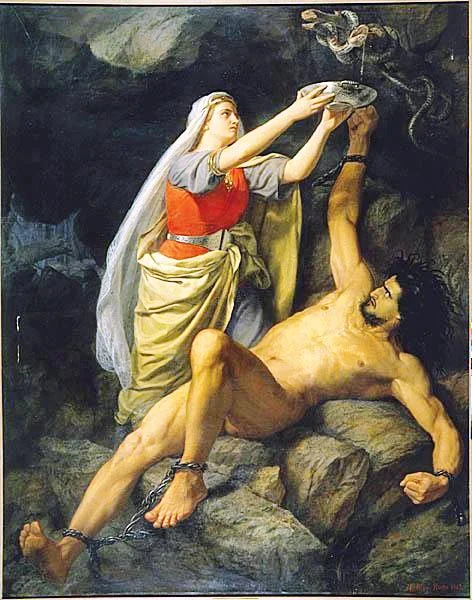
Loki (Old Norse: Loki) is a complex figure in Norse mythology — a shape-shifting trickster who is blood-brother of Odin and a frequent companion of Thor and other Aesir gods, yet also the agent of Baldr's death and a key catalyst of Ragnarök. The son of the giant Fárbauti and Laufey, he is technically a giant (Jötunn) but lives among the gods. He is responsible for both aiding and endangering the Aesir through his cunning. After engineering Baldr's death, he was bound under the earth until Ragnarök. His deeds are narrated in Snorri Sturluson's Prose Edda and the Poetic Edda.
Quick facts
- Pantheon
- Norse
- Figure type
- God
- Period
- Attested in Norse literary sources from the 13th century CE; older traditions debated
- Primary sources
- Snorri Sturluson Prose Edda: Gylfaginning 33–34 (death of Baldr); Snorri Sturluson Prose Edda: Gylfaginning 49–50 (binding of Loki); Poetic Edda: Lokasenna; Snorri Sturluson Prose Edda: Skáldskaparmál 35 (theft of Mjölnir hair)
- Related figures
- odin, thor, baldr, fenrir, jormungandr, hel
Shape-shifting and deeds
Loki is an accomplished shape-shifter who has appeared in the forms of a mare, a salmon, a fly, and various other creatures throughout Norse myths. Among his notable deeds recorded in Snorri's Prose Edda: he caused the gods to have Sleipnir (Odin's eight-legged horse) by mating in mare form with the stallion Svaðilfari; he aided in the theft of Iðunn's apples (Skáldskaparmál 1–2) and in recovering them; he was present at the forging of Mjölnir; he helped Thor retrieve Mjölnir from the giant Þrymr by disguising Thor as Freyja (Poetic Edda: Þrymskviða). His help often arrives only after he has created the problem in the first place.
Baldr's death and punishment
Loki's most consequential act is engineering the death of Baldr, the beloved god. Snorri's Prose Edda (Gylfaginning 49) narrates that Baldr had been made safe from all things — every object swore not to harm him — except the mistletoe, overlooked as too young and harmless. Loki discovered this exception, fashioned a dart of mistletoe, and guided the blind god Höðr's hand to throw it at Baldr in the gods' game of testing Baldr's invulnerability. Baldr was killed. As additional punishment, Loki was bound beneath the earth, where a serpent drips venom on his face; his wife Sigyn holds a bowl to catch it, but when she must empty it, the venom causes Loki to writhe, creating earthquakes.
Sources & further reading (2)
- primary-source — accessed 2026-05-06
- encyclopedia — accessed 2026-05-06
Frequently asked questions
Is Loki a god or a giant in Norse mythology?
Loki's parentage places him among the giants (Jötnar) — his father is the giant Fárbauti and his mother is Laufey (Snorri Prose Edda: Gylfaginning 33). However, he lives among the Aesir gods in Asgard as Odin's blood-brother and companion. The Norse mythological tradition does not sharply separate gods and giants into purely good and evil categories. Loki acts as both a helper and a troublemaker for the gods throughout the mythology, before his role shifts definitively to antagonist after Baldr's death.
Who are Loki's children?
Loki fathered several important figures in Norse mythology. With the giantess Angrboða, he had three monstrous children: the wolf Fenrir, the World Serpent Jörmungandr, and Hel, ruler of the realm of the dead (Snorri Prose Edda: Gylfaginning 34). With his wife Sigyn, he had two sons: Váli and Narfi (or Nari). In mare form, he bore Sleipnir, the eight-legged horse, as offspring of the stallion Svaðilfari (Gylfaginning 42). Loki's children play central roles in Ragnarök, fulfilling prophecies of destruction.