God
Heimdall
Watchman of the Norse gods, guardian of the rainbow bridge Bifröst.
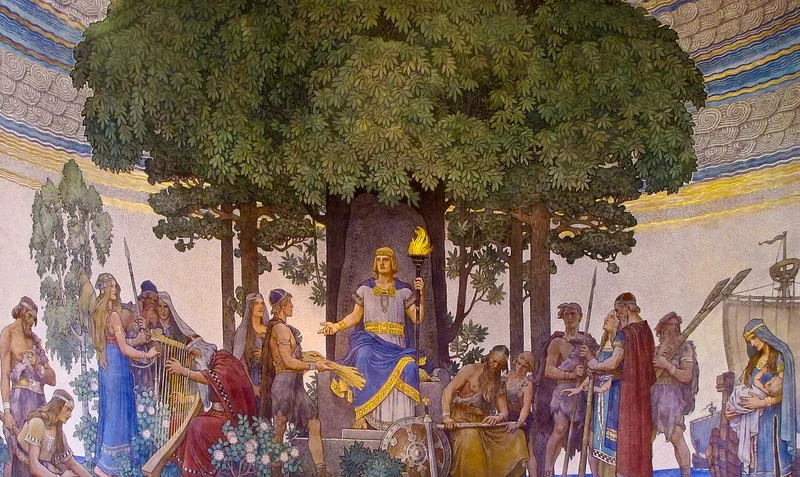
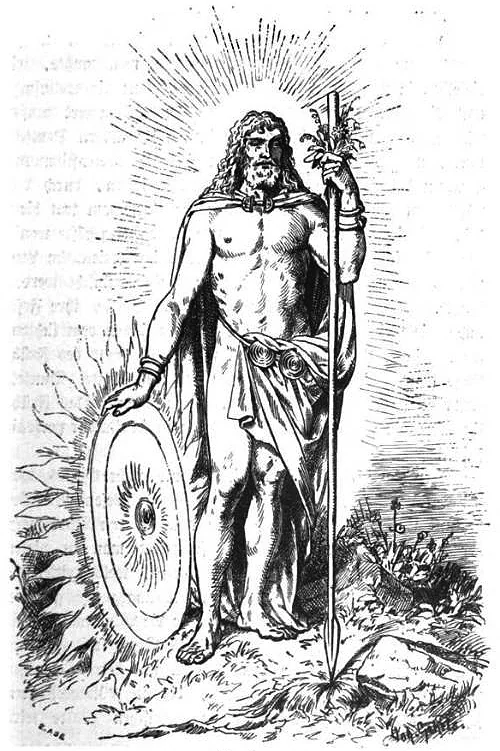
Heimdall (Old Norse: Heimdallr) is the watchman of the Norse gods and the guardian of Bifröst, the rainbow bridge connecting Asgard to the other worlds. He has remarkable senses — he can hear grass growing and wool growing on sheep, and can see for hundreds of miles in any direction, day or night. He sleeps less than a bird. He possesses the horn Gjallarhorn, which he will sound at the onset of Ragnarök, summoning all the gods and warriors for the final battle. He is the father of all classes of humanity according to the Poetic Edda's Rígsþula. He and Loki are destined to kill each other at Ragnarök.
Quick facts
- Pantheon
- Norse
- Figure type
- God
- Period
- Attested in Norse literary sources from the 13th century CE
- Primary sources
- Snorri Sturluson Prose Edda: Gylfaginning 27; Poetic Edda: Rígsþula; Snorri Sturluson Prose Edda: Gylfaginning 51 (Ragnarök)
- Related figures
- odin, loki, thor, bifrost
Guardian of Bifröst
Snorri's Prose Edda (Gylfaginning 27) describes Heimdall as the shining god, great and holy, who guards Bifröst. He requires very little sleep and can see equally well by night and day. His hearing is so acute he can hear grass growing in the fields and wool growing on sheep. He has foresight. He lives at the edge of heaven at a place called Himinbjörg ('Sky Cliffs'). He possesses the Gjallarhorn ('Yelling Horn'), the sound of which will be heard throughout all the nine worlds. He will blow it at the onset of Ragnarök to summon all beings to the final battle.
Father of human classes
The Poetic Edda's Rígsþula ('Song of Ríg') attributes the origin of the three classes of humanity to Heimdall, who wandered among humans under the name Ríg. He visited three households: a poor couple (Áii and Edda), a middle couple (Afi and Amma), and a wealthy couple (Faðir and Móðir). He fathered children with the women of each household. From the poorest came Thrall (the serf class); from the middle came Karl (the free farmer class); from the wealthy came Jarl (the noble warrior class). The myth provides a mythological origin for Norse social stratification.
Sources & further reading (2)
- primary-source — accessed 2026-05-06
- encyclopedia — accessed 2026-05-06
Frequently asked questions
What is the Gjallarhorn?
The Gjallarhorn ('Yelling Horn' or 'Resounding Horn') is Heimdall's great horn, kept by him at the edge of heaven while he guards Bifröst (Snorri Prose Edda: Gylfaginning 27). He will sound it at the beginning of Ragnarök, and its blast will be heard in all nine worlds, summoning gods and warriors to assemble. The name may also be connected to Mímir's well: the Poetic Edda (Völuspá 28) states that Gjallarhorn lies hidden near Mimir's well, where Odin pledged his eye for wisdom.
What is Bifröst?
Bifröst (Old Norse: Bifröst, 'trembling roadway' or 'shimmering path') is the rainbow bridge connecting Asgard (the realm of the gods) to the other worlds in Norse cosmology, as described by Snorri Sturluson (Prose Edda: Gylfaginning 13–14). Snorri identifies it as the rainbow: 'three colours, very strong, made with more art than any other work.' It is guarded by Heimdall. At Ragnarök, the forces of Múspelheim (the realm of fire) will ride across Bifröst, causing it to break under their weight.