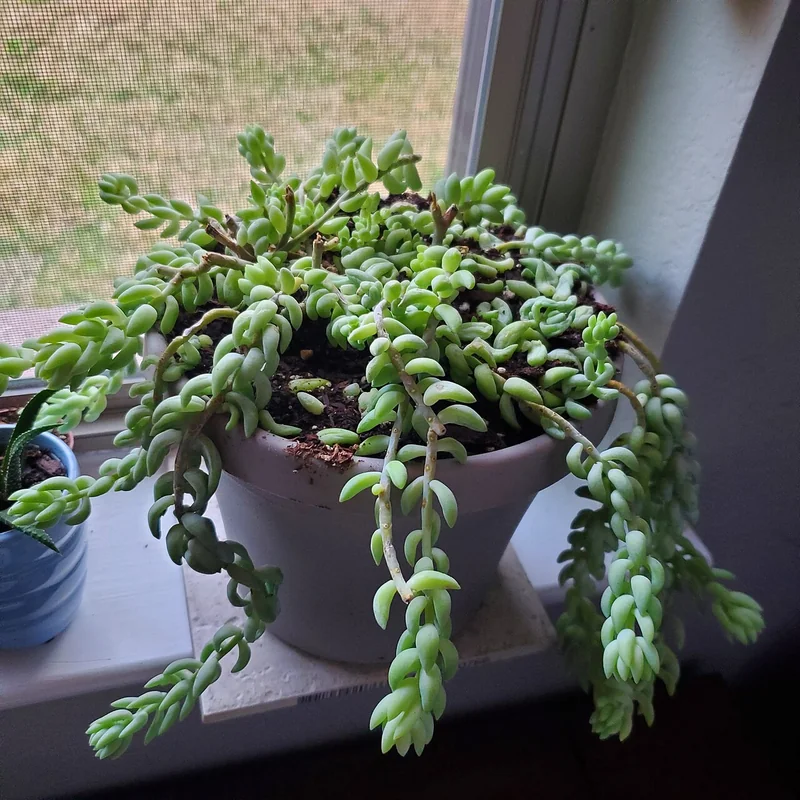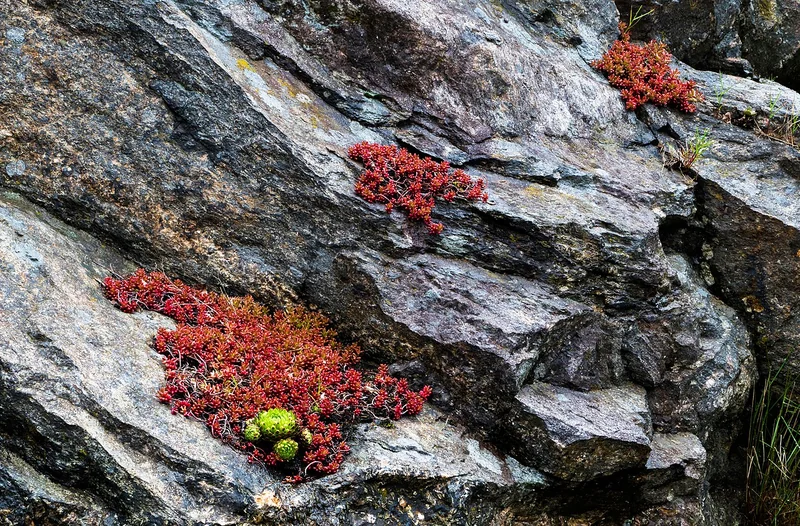
Sedum rubrotinctum is the jelly bean plant, a Mexican succulent with small, chubby, jelly-bean-shaped leaves that flush bright red in strong sun. The leaves cluster along low spreading stems, making the plant a sprawling ground-cover form. It is fast-growing for a sedum and easy to propagate from any leaf or stem fragment.
Care facts at a glance
- Light
- Full sun
- Water
- Water when the mix is fully dry.
- Humidity
- 30–50 %
- Temperature
- 15–27 °C
- Soil
- Free-draining cactus or succulent mix.
- Origin
- Mexico.
- Mature size
- 15 to 25 cm tall, sprawling.
Overview
Sedum rubrotinctum was described in the 1950s and has become one of the most popular small succulents because of its vivid red sun-stress colouring. The Aurora cultivar is a paler pink-leaved sport.
Care Priorities
- Full sun for the brightest red colour.
- Water rarely; jelly beans rot in soggy mix.
- A small shallow pot suits the spreading habit.
- Each leaf and stem fragment roots readily — propagation is effortless.
Common Problems
Mushy leaves are overwatering. Pale green-only colour is too little light; bright sun brings the red back. Leggy stems are low light.
Sources & further reading (2)
- encyclopedia — accessed 2026-04-28
- botanical-garden — accessed 2026-04-28
Frequently asked questions
Why are my jelly beans not red?
Red colour is a sun-stress response. Plants in moderate light stay plain green. Move to full sun and the red returns within weeks.
Can I propagate from a single leaf?
Yes — drop a leaf on moist mix and within a few weeks tiny new plantlets emerge from the cut end.
Outdoor planting?
In warm climates yes — jelly beans are hardy to about minus 1 °C in well-drained soil.