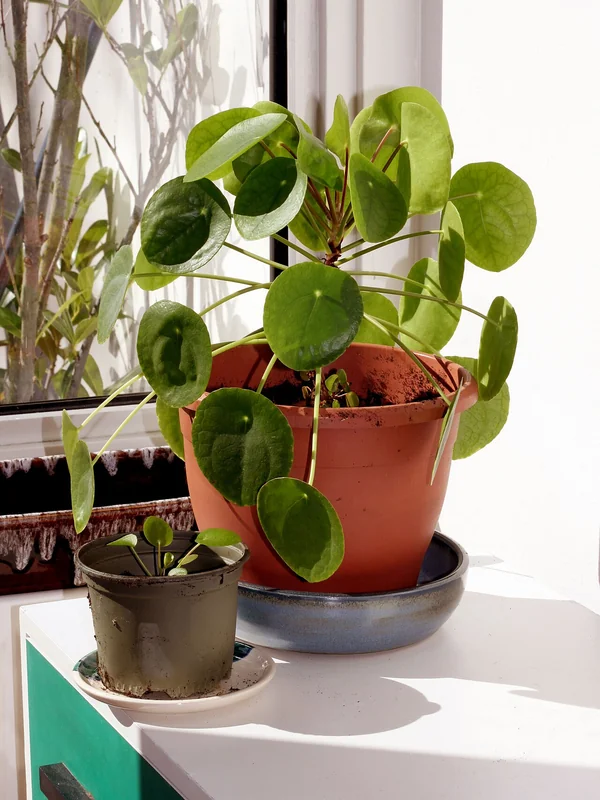
Pilea peperomioides is a small, upright Chinese plant with round, coin-like leaves on long petioles attached at the centre — a peltate leaf form rare among houseplants. It is easy in average rooms with bright filtered light, restrained watering, and a free-draining mix. Mature plants produce small offsets that can be detached and rooted, which is why the species spread through cuttings before it became widely available commercially.
Care facts at a glance
- Light
- Bright indirect
- Water
- Water when the top 2 to 3 cm of mix has dried.
- Humidity
- 40–60 %
- Temperature
- 15–24 °C
- Soil
- Well-draining houseplant mix with extra perlite or pumice.
- Origin
- Yunnan province, southwestern China.
- Mature size
- 20 to 40 cm tall, similar spread.
Overview
Pilea peperomioides was collected in Yunnan in the 1940s by a Norwegian missionary and travelled through Scandinavia as a passed-around cutting before reaching mainstream nurseries decades later. The peltate leaf — petiole attached at the centre — is its diagnostic feature.
Care Priorities
- Bright filtered light keeps growth compact and leaves disc-shaped; deep shade stretches the petioles.
- Rotate the pot every week — this species leans hard toward the brightest light.
- Water on the dry side of moist; the slightly succulent leaves tolerate brief dryness.
- Pop off offsets when they reach a few cm and pot up — this is one of the easiest houseplants to share.
Common Problems
Yellow lower leaves are usually overwatering. Drooping leaves are thirst — water and they perk up within hours. White spots on undersides are often calcium oxalate excretion (normal) rather than a pest, but check for mealybugs first.
Sources & further reading (2)
- encyclopedia — accessed 2026-04-28
- botanical-garden — accessed 2026-04-28
Frequently asked questions
How do I get my Pilea to make babies?
Mature plants in good light and a slightly root-bound pot push offsets from the rhizome and the main stem. Keep the parent steady and offsets typically appear within a year.
Why are my new leaves smaller than the old ones?
Smaller new leaves usually mean lower light, exhausted soil, or under-feeding. Move closer to a window and refresh the top of the mix.
Can I prune the bare stem?
Yes. A leggy stem can be cut back to a few inches; both the cut top and the stump usually re-root with new growth.