Goeppertia makoyana
Goeppertia makoyana (Peacock Plant) Care Guide
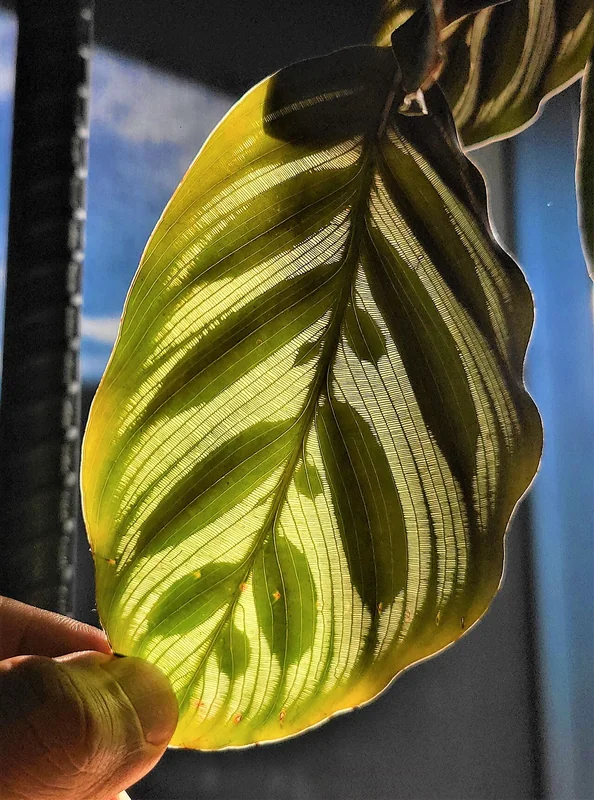 Featured photogoeppertia-makoyana.jpg
Goeppertia makoyana, formerly Calathea makoyana, is the peacock plant — translucent oval leaves marked with bold dark-green ovals on a pale-cream background, with deep purple undersides. The pattern looks almost printed and shifts as the leaves move through their daily prayer-plant cycle. Care is standard calathea: filtered water, soft light, steady humidity.
Care facts at a glance
- Light
- Bright indirect
- Water
- Water when the top 1 to 2 cm of mix has dried.
- Humidity
- 60–80 %
- Temperature
- 18–27 °C
- Soil
- Peat-rich, well-draining mix with perlite.
- Origin
- Eastern Brazil.
- Mature size
- 45 to 60 cm tall, similar spread.
Overview
Goeppertia makoyana has been in European cultivation since the 1870s. The leaves are unusually thin and translucent for a calathea, which is why backlighting reveals the pattern from below as well.
Care Priorities
- Soft, filtered light shows the peacock pattern best.
- Filtered water; this species is on the more sensitive end of the genus.
- Keep evenly moist.
- Avoid cold draughts and sudden temperature swings.
Common Problems
Crispy edges from tap water or dry air. Pattern fading is age or low light. Yellowing leaves are typically overwatering.
Sources & further reading (2)
- encyclopedia — accessed 2026-04-28
- botanical-garden — accessed 2026-04-28
Frequently asked questions
Why are my peacock-plant leaves so thin?
Thin leaves are normal for this species. They look almost translucent compared with thicker calatheas like orbifolia.
Best room for it?
An east-facing room with a humidifier, or a brightly lit bathroom. Avoid kitchens with frequent temperature swings from cooking.
Will it flower indoors?
Rarely — and the small white-cream flowers are insignificant. Foliage is the entire reason to grow it.