Dracaena fragrans Compacta
Dracaena fragrans Compacta (Compact Dracaena) Care Guide
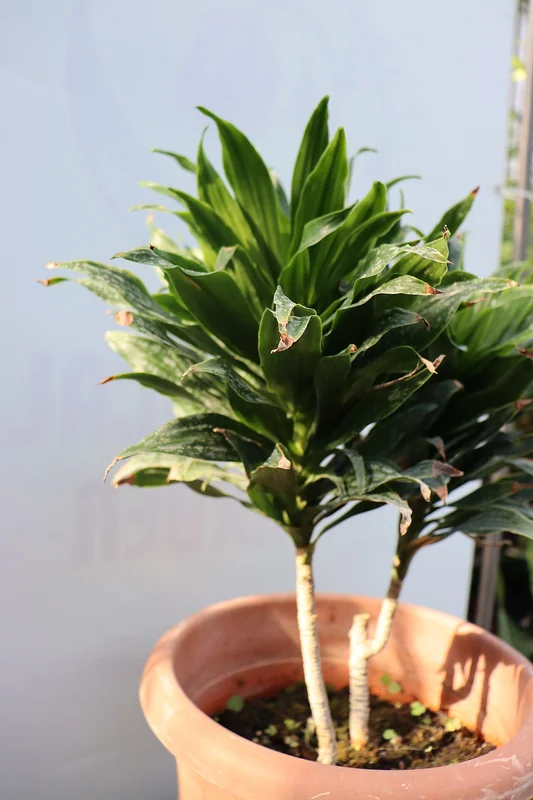 Featured photodracaena-compacta.jpg
Dracaena fragrans Compacta, sold as Compact Dracaena, is a member of *Dracaena*, a genus of about 120 species in Asparagaceae. A compact cultivar of D. fragrans with very densely packed glossy dark-green leaves on short woody stems, looking more like an upright bromeliad than a typical Dracaena. Slow-growing and compact in cultivation. Most cultivated Dracaena tolerate lower light than flowering plants, prefer steady warmth, and are sensitive to fluoride and chlorine in tap water — leaf tips brown if the water is hard.
Care facts at a glance
- Light
- Bright indirect
- Water
- Water when the top 3 cm of mix has dried.
- Humidity
- 40–60 %
- Temperature
- 16–27 °C
- Soil
- Free-draining houseplant mix with perlite for aeration.
- Origin
- Tropical and subtropical Africa, Asia, and the Americas; specific origins vary by species and cultivar.
- Mature size
- 1 to 2 m tall in cultivation depending on cultivar.
Overview
Dracaena fragrans Compacta sits in Dracaena, a tropical genus that recently absorbed Sansevieria via molecular taxonomy. A compact cultivar of D. fragrans with very densely packed glossy dark-green leaves on short woody stems, looking more like an upright bromeliad than a typical Dracaena. Slow-growing and compact in cultivation. Most cultivated Dracaena form woody stems with leaf rosettes at the apex; mature plants take many years to develop the trunk-like silhouette.
Care Priorities
- Bright filtered light or medium light.
- Free-draining mix.
- Water with rainwater or filtered water — sensitive to tap-water fluoride and chlorine.
- Wipe leaves monthly to discourage spider mites.
Common Problems
Brown leaf tips are almost always tap-water fluoride. Soft trunk base is overwatering. Yellow lower leaves are normal aging — trim at the base.
Sources & further reading (2)
- encyclopedia — accessed 2026-04-29
- botanical-garden — accessed 2026-04-29
Frequently asked questions
Why is 'Compacta' so dense?
D. fragrans 'Compacta' is a sport mutation with extremely short internodes between leaves — the result is densely packed leaf rosettes that stay tight even on mature stems. The cultivar grows roughly half as fast as the species form.
Why are the leaf tips browning?
Brown leaf tips on Dracaena are a near-universal sign of fluoride or chlorine in tap water. Switch to rainwater or filtered water and the new growth comes in clean within a season.
Can I cut a Dracaena back if it gets too tall?
Yes — Dracaena tolerates pruning well. Cut the trunk at the desired height; the rootstock typically pushes one or two new leaf rosettes from below the cut over a few months. The removed top section can be rooted as a stem cutting.