Goeppertia orbifolia
Calathea orbifolia (Round-Leaf Calathea) Care Guide
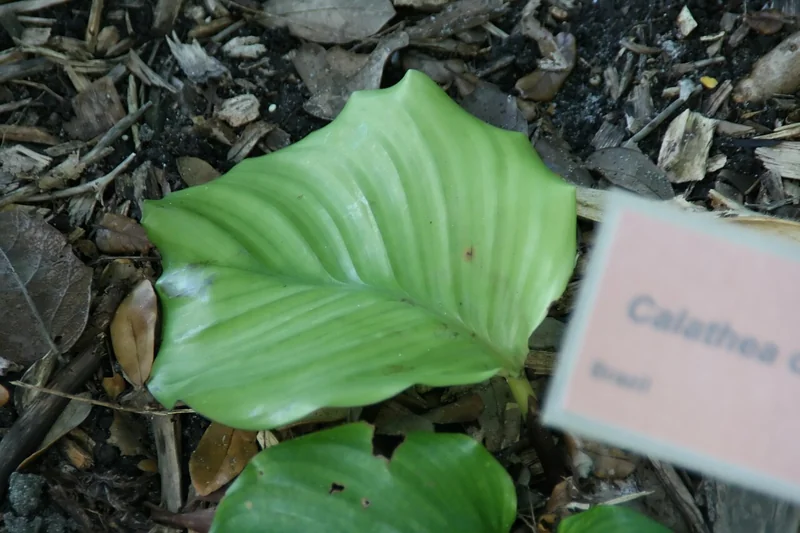 Featured photocalathea-orbifolia.jpg
Calathea orbifolia, now formally Goeppertia orbifolia, is a Bolivian prayer plant with large, almost circular leaves striped in silver-green and pale white. It folds its leaves upward at night, hence the prayer-plant family name. Indoors it wants steady warmth, soft light, and the high humidity that all calatheas need to keep their edges from crisping.
Care facts at a glance
- Light
- Bright indirect
- Water
- Keep the mix evenly moist but never soggy; water when the top 1 to 2 cm has dried.
- Humidity
- 60–80 %
- Temperature
- 18–27 °C
- Soil
- Peat-rich, well-draining mix with perlite for air; pH around 6 to 6.5.
- Origin
- Forests of Bolivia.
- Mature size
- 60 to 90 cm tall, similar spread.
Overview
Goeppertia orbifolia was reclassified out of Calathea in 2012, but the trade still sells it as Calathea orbifolia. The large round leaves and tall, slim petioles make it the most architectural of the prayer plants.
Care Priorities
- Soft, filtered light only; direct sun bleaches and burns the leaves.
- Filter water — fluoride spotting is severe on calatheas.
- Keep the mix evenly moist; do not let it dry out completely.
- Hold humidity above 60 percent or leaf edges crisp within weeks.
Common Problems
Crispy edges and brown leaf tips are dry air or hard water — fix both. Yellowing whole leaves at speed is overwatering. Curled, rolled leaves point to underwatering or low humidity.
Sources & further reading (2)
- encyclopedia — accessed 2026-04-28
- botanical-garden — accessed 2026-04-28
Frequently asked questions
Calathea vs Goeppertia — which is correct?
Goeppertia is the current accepted genus; Calathea is the older, still widely used trade name. Both refer to the same plant for orbifolia.
Why are the leaves curling and crispy?
Either thirsty or short of humidity. Check the pot weight and the air; both are usually low when this happens together.
Best water type?
Rainwater, distilled, or filtered tap water. Plain tap water crisps the edges over months.