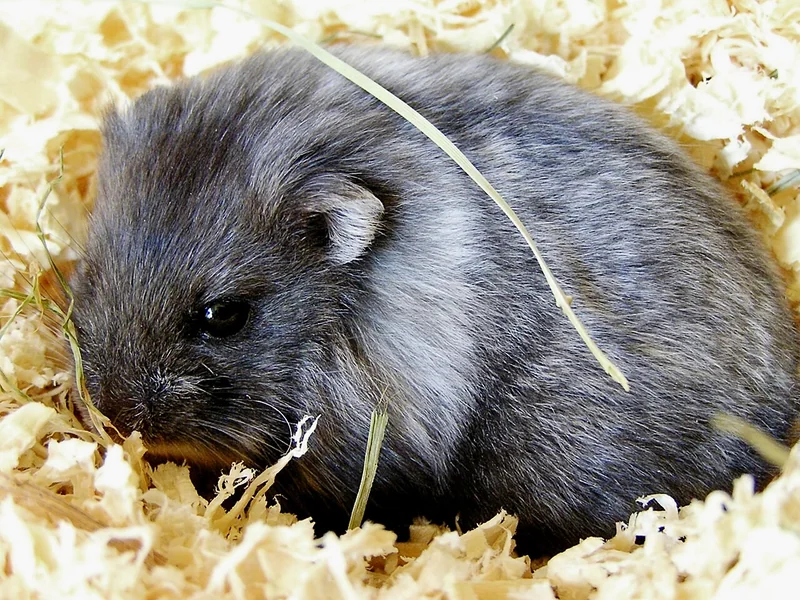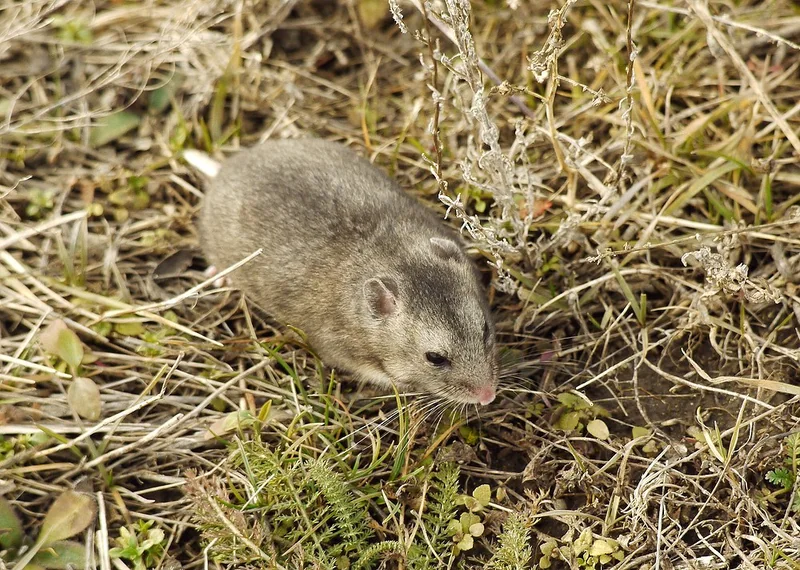
Cricetulus migratorius, the gray (or grey) dwarf hamster, has the largest range of any Cricetinae species, extending from southeast Europe and the Balkans across the Caucasus and the Iranian plateau into central Asia, Pakistan, and northwestern China. Adults reach 9 to 12 cm with a short tail. The species is the only hamster found west of the Black Sea outside of the Romanian and European hamsters. The IUCN Red List assesses the species as Least Concern.
Quick facts
- Lifespan
- 1.5–2.5 years
Overview
Adults are uniformly grey-brown above with a paler belly and a short, mouse-like tail. The dorsal coat carries no dark stripe, distinguishing the species from most other Cricetulus. Despite the common name 'migratory hamster', the species does not undertake seasonal movements — the name reflects its dispersal ability rather than true migration.
Distribution
The wild range covers Greece and the Balkan steppes, eastern Turkey, the Caucasus, the Iranian plateau, the Levant and Iraq, central Asia, Pakistan, and northwestern China. The species occupies semi-deserts, dry grasslands, agricultural land, and rocky hillslopes from sea level to about 4000 m elevation.
Behaviour
Crepuscular and partly nocturnal. The species occupies shallow burrows and rock crevices, and is comparatively tolerant of cohabiting human settlement — it is occasionally found in farm buildings and grain stores. Population density is high in years of good seed production.
Taxonomy
Cricetulus migratorius was described by Pallas in 1773 from a specimen collected in the Caspian region. The species shows broad morphological variation across its enormous range, and several subspecies have been described, none of which are currently considered to warrant species rank.
Sources & further reading (2)
- iucn-red-list — accessed 2026-04-29
- encyclopedia — accessed 2026-04-29
Frequently asked questions
Why is the gray hamster called migratorius?
Pallas applied the epithet migratorius (Latin for 'wandering') to the species in 1773 in reference to its broad geographic range and apparent dispersal ability, not to seasonal migration. The species does not undertake seasonal movements.
How wide is the species' range?
Cricetulus migratorius has the widest distribution of any Cricetinae, extending from Greece and the Balkans east through Turkey, the Caucasus, the Iranian plateau, central Asia, Pakistan, and northwestern China. No other hamster species reaches as far west or south.
Is the species considered a pest?
Locally, yes. In parts of the Iranian plateau and the Levant the species enters grain stores and damages cereal stocks; population control measures are sometimes applied. The IUCN Red List nonetheless assesses the species as Least Concern.