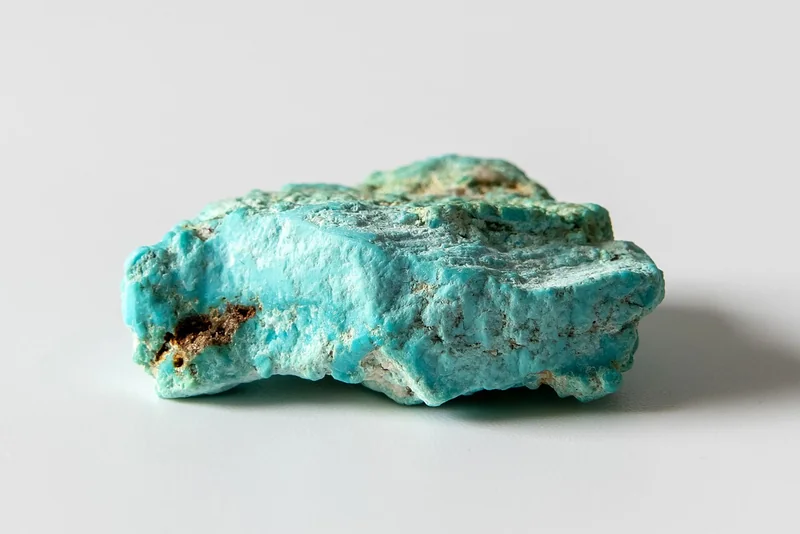
Turquoise is a hydrated copper aluminium phosphate mineral, CuAl6(PO4)4(OH)8·4H2O, crystallising in the triclinic system and rating 5–6 on the Mohs scale. Its characteristic blue to blue-green colour arises from Cu2+ ions in the crystal structure. Turquoise forms as a secondary mineral in the oxidation zone of copper ore deposits in arid climates, typically as veinlets and nodules in altered volcanic and sedimentary rocks. Iran's Nishapur district has produced turquoise continuously for over 3,000 years; the American Southwest (Arizona, Nevada, New Mexico) produces most contemporary commercial supply. The name derives from the Old French 'pierre turquoise' — Turkish stone — because early European imports came via Turkey.
Quick facts
- Item type
- Mineral
- Mineral class
- phosphate
- Mohs hardness
- 5.5
- Crystal system
- triclinic
- Chemical formula
- CuAl6(PO4)4(OH)8·4H2O
- Color range
- blue, blue-green, green, sky-blue
- Notable localities
- Nishapur (Neishabur), Khorasan Province, Iran (finest Persian blue); Bisbee, Arizona, USA (intensely blue); Cerrillos, New Mexico, USA (historic pueblo source); Royston, Nevada, USA (blue-green with brown matrix); Sinai Peninsula, Egypt (ancient Egyptian source)
Formation and Mineralogy
Turquoise forms as a secondary (supergene) mineral in the oxidation and weathering zone above copper ore deposits. Copper-bearing groundwater reacts with aluminium-rich rocks and phosphate from organic matter, precipitating turquoise in pores, cracks, and along fractures. The process requires an arid to semi-arid climate where evaporation concentrates mineralising solutions. The characteristic blue colour comes from Cu2+ coordinated by oxygen atoms; the exact hue from sky-blue to blue-green depends on copper-to-iron ratio (more iron shifts colour toward green). Iron substituting for aluminium in the structure gives greener turquoise; pure copper-rich, iron-poor turquoise from Iran is the most prized sky-blue. Turquoise crystals are rare; it typically occurs as cryptocrystalline masses (polycrystalline aggregates too fine to see individual crystals).
Iranian (Persian) Turquoise and Quality Standards
Iran's Nishapur (Neishabur) mines in Khorasan Province have produced turquoise since at least the 3rd century BCE. Persian turquoise is prized for its characteristic robin's egg to sky-blue colour with minimal matrix (the surrounding rock material). The finest grade, called 'ahu' (gazelle), is the most intensely blue, uniform, hard, and lustrous. Iranian turquoise grades from the intensive 'ahu' down through 'arabi' (slightly greenish blue), 'barkhaneh' (paler, greenish), and 'ferozi' (plain blue). Much modern Iranian material is treated with wax, resin, or stabilisation to improve surface hardness and colour uniformity. American turquoise from the Southwest ranges widely; Bisbee (Arizona) blue is particularly sought; Royston (Nevada) is noted for its blue-green body with brown or black matrix patterns.
Stabilisation and Imitation
Much commercial turquoise is stabilised — impregnated with resin, wax, or epoxy under pressure to harden the stone, deepen the colour, and improve lustre. Stabilisation is accepted in the trade when disclosed. 'Colour-enhanced' turquoise has additional dye added during stabilisation. 'Chalk turquoise' is very porous natural turquoise coloured blue by dye alone, without significant natural colour. Imitation turquoise is made from howlite, magnesite, or plastic dyed blue-green; these can be distinguished by hardness, reaction to acetone, and spectroscopy. The GIA and other labs test and report treatment status. The widespread use of stabilisation means that high-quality natural, untreated turquoise of fine Persian blue is significantly rarer in the market than stabilised material.
Sources & further reading (3)
- gemological-institute — accessed 2026-05-08
- encyclopedia — accessed 2026-05-08
- mineral-database — accessed 2026-05-08
Frequently asked questions
Why does turquoise turn green over time?
Natural turquoise can change colour when it absorbs oils, water, or other substances that affect the oxidation state of copper in the surface layer. Exposure to oils (skin oils, cosmetics) can cause turquoise to turn greenish. Turquoise with higher iron content tends toward green naturally. The colour change is usually irreversible for absorbed organic compounds. Stabilised turquoise (impregnated with resin) is far more resistant to colour change because the pores are sealed. Storing turquoise away from oils, perfumes, and prolonged water exposure helps preserve its colour.
What is the difference between natural and stabilised turquoise?
Natural turquoise has not been treated beyond cutting and polishing. Stabilised turquoise has been impregnated with colourless or tinted resin under pressure to harden the porous surface, deepen the colour, and improve lustre. Stabilisation is disclosed in responsible trade practice. Natural untreated turquoise of fine colour and hardness is increasingly rare and commands premium prices. Detecting stabilisation requires infrared spectroscopy or Raman spectroscopy; visually and in terms of appearance, stabilised turquoise can be indistinguishable from natural material to the naked eye.
Why is turquoise called 'Turkish stone' if it comes from Iran and Arizona?
The English name 'turquoise' derives from the Old French 'pierre turquoise' (Turkish stone), and Middle French 'turqueise'. The name reflects the historical trade route: fine Persian turquoise reached Western Europe through merchants in the Ottoman Empire (Turkey), giving European buyers the impression that the stone originated in Turkey. The French term, adopted into English by the 14th century, preserved this geographic misconception even after the actual Persian origin was established. The gem has no significant commercial deposit in Turkey itself.