silicate
Trapiche Emerald
Colombian emerald with a six-rayed carbon-spoke pattern; found exclusively in Muzo and Penas Blancas.
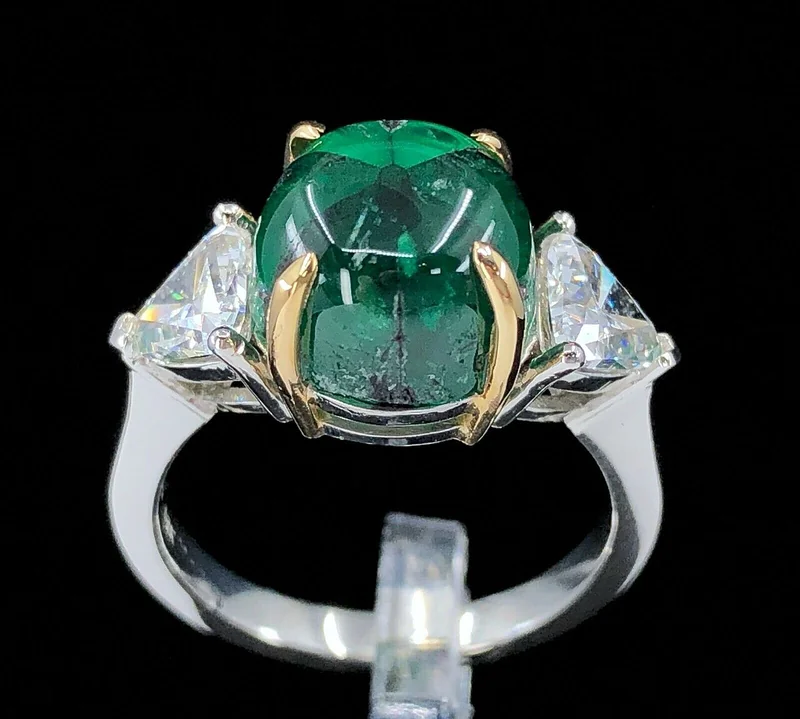
Trapiche emerald is a rare variety of Colombian emerald displaying a six-rayed star-like pattern of dark carbonaceous inclusions radiating from a central core. The name 'trapiche' comes from the Spanish word for a sugar-cane mill — the six-spoked wheel used to press sugar cane, whose shape the inclusion pattern resembles. Each spoke consists of organic carbon (graphite/carbonaceous matter) derived from the black shale host rock, trapped during crystal growth along the beryl crystallographic c-axis sector boundaries. Trapiche emeralds are found only in Colombia, primarily at the Muzo and Penas Blancas mines in Boyaca Department. They are distinct from ordinary Colombian emeralds and from asterism in corundum.
Quick facts
- Item type
- Variety
- Mineral class
- silicate
- Mohs hardness
- 7.75
- Crystal system
- hexagonal
- Chemical formula
- Be3Al2Si6O18
- Color range
- green, yellowish-green
- Notable localities
- Muzo mine, Boyaca, Colombia (primary source); Penas Blancas mine, Boyaca, Colombia
Formation of the Trapiche Pattern
The trapiche pattern forms during beryl crystal growth in the Colombian black shale environment. As an emerald crystal grows, it develops six distinct sector zones corresponding to the six prism faces of the hexagonal crystal form. During growth, carbonaceous organic matter and fluid inclusions from the black shale are episodically trapped at the boundaries between sectors, forming a thin film that extends radially outward from the core. The result is six dark radial spokes of carbonaceous material dividing the crystal into six green segments. The central core may be a small green beryl crystal, a calcite crystal, or a carbon aggregate. Cross-sections cut perpendicular to the c-axis reveal the complete star pattern. Growth kinetics and the specific organic content of Muzo shales are responsible for the phenomenon.
Uniqueness to Colombia
Trapiche emeralds are known almost exclusively from Colombia, specifically from the western-zone mines of Boyaca: primarily Muzo and Penas Blancas. The combination of organic-rich shale host rock, specific hydrothermal fluid chemistry, and growth conditions at these deposits creates the trapiche pattern. Attempted analogue searches in Brazilian, Zambian, and other emerald deposits have not confirmed equivalent trapiche formation, reinforcing the connection to Colombia's unique sedimentary-hydrothermal genesis. Trapiche ruby has been reported from Myanmar and sapphire from Asia, but these are distinct phenomena unrelated to Colombian emerald trapiche, which involves carbonaceous matter rather than the mineral inclusions responsible for sapphire trapiche.
Gem Cutting and Market
Trapiche emeralds are typically cut as thin flat slabs or cabochons perpendicular to the c-axis to display the six-pointed star pattern. Faceted cutting is rare because faceting destroys the visual pattern or hides it behind reflections. Quality is assessed by the sharpness and symmetry of the six spokes, the depth of green in the six sectors, transparency of the sectors, and size. Very large, well-formed trapiche emeralds with clear, distinct spokes and fine green colour are exceptional rarities. They appear in major auction houses and specialist gem collections. The trapiche pattern is natural and arises from growth geometry; it is not a treatment or artificial enhancement.
Sources & further reading (3)
- gemological-institute — accessed 2026-05-08
- encyclopedia — accessed 2026-05-08
- mineral-database — accessed 2026-05-08
Frequently asked questions
Why is the pattern called 'trapiche'?
Trapiche is the Spanish word for a manually operated sugar-cane mill — specifically the six-spoked wooden or stone wheel used to press cane juice. The six-rayed spoke pattern of the emerald's dark inclusions resembled this wheel to the Colombian miners who first described it. The name entered gemological literature and has been used as a formal descriptor since at least the 1950s when the pattern was scientifically studied. 'Trapiche' is now used for any gem mineral showing a comparable six-rayed sector boundary pattern, including trapiche ruby and sapphire, though these involve different inclusion types.
Are trapiche emeralds more valuable than plain Colombian emeralds?
A fine trapiche emerald with a well-defined, symmetric pattern, clear green sectors, and good overall size is a distinct collector's item that commands premium prices relative to an ordinary commercial emerald. However, the trapiche pattern does not automatically mean higher value — a poorly formed, small, or low-clarity trapiche emerald is worth less than a fine clean Colombian emerald of comparable size. The premium for trapiche is specifically for the symmetry and clarity of the pattern combined with fine emerald colour. Museum-quality large trapiche specimens with sharp, symmetrical patterns and intense green are among the most desirable Colombian emerald collector pieces.
Can the trapiche pattern be created artificially?
No known method produces a synthetic trapiche-patterned emerald. Synthetic emeralds grown by hydrothermal or flux-melt methods do not replicate the organic-matter trapping mechanism of Colombian shale environments. The carbon inclusion pattern in natural trapiche emeralds is a direct record of the Colombian sedimentary hydrothermal growth environment and is used as an indicator of natural origin. Distinguishing natural trapiche from any potential synthetic or simulant is straightforward for a trained gemologist because the inclusion chemistry and pattern geometry are unique to the natural Colombian geological environment.