silicate
Tourmaline
Boron silicate cyclic mineral group with the widest colour range of any gem species.
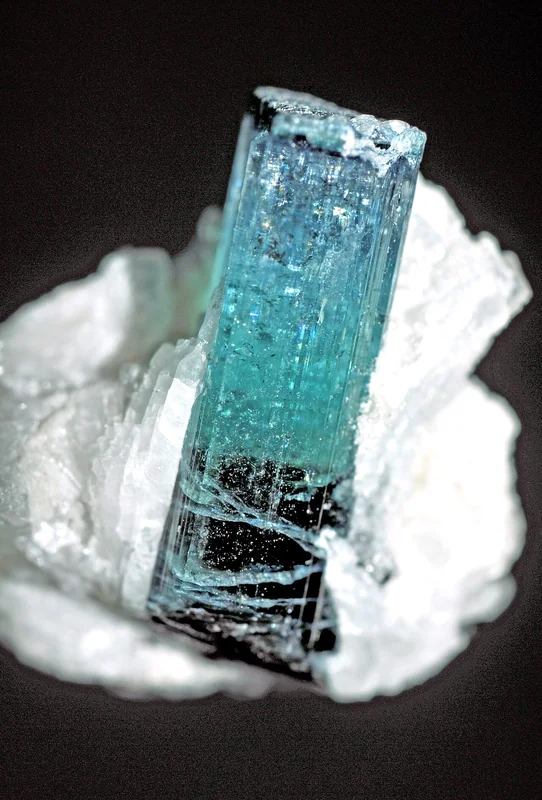
Tourmaline is a group of boron-silicate cyclic minerals with the complex general formula XY3Z6(T6O18)(BO3)3V3W, where sites X, Y, Z, T host a variety of cations. The three principal gem species are elbaite (Na(Li,Al)3Al6(Si6O18)(BO3)3(OH)3(OH)), dravite (NaMg3Al6(Si6O18)(BO3)3(OH)3(OH)), and schorl (NaFe3Al6(Si6O18)(BO3)3(OH)3(OH)). Tourmaline crystallises in the trigonal system, rates 7–7.5 on Mohs, and occurs in a wider natural colour range than any other single mineral group — from colourless through yellow, green, blue, red, pink, orange, purple, and black. Individual crystals often show multiple colour zones along or across the c-axis.
Quick facts
- Item type
- Mineral
- Mineral class
- silicate
- Mohs hardness
- 7.25
- Crystal system
- trigonal
- Chemical formula
- Complex boron silicate (Na,Ca)(Li,Mg,Al,Fe)3Al6(Si6O18)(BO3)3(OH,F)4
- Color range
- colorless, pink, red, blue, green, yellow, orange, purple, black, multicolour
- Notable localities
- Paraiba, Brazil (neon blue-green copper-bearing elbaite); Elba Island, Italy (type locality for elbaite); San Diego County, California, USA (pink and green elbaite); Mozambique and Nigeria (Paraiba-type copper tourmaline); Afghanistan and Pakistan (pink and blue elbaite pegmatites)
Crystal Chemistry and Colour Range
The tourmaline structure consists of six-membered rings of SiO4 tetrahedra arranged in columns parallel to the c-axis, linked by BO3 triangles and various polyhedral sites. The Y site (octahedral) is the primary colour-controlling site: Fe2+ and Fe3+ produce blue-green, brown, and black; Mn2+ produces yellow to pink; Cr3+ and V3+ produce green; Cu2+ produces the intense neon blue-green of Paraiba tourmaline; Ti4+ with Fe produces yellow to brown. Multiple chromophores in a single crystal can create bicolour or multicolour stones. The lack of a centre of symmetry in the trigonal structure gives tourmaline pyroelectric and piezoelectric properties — it generates an electric charge on cooling or under mechanical stress.
Bicolour, Watermelon, and Cat's Eye Tourmaline
Tourmaline crystals commonly show colour zoning that can be exploited in gem cutting. Bicolour stones show two distinct colour zones; the most famous is 'watermelon' tourmaline — a pink core surrounded by a green rim when viewed in cross-section. The pink-to-green transition follows growth zones parallel to the c-axis. Slices cut perpendicular to the c-axis show the watermelon pattern; stones cut parallel show a zoned band pattern. Cat's eye tourmaline (exhibiting chatoyancy) occurs in dravite from Sri Lanka and other sources; the cat's eye effect results from parallel rutile or ludwigite inclusions. Tourmaline crystals are typically elongated prisms with striated faces parallel to the c-axis.
Paraiba Tourmaline
Paraiba tourmaline — discovered by Heitor Dimas Barbosa in Paraiba state, Brazil in 1989 after a decade of searching — is the copper-bearing elbaite variety notable for its intense neon blue-green colour. Copper (Cu2+) and manganese (Mn3+) in the crystal produce an extraordinarily vivid colour unlike any other gem mineral. The Paraiba deposit was nearly exhausted within a few years of discovery. Copper-bearing tourmaline with similar colour was subsequently found in Nigeria (2001) and Mozambique (2005). The GIA and other labs report geographic origin (Brazilian, Nigerian, or Mozambican) on Paraiba tourmaline certificates; Brazilian origin commands the highest trade premium. The LMHC (Laboratory Manual Harmonisation Committee) definition of 'Paraiba tourmaline' requires the presence of copper as the primary colourant regardless of geographic origin.
Sources & further reading (3)
- gemological-institute — accessed 2026-05-08
- encyclopedia — accessed 2026-05-08
- mineral-database — accessed 2026-05-08
Frequently asked questions
What makes Paraiba tourmaline so intensely blue?
Paraiba tourmaline's intense neon blue-green colour is caused by copper (Cu2+) in the Y site of the tourmaline structure. Cu2+ has a broad absorption band in the red and orange wavelength range that produces an extraordinarily saturated blue-green transmission. The simultaneously present Mn3+ absorbs yellow-green, adding to the spectral purity. The combination of copper and manganese absorption creates a transmission window in the blue-green that is wider and more intense than iron or vanadium absorption in other gem minerals. Even small stones show vivid colour due to the strength of copper's absorption.
Why does tourmaline show so many colours?
Tourmaline's extraordinary colour range results from the large number of different ions that can occupy its multiple crystallographic sites (X, Y, Z) and from the wide range of solid solutions possible within the species. Each ion type (Fe2+, Fe3+, Mn2+, Mn3+, Cr3+, V3+, Cu2+, Ti4+) introduces different crystal-field and charge-transfer absorptions, covering different parts of the visible spectrum. Single crystals can host multiple chromophores simultaneously, creating complex mixed colours. Additionally, growth conditions in pegmatites change over time, producing colour-zoned crystals with different compositions in core and rim.
How can bicolour tourmaline crystals form?
Bicolour tourmaline forms because the chemical composition of the hydrothermal or pegmatitic fluid from which the crystal grows changes over time. Tourmaline grows from the outside in (from the prism faces inward) and from the bottom up (along the c-axis). If the fluid composition changes — for example, lithium and manganese increase while iron decreases — the outer shell or upper portion of the crystal records different chemistry and therefore different colour from the earlier-grown core. Watermelon tourmaline, with its pink core and green rim, reflects a temporal sequence where an iron-coloured green outer layer grew around a manganese-coloured pink core.