silicate
Topaz
Aluminium fluorosilicate mineral with diverse colours; Mohs 8, orthorhombic system.
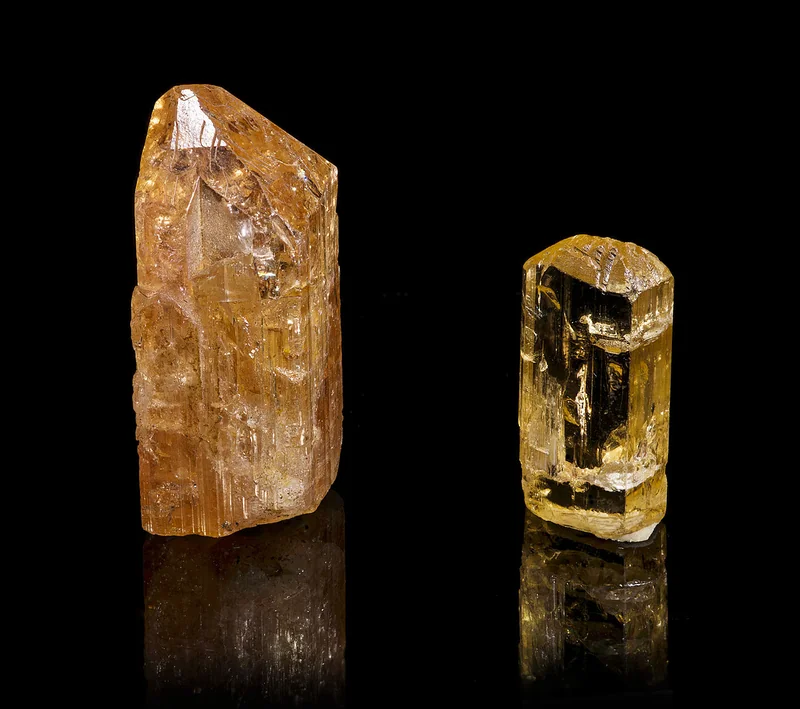
Topaz is a fluorosilicate mineral of aluminium, Al2SiO4(F,OH)2, that crystallises in the orthorhombic system and rates 8 on the Mohs scale. Pure topaz is colourless; impurities and structural defects introduce colours including yellow, orange, pink, red, blue, and green. It has a distinctive perfect basal cleavage perpendicular to the c-axis, which makes it susceptible to breakage from sharp impacts. The most prized variety is imperial topaz, an orange-yellow to orange-pink colour from Ouro Preto, Brazil. Blue topaz — the most widely marketed colour — is almost always produced by irradiation and heat treatment of colourless topaz. Topaz has been known since antiquity; many historical stones called 'topaz' were in fact chrysolite (peridot).
Quick facts
- Item type
- Mineral
- Mineral class
- silicate
- Mohs hardness
- 8
- Crystal system
- orthorhombic
- Chemical formula
- Al2SiO4(F,OH)2
- Color range
- colorless, yellow, orange, pink, red, blue, green, brown
- Notable localities
- Ouro Preto, Minas Gerais, Brazil (imperial topaz); Schneckenstein, Saxony, Germany (historic yellow); Ural Mountains, Russia (pink imperial-type); Nigeria (Plateau State, colourless to blue); Pakistan (Ghundao Hill, Katlang; fine pink-orange)
Crystal Chemistry and Cleavage
Topaz has the formula Al2SiO4(F,OH)2 and belongs to the orthosilicate group. The structure consists of SiO4 tetrahedra and AlO4F2 or AlO4(OH)2 octahedra linked in chains parallel to the c-axis. A critical physical property is perfect {001} basal cleavage — a single plane of weakness perpendicular to the c-axis. This cleavage direction is exactly parallel to the base of the crystal prisms and means that a sharp impact can split a stone cleanly along this plane. Cutters and setters must orient the cleavage carefully to avoid damage. The specific gravity of 3.49–3.57 is notably higher than quartz or beryl, giving topaz a distinct heaviness. Topaz is pleochroic in coloured varieties, showing different colours in different crystallographic directions.
Imperial Topaz
Imperial topaz — the most commercially significant natural topaz colour — is produced exclusively (for trade purposes) from the Capao and Dom Bosco mines near Ouro Preto, Minas Gerais, Brazil, and a few Brazilian deposits. The colour ranges from orange-yellow through orange to orange-pink ('precious topaz'). The orange-pink colour, sometimes called 'precious' or 'Brazilian' topaz, is partly natural and partly attributable to mild natural irradiation combined with iron impurities. Most imperial topaz on the market has been subject to some degree of mild heat treatment to enhance pink or red components. The name 'imperial' is a trade term with no standardised mineralogical definition.
Blue Topaz: Irradiation Treatment
Natural blue topaz does occur (notably from Nigeria and Pakistan) but is rare. Nearly all blue topaz in the market is produced by irradiating colourless topaz and then annealing. Three commercial grades are recognised by treatment intensity: 'Swiss blue' (medium blue, typically gamma irradiation); 'London blue' (deep blue-grey, typically electron-beam irradiation); and 'sky blue' (pale blue, typically neutron irradiation). The treatment is stable and permanent. Irradiated blue topaz must be tested and cleared of residual radioactivity before sale; regulatory standards vary by jurisdiction. The treatment is universally disclosed in trade descriptions. Brazil, Nigeria, and Sri Lanka supply most colourless rough for irradiation.
Sources & further reading (3)
- gemological-institute — accessed 2026-05-08
- encyclopedia — accessed 2026-05-08
- mineral-database — accessed 2026-05-08
Frequently asked questions
Why is pure topaz colourless?
Pure topaz (Al2SiO4F2) with no trace impurities and no structural defects is completely colourless because the crystal has no chromophores — no electronic transitions that absorb visible light. Colour is introduced by specific impurities: iron produces yellow to brown; chromium produces pink to red; structural colour centres (electron or hole traps) caused by irradiation produce blue. When topaz is heated, unstable colour centres created by natural or artificial irradiation can be destroyed, bleaching yellow or brown colours. This is why some brown or yellow topaz from Brazil can be heat-treated to colourless or improved to pink (by reducing the yellow component of orange-pink).
What is the risk of basal cleavage in topaz?
Topaz has one perfect cleavage plane perpendicular to the c-axis (the length direction of the crystal). In a faceted stone this plane runs roughly parallel to the girdle (the widest part of the gem). A sharp impact or thermal shock to the pavilion or table of the stone can propagate a cleavage fracture across the entire stone, splitting it in two. Setters must avoid hammer blows when setting topaz in metal prongs. Ultrasonic cleaners are not recommended for topaz in cracked or included stones. Despite this fragility, a well-cut, uncracked topaz in a protected setting is durable for everyday wear.
Is 'topaz' in historical texts always the mineral topaz?
No. Historical use of 'topaz' was inconsistent and often referred to yellow or green stones regardless of mineralogy. In the Bible's Book of Revelation and in medieval lapidary texts, 'topaz' frequently referred to what we now call chrysolite or peridot (olivine), which was extensively mined on Zabargad Island (St. John's Island) in the Red Sea. The ancient Greeks applied 'topazios' to various yellow stones from the same island. Modern mineralogical usage of 'topaz' refers specifically to Al2SiO4(F,OH)2. Many old crown jewel descriptions that cite 'topaz' may refer to citrine, chrysoberyl, or other yellow minerals.