silicate
Tanzanite
Blue-violet zoisite variety from Tanzania's Merelani Hills, coloured by vanadium; Mohs 6–7.
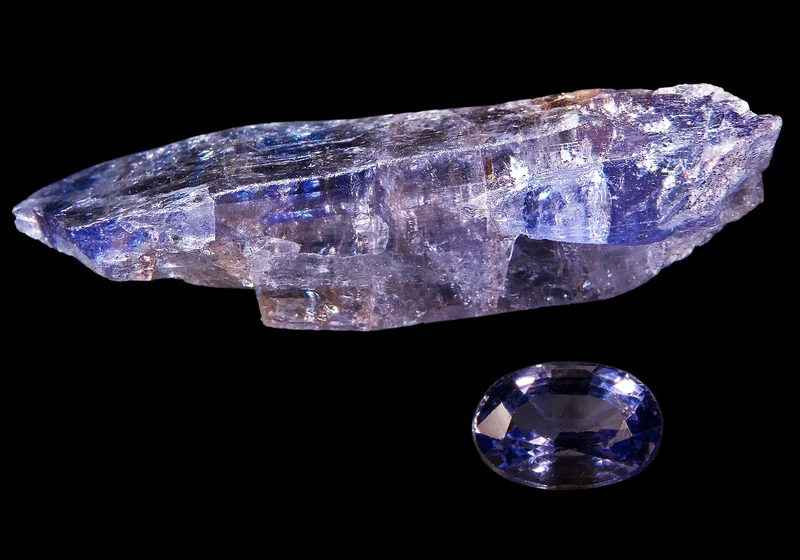
Tanzanite is the blue-violet to violet-blue variety of the mineral zoisite (Ca2Al3(SiO4)(Si2O7)O(OH)), coloured by vanadium (V3+) impurities. Zoisite crystallises in the orthorhombic system and rates 6–7 on the Mohs scale. Tanzanite was discovered in 1967 in the Merelani Hills near Arusha, Tanzania, and remains known from only that single geological deposit. In its rough state it is typically a brownish-purple; heating to 400–500 °C removes the brown component, producing the characteristic blue-violet. It is strongly trichroic, showing different colours (blue, purple, red-brown) in three crystallographic directions. Tanzanite became one of the most commercially significant gem discoveries of the 20th century; Tiffany and Co. named and popularised it in 1968.
Quick facts
- Item type
- Mineral
- Mineral class
- silicate
- Mohs hardness
- 6.5
- Crystal system
- orthorhombic
- Chemical formula
- Ca2Al3(SiO4)(Si2O7)O(OH)
- Color range
- blue-violet, violet, purple, blue
- Notable localities
- Merelani Hills (Blocks A, B, C, D), Arusha, Tanzania (only known source worldwide)
Geology: The Single-Source Deposit
All tanzanite originates from a small mining area covering approximately 20 km2 in the Merelani Hills, approximately 40 km south of Kilimanjaro near Arusha, Tanzania. The deposit is divided into mining blocks A (artisanal), B (TANZANITE ONE Ltd.), C (smaller operators), and D. The mineral occurs in graphitic metamorphic schists within the Mozambique Orogenic Belt, where Neoproterozoic metamorphism created conditions for vanadium-bearing zoisite formation. The unusual concentration of high-quality gem zoisite in a single locality has no confirmed parallel elsewhere in the world, though zoisite occurs globally. The deposit is considered non-renewable on a human timescale; projected exhaustion estimates vary widely in mining literature.
Heat Treatment and Trichroism
Rough tanzanite from Merelani is typically a tawny brown to reddish-brown with purple, because it contains natural colour centres related to Fe3+ that add a brown component. Heating to 400–500 °C in an oxidising atmosphere converts Fe3+ back to Fe2+, eliminating the brown absorption and revealing the underlying blue-violet from vanadium. Heat treatment is universally applied and considered a standard, accepted process — virtually all commercial tanzanite has been heated. Tanzanite is strongly pleochroic (trichroic): viewed along the three crystallographic axes it appears dark blue to violet, red-purple, and yellow-green respectively. Cutters orient the stone to maximise the desirable blue-violet face-up colour. A well-oriented stone shows blue-violet in the primary viewing direction.
Discovery and Commercial History
Tanzanite was first reported to the wider gemological world after Masai tribesmen found blue crystals near the Mererani area in 1967; the discovery is often attributed to Manuel de Souza, a Portuguese-Indian tailor and part-time prospector, though local Masai had known the stones earlier. Tiffany and Company geologist Henry Platt named the gem 'tanzanite' in 1968, recognising Tanzania as its sole source; the name replaced the cumbersome mineralogical designation 'blue zoisite' which the company felt was commercially unfavourable. Tiffany launched a major marketing campaign, establishing tanzanite as the first major new gem variety of the 20th century. In 2002 the American Gem Trade Association added tanzanite as a December birthstone — the first addition to the modern birthstone list since 1912.
Sources & further reading (3)
- gemological-institute — accessed 2026-05-08
- encyclopedia — accessed 2026-05-08
- mineral-database — accessed 2026-05-08
Frequently asked questions
Why is tanzanite found only in Tanzania?
The specific geological conditions that produced gem-quality tanzanite — particular metamorphic grade, temperature-pressure history, vanadium availability, and fluid chemistry — apparently occurred only in the Merelani Hills of the Mozambique Orogenic Belt. Zoisite itself is a common mineral found worldwide, but the combination of vanadium-chromophore chemistry, transparency, and gem-scale crystal size seems unique to Merelani. Geologists have searched for comparable deposits in structurally similar metamorphic belts in East Africa and elsewhere without confirmed success.
How does tanzanite change colour under different lighting?
Tanzanite's trichroism causes different perceived colours depending on the light source and viewing direction. In daylight (which is blue-rich), heated tanzanite typically appears blue to blue-violet — the colour preferred in the trade. Under incandescent light (which is red-rich), the same stone often appears more violet to purple because the light spectrum enhances the violet-red axis of the mineral. Stones with a stronger blue component appear most dramatically different in the two light types. This colour-shift behaviour is a characteristic of the mineral's optical properties, not a treatment effect.
How fragile is tanzanite compared to other gem minerals?
Tanzanite rates 6–7 on the Mohs scale, making it softer than diamond (10), sapphire (9), and quartz (7). More significantly, it has two directions of imperfect cleavage and is susceptible to thermal shock — rapid temperature changes (as in an ultrasonic cleaner) can fracture the stone. Settings should be protective (bezels rather than prong), and tanzanite should not be worn in rough-activity contexts. For comparison, topaz has perfect cleavage but harder at 8; tanzanite's combination of moderate hardness and cleavage susceptibility places it in the category of gems requiring careful handling.