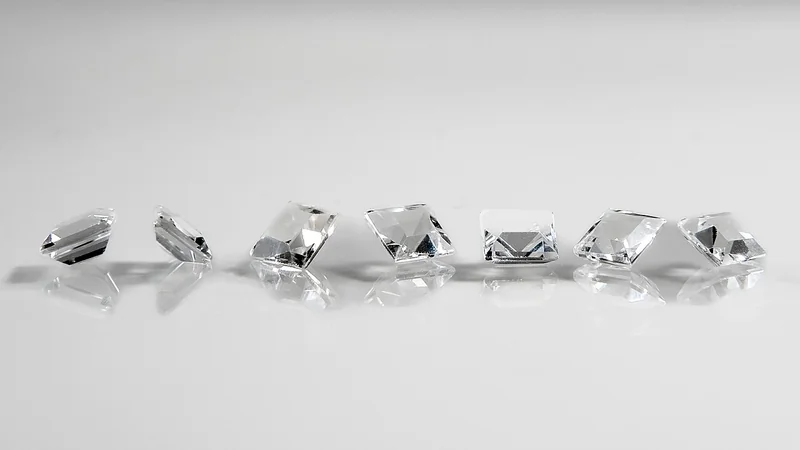
Step cuts are a family of lapidary cutting styles characterised by facets arranged in parallel rows (steps) around a rectangular, square, or octagonal outline, oriented parallel to the stone's girdle. Unlike the triangular facet arrangements of brilliant cuts, step-cut facets are elongated rectangles or trapezoids that produce a hall-of-mirrors depth effect rather than sparkle. The emerald cut (rectangular with truncated corners, 58 facets) and Asscher cut (square with truncated corners, 58 or 74 facets) are the most common modern step cuts. Step cuts were developed primarily for emerald — whose jardin inclusions are partially hidden by the parallel facets — but are also used for aquamarine, sapphire, tanzanite, and diamond. The step cut's clear transparency emphasises colour and clarity.
Quick facts
- Item type
- Cut
Geometry and Optical Character
Step-cut facets run parallel to the girdle, creating concentric rectangular or trapezoidal tiers on both crown and pavilion. The crown typically has 3 steps (table plus 2 additional tiers); the pavilion has 3 or 4 steps. Corners are truncated to prevent chipping at sharp points. The emerald cut has 8 sides (octagonal with longer parallel sides), producing 58 facets. Unlike brilliant cuts, step cuts do not attempt total internal reflection from the pavilion — light passes through the stone and back, producing a characteristic 'hall of mirrors' or 'windowed' effect where large flat facets reflect the surroundings. This creates an elegant, art-deco aesthetic. Small inclusions are more visible under the large, clear facets than in brilliant cuts, so high clarity is conventionally desirable for step-cut gems.
Why Step Cuts Suit Emerald
The emerald cut's name reflects its historical development for the emerald gem. Emerald's inherent jardin inclusions (fluid inclusions, healed fractures, crystal inclusions) are always present in natural stones. The parallel facets of the step cut do not produce the many small virtual reflections of a brilliant cut that could fragment and confuse the view of inclusions. Instead, the large flat facets provide a clear window into the stone, where trained gemologists and buyers can assess the jardin — a key indicator of natural origin and quality. Additionally, emerald's moderate hardness (7.5–8 Mohs) and susceptibility to chipping from the jardin planes makes the truncated-corner step cut safer than pointed cuts like the marquise.
Asscher and Other Step-Cut Variants
The Asscher cut, developed by Joseph Asscher of Amsterdam in 1902, is a square step cut with deeply truncated corners producing an almost octagonal outline and a distinctive stepped crown pattern that creates a 'windmill' or 'X' reflection when viewed face-up. The original Asscher had 58 facets; the 'Royal Asscher' (introduced 2001) has 74 facets with a higher crown and refined geometry. The baguette cut (long, narrow rectangle, typically used as a side stone) is a simplified step cut with fewer facets. The carre cut is a square step cut. French and trap cuts are further step-cut variants. Step cuts are also used for non-gem uses: optical prisms, laser substrates, and spectroscopic windows use step-cut geometry to control light path.
Sources & further reading (2)
- gemological-institute — accessed 2026-05-08
- encyclopedia — accessed 2026-05-08
Frequently asked questions
Why does a step-cut diamond look less sparkly than a round brilliant?
Step cuts produce large flat facets that create a hall-of-mirrors depth effect and broad flashes of light rather than the rapid scintillation of a brilliant cut. The parallel tier arrangement does not achieve total internal reflection in the same geometry as a brilliant — instead, light passes through the stone, reflects from the flat facet floors, and returns, creating deep, mirror-like transparency. The result is fewer, larger flashes of light and more colour depth. This is intentional: step cuts prioritise colour and clarity visibility over sparkle. In the diamond market, step-cut diamonds (emerald and Asscher) represent a distinct aesthetic preference from brilliant cuts.
Why are step-cut diamonds often described as 'art deco'?
The step cut's geometric, linear aesthetic aligns naturally with the Art Deco design movement of the 1920s–1930s, which favoured rectilinear forms, symmetry, and architectural precision over Victorian floral curves. The parallel tiers and truncated corners of the emerald cut create a clean, architectural appearance. Art Deco jewellery designers (Cartier, Boucheron, Van Cleef) used emerald cuts and baguettes extensively. The Asscher cut also dates from 1902 — before Art Deco — but was widely used in Art Deco settings. The step cut's characteristic aesthetic continues to appear in modern jewellery as a reference to this period.
Does a step cut require higher clarity than a brilliant cut?
Conventionally yes. The large, transparent facets of step cuts provide less visual interference than the many small triangular facets of brilliant cuts, which scatter light and can hide small inclusions. In a brilliant cut, inclusions must be fairly large or well-positioned to be visible to the naked eye. In a step cut's large flat facets, smaller inclusions are more easily seen. Industry conventions suggest emerald-cut diamonds should ideally be VS1 clarity or above for eye-clean appearance, while a brilliant-cut diamond can appear eye-clean at SI1 or even SI2. The specific relationship depends on inclusion type and position.