oxide
Star Sapphire
Sapphire exhibiting six-rayed asterism from oriented rutile needles; cut as cabochon.
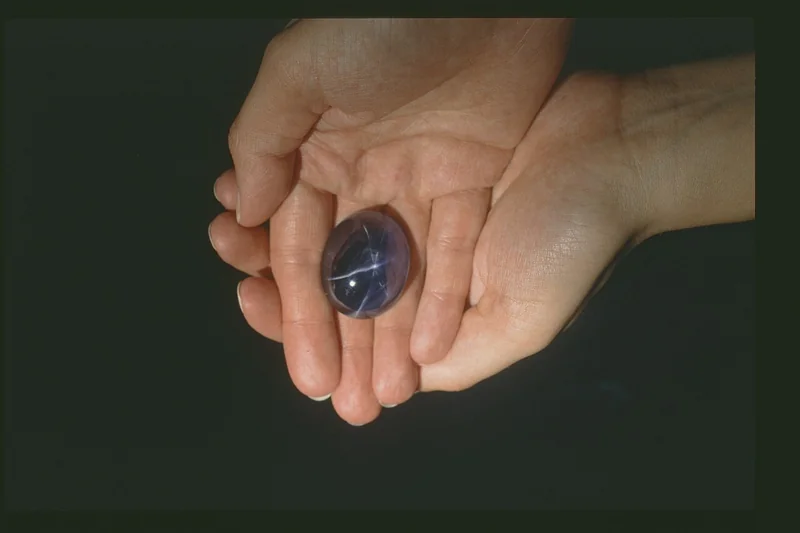
Star sapphire is a variety of corundum (Al2O3) that exhibits asterism — a six-rayed luminous star visible on the dome of a cabochon-cut stone in reflected light. The star results from three sets of fine rutile (TiO2) needle inclusions oriented 120° apart, parallel to the crystallographic a-axes of the trigonal corundum structure. When light reflects from these needles simultaneously, it concentrates into a bright band perpendicular to each set, producing a six-point star pattern. The Star of India (563 ct, American Museum of Natural History) and the Star of Asia (330 ct, Smithsonian) are among the most famous examples. Sri Lanka's alluvial gravels are the principal source; Myanmar also produces fine material.
Quick facts
- Item type
- Variety
- Mineral class
- oxide
- Mohs hardness
- 9
- Crystal system
- trigonal
- Chemical formula
- Al2O3
- Color range
- blue, grey-blue, black, pink, orange, white
- Notable localities
- Ratnapura, Sri Lanka (Star of India source; fine blue-grey stars); Mogok and Monaswa, Myanmar (blue and black star sapphire); Thailand (black star sapphire, Bang Kha Cha); Australia (Queensland, black star sapphire)
Asterism: Rutile Needle Mechanism
Asterism in sapphire is produced by three sets of fine rutile needle inclusions (exsolved TiO2) oriented parallel to the three sets of a-axes (a1, a2, a3) of the trigonal crystal structure, each set 60° apart (or equivalently 120° when pairs are considered). Each set of parallel needles acts as a reflective diffraction grating; reflected light concentrates perpendicular to the needle axis. Because there are three sets of needles at 60° angles, six bands of reflected light are produced, forming a six-pointed star. For the star to be visible, the stone must be cut as a cabochon with its c-axis perpendicular to the base, so all three needle sets are oriented correctly relative to the viewer. Cutting the stone with the c-axis tilted shifts the star off-centre; cutting parallel to the c-axis produces a cat's eye instead of a star.
Star of India and Notable Specimens
The Star of India (563 ct) is the largest and most famous blue star sapphire in the world, displayed in the American Museum of Natural History in New York. It originated from Sri Lanka and was acquired by J.P. Morgan, who donated it to AMNH in 1901. Notably, the Star of India displays asterism on both the top and bottom faces — a result of the rutile being distributed throughout the stone rather than concentrated near the surface. The DeLong Star Ruby (100 ct, also at AMNH) and Star of Asia (330 ct, Smithsonian) are other iconic starred corundum specimens. Most commercial star sapphires are grey-blue to black; fine blue stars with sharp, centred star lines and good body colour are less common.
Heat Treatment vs. Natural Silk
The rutile needles responsible for asterism ('silk') in sapphire are dissolved by heat treatment at 1600–1800°C, which improves transparency but destroys the star. Therefore, star sapphires and star rubies are never heat-treated for clarity improvement — the treatment would eliminate the phenomenon being sold. Natural star sapphires are sold without heat treatment and are among the few categories of corundum where untreated status is inherent to the product rather than a premium designation. 'Composite' star sapphires, assembled from a plain sapphire base and a cabochon top with an artificial star, have been sold; they are detected by careful examination for the seam between the two pieces.
Sources & further reading (3)
- gemological-institute — accessed 2026-05-08
- encyclopedia — accessed 2026-05-08
- mineral-database — accessed 2026-05-08
Frequently asked questions
Why does a star sapphire show six rays rather than another number?
The six-rayed star follows directly from the trigonal crystal symmetry of corundum. In the trigonal system, the three a-axes are equivalent and oriented 120° apart. Rutile needles exsolve along each of these three directions, producing three sets of parallel needles each 60° apart from the next. Each set reflects a band of light perpendicular to its needle direction, and three such bands at 60° intervals produce six visible ray segments, creating the classic hexagonal star. A twelve-rayed star (rare) can occur when rutile needles align along both the a-axes and the a+b diagonals due to specific growth conditions.
How can you tell a natural star sapphire from a composite?
A composite star sapphire has a flat or slightly domed lower portion (plain sapphire) with a cabochon cap — sometimes a synthetic or glass layer — bonded on top to display an artificial star. Detection methods: examine under magnification for a visible seam or adhesive layer at the girdle; check whether the star is visible only from the top (natural stars are also visible from the back in translucent stones); examine with immersion in water or oil (natural stones show uniform structure; composites show the bond line). Natural star sapphires show the star with the stone held under a single point light source; composites may show a more diffuse star.
What causes a black star sapphire?
Black star sapphires (notably from Thailand's Bang Kha Cha area and Myanmar) are nearly opaque black stones that display a sharp silver or golden star in reflected light. The black body colour results from dense concentrations of rutile silk inclusions and other iron-bearing mineral inclusions that collectively absorb most transmitted light. The star itself forms by the same mechanism as blue star sapphires — parallel rutile needles reflecting light into six bands — but the opacity of the material makes the contrast between the reflective star and the dark background very high. Thailand's black star sapphires are among the most commercially available star corundum.