oxide
Sapphire
Blue corundum coloured by iron and titanium; also yellow, orange, green, and pink.
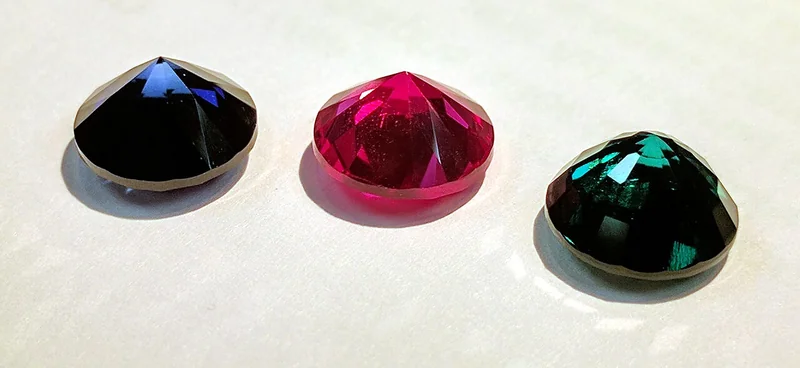
Sapphire is the gem variety of corundum (Al2O3) in any colour except red (which is ruby). The most prized colour is blue, produced by intervalence charge transfer between Fe2+ and Ti4+ ions sharing adjacent aluminium sites in the crystal lattice. Sapphire rates 9 on the Mohs scale, crystallises in the trigonal system, and has a specific gravity of approximately 4.00. Blue sapphire from Kashmir, Sri Lanka, and Myanmar has historically commanded the highest prices in the trade. The term 'fancy sapphire' covers non-blue colours: yellow, orange, green, purple, and the rare orange-pink padparadscha. Sri Lanka's gem gravels (illam) produce a wide range of corundum colours from a single deposit.
Quick facts
- Item type
- Mineral
- Mineral class
- oxide
- Mohs hardness
- 9
- Crystal system
- trigonal
- Chemical formula
- Al2O3
- Color range
- blue, yellow, pink, orange, green, purple, colorless
- Notable localities
- Kashmir, India (cornflower blue, 1880s–1920s major production); Sri Lanka (wide colour range; gem gravels); Madagascar (Ilakaka, major current blue source); Myanmar (Mogok); Montana, USA (Yogo Gulch, vivid cornflower blue)
Colour Origins in Sapphire
The blue colour of sapphire results from intervalence charge transfer (IVCT) between Fe2+ and Ti4+ ions occupying adjacent Al3+ sites in the corundum lattice. This electron transfer absorbs yellow-orange wavelengths (~580 nm) and transmits blue. The concentration and distribution of these ion pairs determines colour intensity and zoning. Other colours arise from different trace impurities: yellow and orange from Fe3+ alone; green from a combination of Fe2+/Fe3+ with no titanium; purple from a mix of Fe-Ti blue and Cr3+ red; colourless from essentially pure Al2O3. Fancy sapphires that include Cr3+ show fluorescence, unlike blue sapphires which have almost none. The padparadscha colour (orange-pink) involves both Fe3+ (orange component) and Cr3+ (pink-red component) in low concentrations.
Kashmir Sapphire
The Zanskar Range deposits of Kashmir (Paddar/Kudi area) were discovered around 1881 and intensively mined until roughly 1920. Kashmir sapphires are prized for a characteristic velvety, cornflower-blue appearance attributed to fine-particle silk inclusions (rutile needles) that scatter light and create a soft internal glow. GIA and other laboratory reports note Kashmir origin as a positive quality factor. Production from Kashmir is now minimal; historical stones re-enter the market through auction. The Kashmir colour — medium-blue with slight violet and strong saturation — is used as a benchmark in sapphire grading globally.
Star Sapphire and Colour Zoning
Star sapphires exhibit asterism — a six-rayed star visible in reflected light — caused by three sets of rutile needle inclusions oriented 120° apart along the hexagonal crystallographic axes. Cutting the stone as a cabochon with the c-axis perpendicular to the base aligns the needles to produce the star. The Black Star of Queensland (733 ct) and the Star of India (563 ct, displayed at the American Museum of Natural History) are prominent examples. Colour zoning is common in sapphire; GIA grading evaluates colour distribution. Heating dissolves rutile silk inclusions (improving clarity) and can alter colour through oxidation of iron ions. Heat treatment at 1600–1800 °C is standard in the trade and widely accepted.
Sources & further reading (3)
- gemological-institute — accessed 2026-05-08
- encyclopedia — accessed 2026-05-08
- mineral-database — accessed 2026-05-08
Frequently asked questions
Why is sapphire blue?
The blue colour of sapphire arises from intervalence charge transfer between Fe2+ and Ti4+ ions. When adjacent aluminium sites in the corundum lattice are occupied by Fe2+ and Ti4+, light absorption causes an electron to transfer temporarily from Fe2+ to Ti4+, absorbing yellow-orange wavelengths around 580 nm. The remaining transmitted wavelengths appear blue to the eye. The phenomenon requires both iron and titanium to be present at neighbouring sites; either element alone does not produce blue.
What makes Kashmir sapphire distinctive?
Kashmir sapphires are notable for their velvety, cornflower-blue appearance, which results from fine silk inclusions (exsolved rutile needles too fine to see individually) that scatter transmitted light, softening the colour and producing an internal glow. Kashmir stones also tend to have a slightly violet hue secondary to blue and exhibit strong colour saturation. GIA reports specifically note Kashmir as a geographic origin because it is correlated with these quality characteristics. Most Kashmir sapphires on the market today are estate pieces; contemporary mining output from the region is negligible.
How does heat treatment affect sapphire?
Heat treatment at 1600–1800 °C is the most common sapphire treatment. In an oxidising atmosphere it dissolves rutile silk inclusions that reduce transparency, and can change iron oxidation states, shifting colour. Some Sri Lankan stones contain colour-zoned rutile needles; heating dissolves these, improving both clarity and colour uniformity. Heating is widely accepted in the gem trade and disclosed on GIA laboratory reports. Beryllium diffusion treatment (adding Be to improve colour) is a more invasive treatment that penetrates deeper; it is disclosed separately and commands lower premium.