oxide
Ruby (Red Corundum)
Red gem-quality corundum coloured by chromium impurities, Mohs 9.
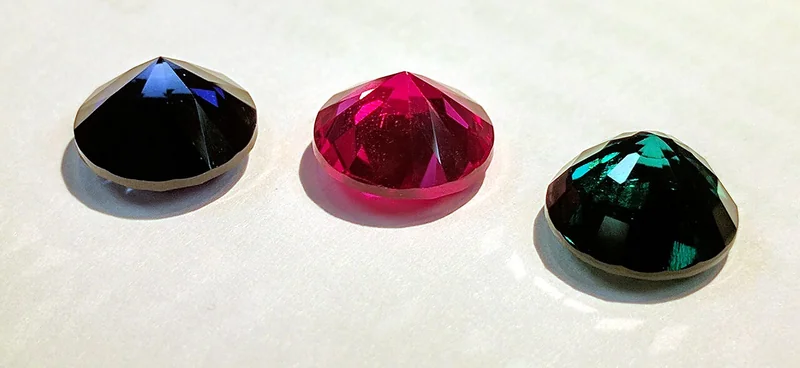
Ruby is the red variety of the mineral corundum (aluminium oxide, Al2O3), coloured by chromium (Cr3+) substituting for aluminium in the crystal lattice. Corundum rates 9 on the Mohs scale — second only to diamond — and crystallises in the trigonal system. The intensity of red depends on chromium concentration; high chromium content also causes red fluorescence under UV light that enhances the apparent colour in daylight. Ruby is distinguished from other red stones by its hardness, fluorescence, and specific gravity of approximately 4.00. Burma's Mogok Valley has historically been the most celebrated source, producing stones described as 'pigeon's blood' for their vivid red colour.
Quick facts
- Item type
- Mineral
- Mineral class
- oxide
- Mohs hardness
- 9
- Crystal system
- trigonal
- Chemical formula
- Al2O3
- Color range
- red, pink-red, orange-red, purplish-red
- Notable localities
- Mogok Valley, Myanmar (historic pigeon's blood source); Mong Hsu, Myanmar (major modern producer); Montepuez, Mozambique (largest current producer by volume); Luc Yen, Vietnam; Longido, Tanzania
Mineralogy and Colour Origin
Ruby and sapphire are gem varieties of the same mineral species, corundum (Al2O3). In ruby, chromium ions (Cr3+) substitute for aluminium ions in the crystal lattice at concentrations of 0.1–3 wt% Cr2O3, producing the characteristic red by absorbing blue-green wavelengths (around 550 nm) and transmitting red. The same chromium substitution also causes strong red fluorescence under UV light (emission around 694 nm), which intensifies the apparent colour in sunlight — which contains UV radiation. Corundum crystallises in the trigonal system (space group R3c) forming hexagonal barrel-shaped or tabular prisms. Cleavage is absent in corundum; it has a conchoidal to uneven fracture and perfect parting along rhombohedral planes.
Notable Sources and Geology
The Mogok Stone Tract in central Myanmar has produced rubies since at least the 15th century; Mogok stones occur in marble (calcium carbonate host rock) which gives low iron content and therefore strong fluorescence. Mozambique's Montepuez deposit, discovered in 2009, occurs in amphibolite metamorphic rock with higher iron content, which slightly suppresses fluorescence. Vietnam's Luc Yen and Quy Chau deposits also occur in marble. East African sources (Kenya, Tanzania, Madagascar) typically occur in metamorphic schists and gneisses. Ruby also occurs in gem gravels (alluvial) in Sri Lanka and Myanmar derived from the primary marble and metamorphic deposits.
Heat Treatment and Treatments
Heat treatment is the most common treatment for ruby, practiced since ancient times and universally accepted in the gem trade. Heating stones to 1600–1900 °C in an oxidising atmosphere dissolves silk (fine rutile needles) inclusions that scatter light, improving transparency. Heating can also improve colour by dissolving blue zones caused by iron. Heat treatment is disclosed on GIA laboratory reports. Glass-filling (fracture filling with lead glass) is a more invasive treatment that greatly improves apparent clarity; it is disclosed separately because it is less stable and requires special care. Diffusion treatment (adding chromium or beryllium to the surface layer) is also distinguished in laboratory reports.
Sources & further reading (3)
- gemological-institute — accessed 2026-05-08
- encyclopedia — accessed 2026-05-08
- mineral-database — accessed 2026-05-08
Frequently asked questions
What distinguishes ruby from pink sapphire?
Both ruby and pink sapphire are gem corundum coloured by chromium. The distinction is one of saturation: the GIA defines ruby as having a colour in the 'red' hue range — pure red to slightly orangy-red or purplish-red — with saturation sufficient to be called red rather than pink. Stones below the saturation threshold are classified as pink sapphire. The boundary is a matter of trade convention rather than a hard mineralogical line. Different national markets apply different thresholds; historically the Thai and US trade used stricter saturation thresholds than Burmese dealers.
Why does Mogok ruby glow red under UV light?
The chromium ions that produce ruby's red colour also act as a fluorescence activator. When UV radiation excites Cr3+ ions, they emit red photons (around 694 nm wavelength) as they return to the ground state — the same R-line emission used in the first laser (Theodore Maiman, 1960). Mogok rubies are particularly fluorescent because the marble host rock produces low-iron stones; iron suppresses fluorescence by competing with chromium for absorbed energy. Sunlight contains UV radiation, so Mogok rubies appear especially vivid outdoors.
How is ruby formed geologically?
Most high-quality rubies form in metamorphic marble where aluminium-bearing fluids react with calcium carbonate host rock under high temperature and pressure. The aluminium crystallises as corundum; chromium, present in trace amounts in the marble, enters the corundum lattice. The marble environment produces low-iron stones with high fluorescence. Rubies also form in metamorphic schists and in basaltic rocks (amphibolites); basalt-hosted rubies often have higher iron content, producing slightly darker, less fluorescent stones. Sri Lanka is notable for alluvial ruby-bearing gem gravels (illam) derived from multiple primary source types.