silicate
Rhodolite Garnet
Rose-pink to purplish-red pyrope-almandine garnet; named from Greek 'rhodon' (rose).
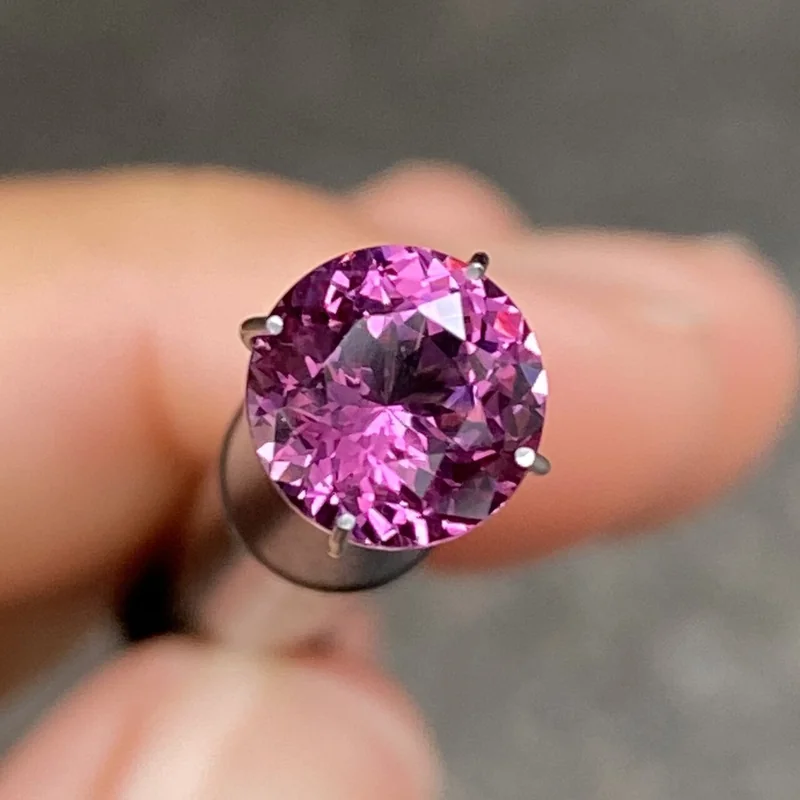
Rhodolite is a trade term for a purplish-red to rose-pink pyrope-almandine garnet solid solution with a composition approximately 70 mol% pyrope and 30 mol% almandine ((Mg,Fe)3Al2Si3O12). The name derives from the Greek 'rhodon' (rose) and 'lithos' (stone), coined by American mineralogists W.E. Hidden and J.H. Pratt in 1898 from specimens found in Macon County, North Carolina, USA. Rhodolite is characterised by a lighter, more rose-red to violet-purple colour than typical deep red almandine, produced by the elevated magnesium content reducing iron concentration. Major contemporary sources include Tanzania, Zimbabwe, Sri Lanka, and India. It crystallises in the cubic system and rates 7–7.5 on Mohs.
Quick facts
- Item type
- Variety
- Mineral class
- silicate
- Mohs hardness
- 7.25
- Crystal system
- cubic
- Chemical formula
- (Mg,Fe)3Al2Si3O12
- Color range
- rose-pink, purplish-red, red-violet, raspberry
- Notable localities
- Umba Valley and Tanga, Tanzania; Masvingo, Zimbabwe; Ratnapura, Sri Lanka; Macon County, North Carolina, USA (type locality, 1898)
Composition and Colour
Rhodolite occupies the high-magnesium end of the pyrope-almandine solid solution series. Pure pyrope (Mg3Al2Si3O12) is deep red to purple-red; pure almandine (Fe3Al2Si3O12) is deep red to reddish-brown. Rhodolite's rose to purplish-red colour results from an intermediate composition where Mg2+ substitutes substantially for Fe2+. The lower Fe2+/Fe3+ content reduces the strong red absorption of iron, allowing a lighter, more transparent, and slightly cooler (more purple-violet) colour. The specific hue depends on the precise Mg:Fe ratio. Rhodolite has no cleavage (cubic garnet), good transparency, and a vitreous lustre with a refractive index of approximately 1.755–1.770.
Geological Occurrence
Rhodolite occurs in metamorphic rocks — primarily amphibolite facies gneisses and schists — where high magnesium content of the original rocks combined with moderate iron results in a pyrope-almandine composition rather than pure almandine. Tanzania's Umba Valley and Tanga region produce fine rhodolite from granulite facies gneisses. Zimbabwe's Masvingo area is another significant source. Sri Lanka's Ratnapura gem gravels yield rhodolite from alluvial deposits derived from Precambrian Highland Series metamorphics. The type locality, Macon County, North Carolina, produces limited quantities of historically significant stones from garnet-bearing gneiss in the Inner Piedmont Belt of the Appalachian Mountains.
Distinction from Pyrope and Almandine
All three — rhodolite, pyrope, and almandine — are garnet group minerals in the same isomorphous series. The trade and gemological distinction: almandine is typically dark red to reddish-brown with higher iron; pyrope is blood-red with lower iron (Mg-dominant); rhodolite occupies the intermediate rose-violet to purplish-red zone. Specific gravity increases with iron content (pyrope ~3.58; rhodolite ~3.73–3.84; almandine ~4.10–4.20). A refractometer and specific gravity measurement can distinguish them, though border-composition stones are classified by the dominant visual colour. In standard gemological reports, the species is reported as 'pyrope-almandine' with a colour range qualifier.
Sources & further reading (3)
- gemological-institute — accessed 2026-05-08
- encyclopedia — accessed 2026-05-08
- mineral-database — accessed 2026-05-08
Frequently asked questions
Is rhodolite garnet a separate mineral species?
No. Rhodolite is a trade name for a colour variety of the pyrope-almandine garnet solid solution, not a distinct mineral species. Mineralogically, these garnets are a continuous mixture of pyrope (Mg3Al2Si3O12) and almandine (Fe3Al2Si3O12) components. GIA and other labs report them as 'pyrope-almandine' on gemological certificates, with 'rhodolite' appearing as a variety designation in trade communications. The IMA (International Mineralogical Association) does not recognise rhodolite as a mineral species.
Why is rhodolite lighter in colour than almandine?
Almandine's deep red colour comes from iron (Fe2+) in the X site, which absorbs a broad range of wavelengths strongly. Rhodolite's elevated magnesium content dilutes the Fe2+ concentration in the lattice (Mg2+ substitutes for Fe2+, with no optical absorption of its own), resulting in weaker overall absorption, higher transparency, and a lighter, more purplish-rose colour. As the Mg:Fe ratio increases toward pyrope end-member, the colour lightens further toward purple-red. The colour shift from deep burgundy almandine through rose rhodolite to paler pyrope reflects the increasing Mg content across the series.
Which country produces the finest rhodolite garnet?
Tanzania's Umba Valley produces particularly vivid raspberry to purplish-rose rhodolite that is highly regarded in the trade. East African rhodolite in general (Tanzania and Kenya) tends to have excellent transparency and fine rose to violet-pink colour. Zimbabwe's Masvingo material is also well regarded. Sri Lankan rhodolite from Ratnapura gem gravels is long-established in commerce. The North Carolina type locality produces historically significant material but is not a major commercial source. Quality varies significantly within each source depending on specific deposit chemistry and cutting quality.