Princess Cut
Square brilliant cut with pointed corners; second most popular diamond shape after the round brilliant.
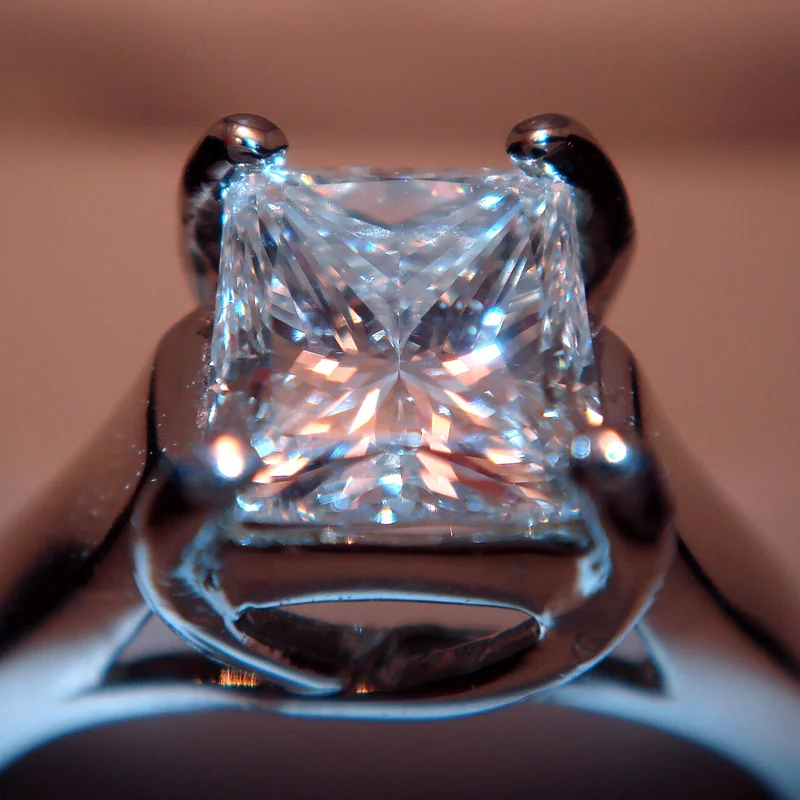
The princess cut is a square or slightly rectangular brilliant-style faceted gemstone cut with sharp, uncut corners, developed in the 1960s–1980s as a modified brilliant for square outlines. Unlike the round brilliant optimised by Tolkowsky, the princess cut adapts the brilliant facet arrangement to a square girdle by adding chevron-pattern pavilion facets radiating from the culet to the corners. Standard facet count is 49, 57, or 76 facets depending on the number of pavilion facet rows. The princess cut became the second-most popular diamond shape globally (after the round brilliant) by the late 1990s, valued for its higher yield from the rough (approximately 80–84% retention vs. approximately 50% for round brilliants cut from an octahedral crystal) and its brilliant-style light return.
Quick facts
- Item type
- Cut
Geometry and Facet Arrangement
The princess cut's crown facets are arranged similarly to a round brilliant but adapted to a square outline: a square table, four bezel facets at the cardinal directions, four corner facets, and star and girdle facets filling between them. The pavilion is distinctive: chevron-pattern main facets radiate from a central culet toward the four corners and the four sides. The number of chevron rows on the pavilion (typically 2 or 3) determines the facet count — a 2-chevron princess has 49 facets; a 3-chevron version has 57 or 76. The four corners are untruncated and remain sharp points (unlike the emerald cut's truncated corners), requiring protective prong settings at each corner to prevent chipping. The square outline produces length-to-width ratios between approximately 1.0 and 1.05 for 'true square' versions; ratios above 1.05 appear rectangular.
Development and History
The princess cut does not have a single credited inventor, but evolved through several parallel developments in the 1960s–1970s. The 'profile cut' (developed by Arpad Nagy, London, 1961) is an early antecedent. Ygal Perlman, Betzalel Ambar, and Israel Itzkowitz developed what they called the 'princess cut' in the 1970s (patented around 1979 by Ambar and Itzkowitz). The cut gained its current market name and popularity primarily during the 1980s–1990s as the diamond fashion market shifted from round solitaires toward fancy shapes. By 2000, the princess cut held approximately 25–30% of the diamond engagement ring market in the United States, making it the dominant fancy shape. Its modern prevalence is driven both by aesthetic appeal (modern, architectural) and economic efficiency in yield.
Yield Advantage and Commercial Significance
The princess cut's commercial prevalence partly reflects its efficient use of octahedral rough diamond crystals. A round brilliant cut from an octahedral crystal requires removing material at the corners and girdle to achieve a round outline, retaining approximately 48–54% of the rough weight. A princess cut retains approximately 80–84% of an octahedral crystal by preserving the four corners as the stone's girdle corners. For equivalent carat weight diamonds, princess-cut stones are typically less expensive than round brilliants (often 20–40% less per carat) despite comparable brilliance. Princess cuts are also used for coloured gemstones (sapphire, citrine, amethyst) where the square brilliant arrangement maximises light return for a square outline. Cutters must balance the square outline against depth requirements: a very thin princess may appear windowed.
Sources & further reading (2)
- gemological-institute — accessed 2026-05-08
- encyclopedia — accessed 2026-05-08
Frequently asked questions
Why does a princess-cut diamond need corner prongs?
The princess cut's four corners are sharp points — there are no truncations like the emerald cut's bevelled corners. Diamond is hard (Mohs 10) but brittle along cleavage planes, and the sharp corners represent a stress concentration point that can chip or cleave if struck at the right angle. Prong settings that cap each corner protect this vulnerable point. Bezel settings also protect the corners. A princess-cut diamond set in a four-prong solitaire with prongs at the corners risks corner chipping if the prongs shift or wear away. Six or eight-prong settings that place additional prongs at mid-sides provide additional security. Even with protective settings, corner chipping remains the most common damage seen in antique or estate princess-cut diamonds.
Does a princess cut sparkle like a round brilliant?
A princess cut produces excellent brilliance — comparable to, and some argue slightly superior in certain lighting conditions to, a round brilliant — because the brilliant-style facet arrangement achieves good total internal reflection from the pavilion. However, the optical performance of a princess cut is significantly more sensitive to proportion variations. The ideal crown angle range for optimal princess cut performance is narrower than for round brilliants. A poorly proportioned princess cut (too shallow or too deep) shows windowing (a transparent window through the center) more readily than a round brilliant, because the square pavilion geometry allows direct light transmission at steeper angles. GIA does not issue cut quality grades for princess cuts (unlike round brilliants), so buyers must rely on proportion specifications.
What is a 'square modified brilliant' on a diamond certificate?
GIA laboratory grading reports describe the princess cut as 'square modified brilliant' (or 'rectangular modified brilliant' for non-square versions). 'Modified brilliant' indicates that the facet arrangement is derived from the round brilliant concept but modified for a non-round outline. This terminology distinguishes the princess cut from 'step cuts' (like the emerald cut) and from 'mixed cuts' (which combine brilliant and step elements). On a GIA Grading Report, the shape and cutting style line reads 'Square Modified Brilliant' and GIA reports depth percentage, table percentage, and overall proportions, but does not issue a cut grade (unlike for round brilliants, which receive Excellent–Poor cut grades).