oxide
Pigeon's Blood Ruby
Trade term for the most prized ruby colour: vivid red with strong chromium fluorescence.
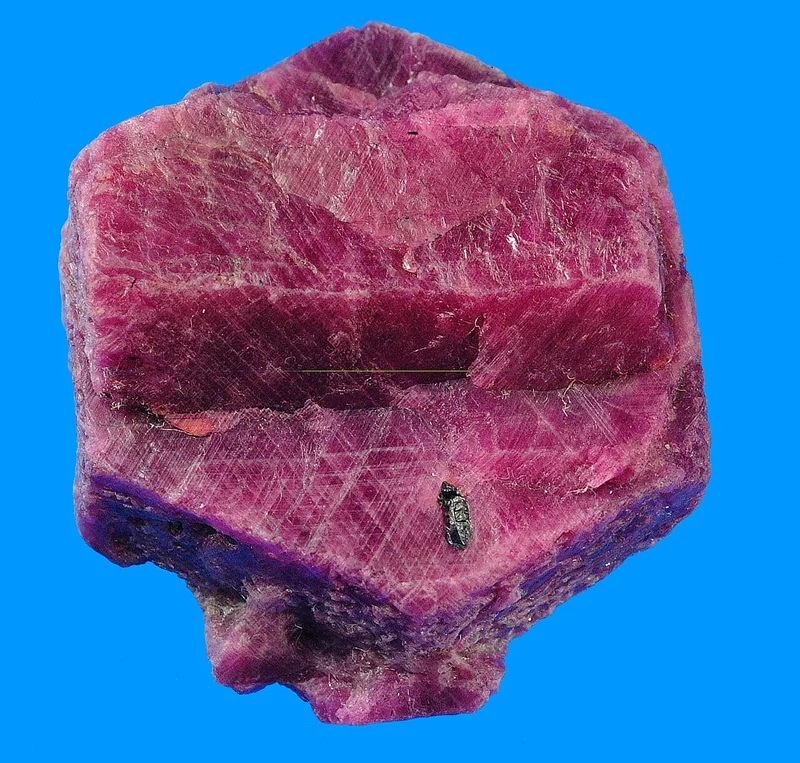
Pigeon's blood is the premier colour descriptor in the ruby trade, referring to a vivid, pure red with a slight bluish undertone and strong fluorescence — comparable to the deep red of a pigeon's blood, according to Burmese gem-trade tradition. The designation originates in the Mogok Valley of Myanmar, which historically produced most of the finest examples. GIA, Gübelin Gem Lab, and SSEF use 'pigeon's blood' as a quality notation on gemological reports when a ruby meets defined colour saturation, hue, and fluorescence criteria. The colour results from a combination of high chromium concentration, low iron content, and strong UV-driven fluorescence. Stones meeting the criteria from Mozambique, Vietnam, and Sri Lanka may also receive the designation based on colour properties alone.
Quick facts
- Item type
- Variety
- Mineral class
- oxide
- Mohs hardness
- 9
- Crystal system
- trigonal
- Chemical formula
- Al2O3
- Color range
- vivid red, slightly purplish-red
- Notable localities
- Mogok Valley, Myanmar (historic benchmark source); Montepuez, Mozambique (commercial pigeon's blood stones post-2009); Mong Hsu, Myanmar; Luc Yen, Vietnam
Colour Definition and Fluorescence
Pigeon's blood ruby combines a pure hue (primary hue red with at most a slight secondary blue or purple tone), very strong colour saturation, and strong red fluorescence. The fluorescence is critical: in natural daylight, which contains UV, the Cr3+ ions emit additional red light (R-line emission at 694 nm), boosting the apparent colour intensity beyond what the pure absorption-transmission colour would provide. Low iron content in Mogok marble-type rubies allows this fluorescence; higher iron in some non-Mogok stones suppresses it, reducing the glowing quality. GIA's laboratory quality-notation system (introduced 2009) assigns 'pigeon's blood' when hue falls in the red range (slightly purplish-red to slightly orangy-red primary red hue) at strong to vivid saturation combined with a 'vivid' to 'strong' fluorescence qualifier.
Geographic Origin and the Mogok Standard
Mogok Valley, in Mandalay Region of Myanmar, is the benchmark for pigeon's blood colour because its marble-hosted rubies historically showed the combination of deep red, strong fluorescence, and fine transparency most consistently. The marble origin creates a low-iron chemistry that is key to strong fluorescence. Not all Mogok rubies are pigeon's blood colour — the grade refers to a minority of top-colour stones within any source. Since 2009, Mozambique's Montepuez deposit has become the largest volume ruby source; some Montepuez stones achieve pigeon's blood colour criteria, though their average iron content is higher than Mogok. Gübelin Gem Lab and SSEF issue special 'pigeon's blood' and 'royal red' colour notations in addition to origin reports.
Laboratory Criteria and Trade Premium
Multiple major gem laboratories have published criteria for the pigeon's blood designation, though they differ in detail. GIA (2009) requires hue in the 'slightly purplish-red' range with saturation of 'strong' to 'vivid' on the GIA colour scale. Gübelin has used 'pigeon's blood red' since 2002; SSEF since 2003. All require fluorescence to be at least moderate to strong. Disagreements between labs can occur: a stone may receive the designation from one lab but not another based on borderline saturation or hue angle. The designation is not standardised across all labs. In auction markets (Sotheby's, Christie's), a GIA or Gübelin pigeon's blood notation on a Mogok-origin stone of significant carat weight drives substantial premium over comparable stones without the notation.
Sources & further reading (3)
- gemological-institute — accessed 2026-05-08
- encyclopedia — accessed 2026-05-08
- gemological-institute — accessed 2026-05-08
Frequently asked questions
Is pigeon's blood a mineralogical term?
No. Pigeon's blood is a trade designation, not a mineralogical category. All pigeon's blood rubies are the mineral corundum (Al2O3) — the same as any other ruby. The designation describes a specific colour grade that multiple gemological laboratories apply based on hue, saturation, and fluorescence criteria. Different labs have slightly different thresholds. The term originated in the Burmese gem trade, where the ideal ruby colour was described as the red of fresh blood from a slaughtered pigeon — a vivid red with a slight bluish tone.
Can pigeon's blood ruby come from outside Myanmar?
Yes. While pigeon's blood colour was historically associated with Mogok, Burma, the colour designation by major labs is based on measurable colour properties (hue, saturation, fluorescence) rather than strictly on geographic origin. A Mozambique or Vietnam ruby that meets the colour criteria will receive the pigeon's blood designation from labs such as GIA, Gübelin, or SSEF. However, a Mogok-origin stone with pigeon's blood colour generally commands the highest auction prices because Mogok origin itself adds to the narrative and historical prestige of the stone.
How does fluorescence contribute to pigeon's blood colour?
In daylight, which contains UV radiation, chromium ions in ruby emit additional red photons (R-line fluorescence, ~694 nm). This adds to the transmitted red colour from simple absorption, making the stone appear more intense than it would under pure white light alone. For Mogok marble-type rubies, where iron content is low, this fluorescence can be very strong — effectively amplifying the perceived colour saturation. A stone with moderately deep absorption colour but strong fluorescence can appear far more vivid outdoors than indoors under artificial light that lacks UV. This 'living' quality of the colour under daylight is part of what makes pigeon's blood ruby so prized.